Cornered and dangerous, the lame-duck leader of the free world now poses a greater risk to Australia than ever | Paul Daley
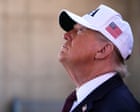
As the blue wave of unambiguous Maga repudiation crashed over the United States, a former Australian ambassador to Washington issued a warning about what to expect from the newly minted lame-duck leader of the free world, Donald Trump.
Arthur Sinodinos, ambassador for three years until 2023, said Trump “is always at his most dangerous when he’s cornered”.
It was an ominous warning, and one that echoes the anticipation of the Australian government and its leading military-strategic, intelligence and diplomatic thinkers.
Indeed, Trump’s somewhat conciliatory – even sanguine – tone amid the Republican rout including his concession that his great folly, the US-Israel war against Iran, had been a contributing factor, was his first act of unpredictability.
A closer result – one more blithely dismissed by Trump as a “fraud” or a “fake” – would have posed immediate challenges for other democracies. Not least of them is Australia, the most assiduous – and at times obsequious – middle-power American ally which has largely been reluctant to call out Trump’s creeping second-term absolutism.
Would Australia (having willingly called out election subversion in developing-world dictatorships) condemned any such conduct in the US while Trump still had two years to serve?
It’s now a moot question, but one that goes to successive Australian governments’ “don’t poke the bear” approaches to Trump wrangling since the Maga rise. (Witness the 2025 presidential-prime ministerial White House meeting involving then ambassador Kevin Rudd.)
Like all narcissists, Trump is adoringly self-focused on posterity. And so, the clear and present geopolitical uncertainty for his “all the way” allies like Australia is just what might be involved as the president self-curates his legacy over the next two years.
Trump has always wallowed in the hyper-potency of will he/won’t he ambiguity. Thus the US and the world held their breath about whether he would “accept” this week’s election result.
Now the biggest question – the one that impacts global security and in large part dominates our own national security and economic atmospherics – is whether Trump will, together with Israel, mount a renewed attack on Iran to “finish” the reckless, inhumane war he started.
Australia’s federal government is weathering the profound impact of the double whammy of red-hot inflation and interest rate electoral resentment. Trump is mostly to blame – though you’ll rarely hear a government MP say it quite so frankly.
So it was with atypical, welcome candour that the federal education minister, Jason Clare, on Thursday said “we didn’t start the [Iran] war but we are copping it”.
Australians, like Americans, are suffering at the fuel bowser. They are watching their superannuation and other retirement savings dwindle weekly while the cost of living skyrockets, mostly thanks to the botched Trump/Netanyahu war.
Now Trump’s bellicose threat before the United Nations general assembly to “annihilate” Iran remains on the table.
The new Democratic dominance of the legislature is unlikely to impede Trump’s vow to govern by decree in the absence of congressional support. But there is no global appetite for the type of bloodshed he has presaged, even should it precipitate the reopening of the strait of Hormuz and normalisation of the global oil trade.
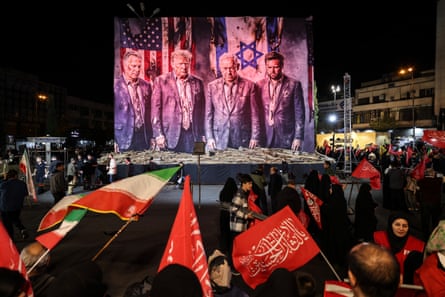
The big question Australian sceptics of our unerring, determinedly unnuanced alliance with the US are pondering is whether America’s domestic political realignment will impact on Canberra’s reckless, bipartisan shielded Aukus deal with Washington (to the cost of $500bn and taking into account the management and storage of nuclear waste).
There are plenty of privately vociferous critics of Aukus within Labor caucus, and many publicly in the broader party movement – including former senior ministers Peter Garrett, Gareth Evans and Bob Carr.
It’s fair to say some in the parliamentary party had hoped or even anticipated that at some point Trump (hypersensitive to any perceived diplomatic slight and quick with criticism of policies he doesn’t like, such as Australia’s cyber-safety moves) could, in some fit of pique unilaterally ditch Aukus. But then the only country paying hand over fist for Aukus right now is Australia. That’s some deal!
And the Pentagon, both congressional Democrats and Republicans, and not least Trump, know a good deal.
Any modification to Australia’s Aukus “deal” (or no deal) will have to come from within Australia.
Having a closest ally that makes good on a threat to “annihilate” another nation could, tragically, be the only catalyst to abandon that policy.
The lame-duck leader of the free world – cornered and dangerous – will wallow in his swamp of ambiguity.
This will render the next two years of Australian alliance management more unpredictable and potentially dangerous than ever.
KioskNews shows a cleaned-up reading view extracted from the publisher’s page — the original always lives on their site, not ours.