443 years after a shipwreck, X-rays crack a smuggler's four-letter padlock code
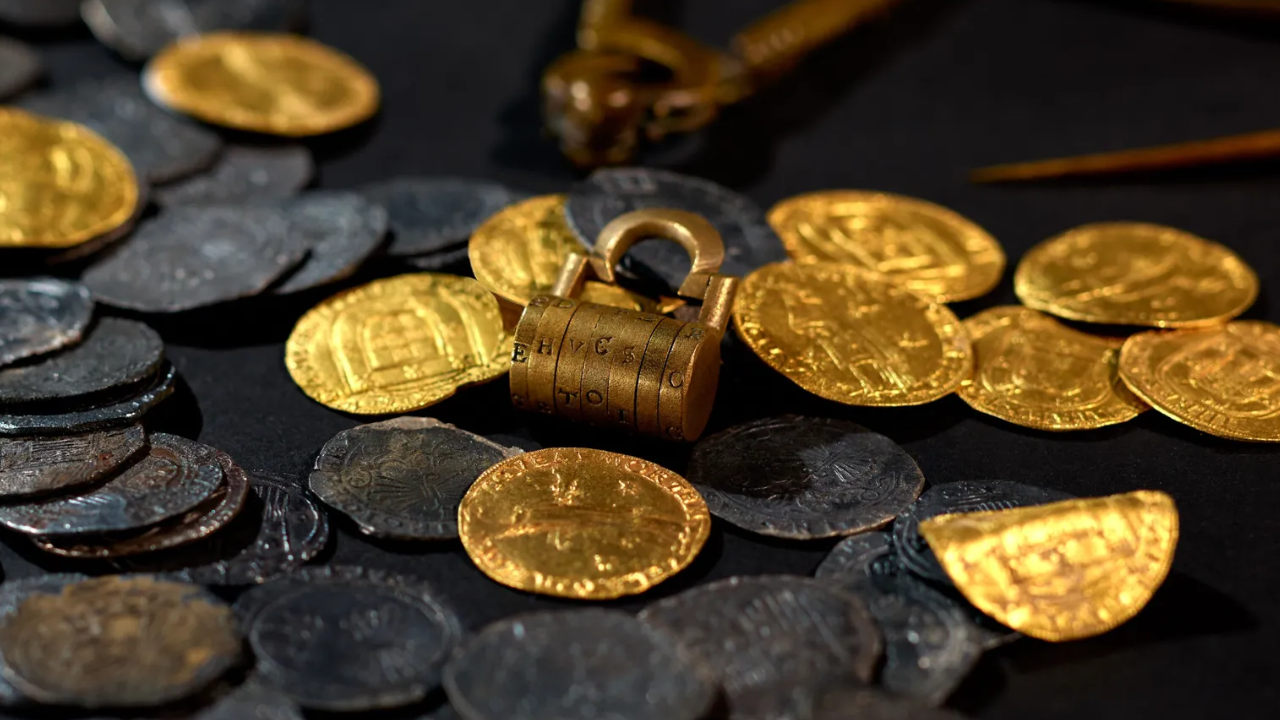
A brass combination lock recovered from a 16th-century shipwreck off the Welsh coast has finally been opened after more than four centuries, thanks to modern medical imaging technology.
Researchers from Cardiff University and Amgueddfa Cymru, also known as Museum Wales, used advanced micro-CT scanning to uncover its four-letter combination without damaging the fragile artefact. The code was identified as ANCE, solving a mystery surrounding an object recovered from the wreck of the Ann Francis, a merchant vessel that sank during a storm on December 28, 1583. The discovery was reported by Live Science, Cardiff University and the BBC, with researchers revealing the findings on November 4, 2026.
The lock formed part of a treasure collection uncovered over several years at Margam Beach in South Wales. Although its external lettered dials could still turn, nobody had managed to find the correct combination since its discovery.
A ship carrying a secret cargo
The Ann Francis belonged to Francis Shaxton, an English merchant known for his involvement in smuggling. Historical accounts suggest that the vessel was carrying wheat from England to Spain, where grain was in demand.
The cargo was reportedly exchanged for gold and silver, including precious metals originating from Spanish colonial territories in Central and South America. The ship was returning from Spain when it encountered a violent storm on December 28, 1583.
Strong winds pushed it off course, eventually driving it onto Margam Beach, near present-day Port Talbot in Wales.The wreck was quickly looted by local residents, triggering a dispute over ownership of the recovered goods.
Historical records from the period describe the seizure of cannons, firearms, ship equipment, Spanish silver and three chests whose locks had already been broken. Researchers believe the newly opened padlock may have belonged to one of these chests, although its original contents remain unknown.
How scientists cracked the combination
The lock was discovered by metal detectorist Peter Hughes, who recovered much of the Ann Francis treasure hoard between 1996 and 2017.
The collection includes approximately 870 gold and silver coins, alongside ship equipment and other personal objects. Despite its age, the brass lock was remarkably well preserved. Its rotating letter dials could still move, but finding the correct combination proved difficult.
Museum specialists were reluctant to experiment with the mechanism because they could hear particles moving inside it and feared that repeated attempts might damage the artefact.Instead, they turned to researchers at Cardiff University for help. The team used micro-computed tomography, or micro-CT, a technique that captures thousands of X-ray images to create a detailed three-dimensional representation of an object's internal structure. Although the technology is commonly used to examine bones and other biological materials, researchers adapted it to study the lock's intricate mechanism.
The resulting images allowed them to examine the internal notches and understand how they aligned with the letters on the rotating rings. By matching these components, they identified the correct sequence as ANCE and successfully opened the lock without physically dismantling or damaging it.
The mystery behind ANCE remains unsolved
While the discovery has answered one longstanding question, it has created another. Researchers have not established what the four letters ANCE represented or why the original owner selected them as the combination.
It is also unclear whether the lock protected coins, important documents, textiles or other valuables. Its association with a precisely dated shipwreck, however, makes it particularly significant for historians studying Elizabethan-era maritime trade and security.The padlock is now part of the Ann Francis collection displayed at the National Waterfront Museum in Swansea, alongside rare Spanish gold coins, navigational equipment and a boatswain's whistle recovered from the wreck. The exhibition, titled Tides of Treasure, is scheduled to remain on display until September 2027. More than four centuries after the Ann Francis disappeared beneath the waves, scientists have finally managed to open one of its surviving secrets.
What the lock was originally protecting, however, may remain lost to history.
KioskNews shows a cleaned-up reading view extracted from the publisher’s page — the original always lives on their site, not ours.