Peter and Maria were mourned by people who loved them. So how did they end up in unmarked communal graves?
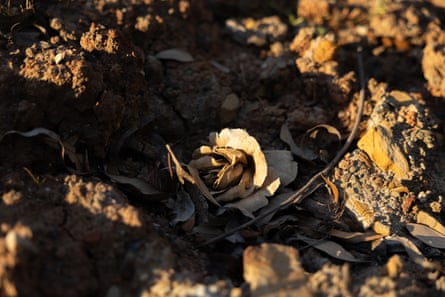
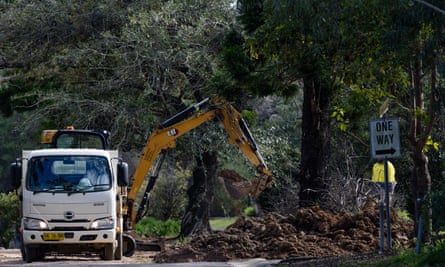
The track marks have dried in the mud beside Peter Giesel’s unmarked grave. The digger is long gone, although other signs of work remain.
A disused shovel. A traffic cone. A stretch of earth where the soil is yet to settle, sandwiched between an old set of headstones and a dirt walkway at Sydney’s Rookwood general cemetery.
Nothing tells you Giesel is here – no headstone, cross or plaque.
There’s no sign that the New South Wales government buried him in this grave with three others on a single day in late June, four strangers united only by the plot they share.
Giesel’s sister, Nicole, is confused and devastated after belatedly learning that her older brother had been put in an unmarked communal grave.
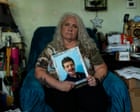
So is his close friend Elaine Grady, who would spend hours each day on the phone to Peter from the US, joking and laughing, sharing pictures of American cars, and dreaming up plans for the out-of-work mechanic to escape his difficult life in Australia.
“How could such a heartless thing happen to someone who gave so much of his heart to others?” she says.
Giesel’s plot sits in a row of nine unmarked graves dug in the first half of this year to hold people the NSW government has designated “persons without means” – those unable to afford their own funerals.
The designation gives the state control over the handling of their remains, leading to about 98 burials, 293 cremations and 22 ash interments each year.
A Guardian Australia investigation has found that the process is sending hundreds of poor and vulnerable Australians into unmarked communal graves like Giesel’s, which typically hold four to six people each.
The three-month investigation, encompassing evidence from family, friends and support workers alongside analysis of cemetery records and aerial and satellite imagery, has also identified serious failures that are putting people into unmarked graves unnecessarily.
In six cases uncovered by the Guardian, friends, community leaders and family were either not told of the use of unmarked communal graves or not given a proper chance to intervene and pay or crowdfund for a proper burial or marker, a likely breach of government policy.
Guardian Australia has also discovered that at least 18 individuals known to Sydney homelessness services have been placed in the unmarked graves since 2016.
In one case, the rough sleeper Roger Davies was put in a grave with four strangers without his sister’s knowledge because police lacked her current contact details.
His sister, Chantel Dubsky, was alive and well in Adelaide, and would have paid for her brother’s cremation and repatriation.
She describes the failing as “unspeakable”.
Prominent leaders in Sydney’s homelessness sector are outraged by the revelations, saying they were not informed about the use of unmarked communal graves and were never given the chance to intervene and pay for proper burials for clients or former clients.
“Some people in the homelessness sector are aware that destitute funerals exist, and some may have attended them in the past as case workers, often as the only person present, myself included,” says Jon Swain, the Australian Alliance to End Homelessness NSW homelessness adviser.
“What we were not aware of, and what has caused considerable alarm, is that people were potentially being buried in unmarked communal graves with multiple individuals in the same plot.”
Guardian Australia has also identified two Vietnam war veterans buried in unmarked communal graves in 2024 and 2025. Both served in the Royal Australian Navy.
The federal government runs a funding assistance program designed to pay for the funerals of indigent veterans. The Department of Veterans’ Affairs confirmed it “has not been approached to help fund the burials of destitute persons since 2020”.
Queensland is also using unmarked graves for burials, though it does not use communal interments in the same manner as NSW.
The situation in both states contrasts sharply with that in Victoria, where the state trustee uses a rural cemetery at Ballan to bury its most disadvantaged citizens in single plots, each with a marking.
It does this as a “matter of respect for the deceased” and to ensure families and friends have a place to visit.
The process costs $3,000 a burial, a fixed rate that, if adopted in NSW, would cost the state government at most about $360,000 a year.
“We just feel like this is the appropriate way of honouring the deceased, to put them in their individual graves and to mark it,” says the State Trustees Victoria chief executive, Melissa Reynolds.
“I don’t think there’s any right or wrong in the way that different states take a position on these things.
“We just think … it’s important should anybody come forward at a future point, to recognise that they have got their own site and have been treated with dignity at the end of their life.”
The revelations have prompted an immediate response.
NSW Health delivered an apology to the dead and their loved ones, acknowledging they had not always been treated with the dignity and respect they deserved.
The health minister, Ryan Park, has also intervened, describing the past failings as “unacceptable”.
The NSW government says it hopes recent changes may improve the process and has flagged further reforms, including working with charities and non-government organisations to find funding for funerals.
‘Buddy was his lifeline’
There’s a photo of Peter Giesel that Grady loves to share.
He is looking down at the camera, a weary smile on his face. On his lap sits Buddy, a brown and white border collie.
Buddy was Giesel’s whole world, a source of unconditional love in an isolated and difficult life.
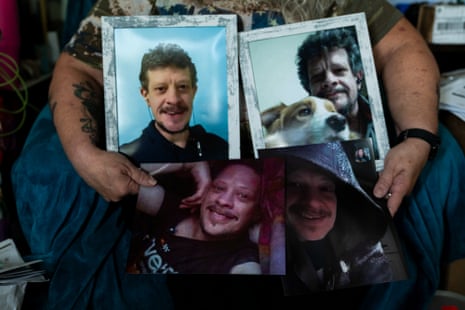
“Buddy was his lifeline, the reason he got up every morning, his partner and his best friend,” Grady says.
Giesel had a difficult upbringing.
His brother died of a brain tumour when he was in primary school. Nicole remembers spending long stretches with her brother at the Ronald McDonald House in Camperdown while their parents spoke to doctors and surgeons.
She has fond memories of a nurse taking the siblings to the movies, and of wandering the grounds of Camperdown children’s hospital, finding trees to climb.
The family struggled for money in later years.
As an adult, Giesel lived with his father in a public housing property and Grady remembers ordering groceries online from her home in Rhode Island and having them delivered to them, worried that they weren’t eating.
The pair met on Facebook about 10 years ago. They quickly struck up a close friendship.
Giesel reconditioned old engines and Grady delivered auto parts across Rhode Island and neighbouring states for a living. He loved all things American cars.
“My daily journey for work was like attending a car show, so I would bring him along with me for the ride,” Grady says.
Giesel came to know Grady’s family. He’d play them Australian music – Cold Chisel were a favourite – and Grady watched as her friend tried, with limited success, to learn guitar.
“He would play songs for me and it would make me smile,” she says. “I always told him it was great while I secretly turned the volume down. I’m pretty sure he knew but neither of us ever said anything.”
Then Grady watched on, feeling helpless, as her friend suffered hit after hit in his final year.
When his father died in September 2023, Giesel was booted from the home they shared, losing many of his possessions. He ended up in a caravan outside his sister’s place in Minto, south-western Sydney.
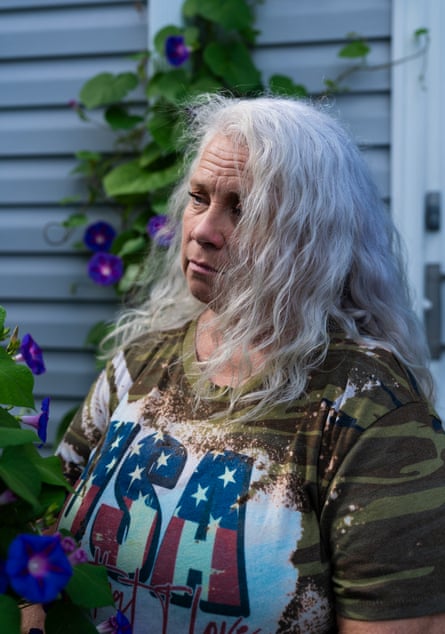
“All he had left was his dog, Buddy, and what he could carry out with him,” Grady says.
Two months later, Buddy was hit by a car. Giesel had to put him down, a decision that broke him.
He sank into depression.
“Peter was never the same,” Grady says. “He became quiet and kept to himself most of the time, sometimes going days without contacting me, despite my best efforts to reach him.”
About 10pm on 14 August 2024, police were called for a welfare check on Giesel. They found him inside the caravan, dead, from what the coroner says were natural causes.
Nicole says she had no money to pay for her brother’s funeral. But she also says she was never told that an unmarked or communal grave would be used for his remains.
“This is the first I’ve heard of this and I’m devastated,” she says. “I feel sick.”
The policy is clear. NSW health authorities are supposed to do everything they can to identify people willing to pay for a funeral.
That includes contacting “friends or other interested parties associated with the deceased to pay for a burial or cremation”.
And NSW Health is supposed to consider using “publicly available funding avenues (such as crowdfunding)”.
Policy documents state that this is designed to “help to avoid causing unnecessary distress to people who may have wished to make other funeral arrangements and been willing to pay the funeral costs”.
Grady was not hard to find. She had posted on Giesel’s publicly accessible Facebook profile, informing others of his death and paying tribute to her late friend two years before he was eventually buried.
Had she been contacted, she says, she would have helped to pay for the funeral. Giesel’s other friends in the US would have contributed, she adds, had she set up a GoFundMe page.
“This news was devastating, not only to me, but to my family who loved him just as much as I did,” she says. “If nothing else, you would think he deserved to be buried in his own space, with a marker saying he was there.”
‘Mary fell through the cracks’
Maria Kikkert often came to work bearing gifts.
Most days she’d stop off at a small Vietnamese bakery on her way to Sydney’s north shore from her own home in Chester Hill, near Bankstown in western Sydney.
She’d turn up on the doorstep of her employers, the Cowley family from Lindfield, with fresh bánh mì rolls.
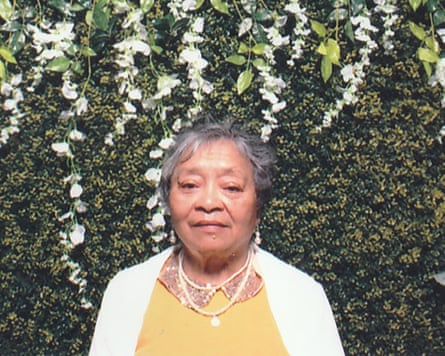
Kikkert was the Cowleys’ housekeeper for almost 20 years. Kathy Cowley says she was there so long she became part of the family.
The rolls were just the start.
Kikkert brought clothes for Kathy’s daughter, a coffee machine for their kitchen and a pie-maker for Kathy.
“She was such a wonderful help, such a kind, generous person,” Cowley says. “So generous – and yet we didn’t realise until we went to her memorial service and visited her home afterwards that she had been living in complete poverty.”
Kikkert hadn’t told the Cowleys much about her personal life.
She had a life of trauma and loss, mental ill health and poker machine addiction that had driven her to financial despair.
Kikkert’s life began to spiral out of control after her husband, Egbert, died in 2011. She began spending long stretches at the Bankstown sport club, often staying until closing time, feeding what little money she had into the machines.
She was left with no money to look after herself, one neighbour and friend said. Her home became filled with junk and she borrowed money and pawned jewellery to survive.
Her appearance became increasingly dishevelled and her neighbour grew concerned that the deterioration in her mental health was not being picked up by her doctors.
In August 2022 she was found dead at home.
“Mary fell through the cracks in the system,” the friend says, adding: “She is a victim. She’s a victim of the system, and that’s why she’s died with no money and ended up in a pauper’s grave.”
Kikkert, a Catholic, was buried as a “person without means” by the NSW government on 23 November 2022.
She was put in an unmarked grave with the remains of four others.
Cowley remembers turning up for the burial and being shocked by what she saw.
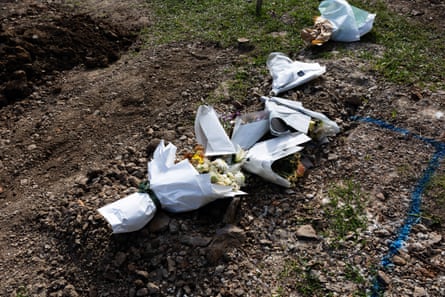
Her friend’s simple timber casket had been taken to a strange part of the cemetery, between a dirt walkway and a set of old headstones.
“I wouldn’t even know how to find it again,” she says. “It was just a patch of dirt. Several graves had been dug and some were freshly sort of covered over.
“It was Mary’s that was the only one that was open, ready for the casket, and then, following the short dedication and prayers from Mary’s parish priest, there were a couple of men just standing by, ready to fill the grave after we departed.”
Cowley says she wasn’t given a chance to provide money for the funeral, a responsibility that falls to the NSW government. The funeral director was helpful and supportive, she says, and allowed her to pay for flowers for Kikkert’s casket.
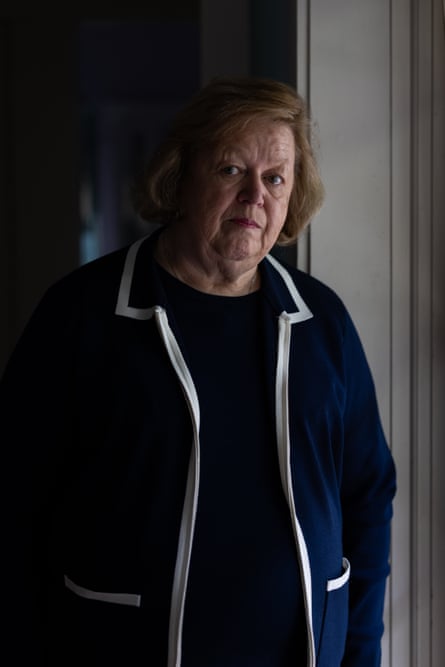
But she says she would have paid for a headstone or “something to commemorate Mary and her life”, particularly if she’d known her friend was going into an unmarked communal grave.
“I would have said that’s unacceptable if I had been asked, and I would have said, ‘Look, what can I do? How can I contribute?’”
Kikkert’s stepdaughter remembers getting a phone call the day before the burial.
It was from a funeral director, not anyone within the NSW government.
She says she was never told what the burial would entail.
“I was informed that she was having a destitute burial,” she says. “But the sentence should have gone on and said she will be with four or five other people, and there will be no marking.
“Mary had a dreadful life, and she had a dreadful time after my father died. And now she’s had a dreadful time after her death.”
The stepdaughter was using the surname “Kikkert” at the time of her stepmother’s death. She says it would have been easy for the NSW authorities to find her.
“I don’t think I’m hard to find,” she says. “As you say, you found me.”
New South Wales Health, which assumed greater control of the process from police in 2025, issued a statement apologising for past failings.
“Families and friends who have lost a loved one face many challenges managing arrangements during a time of grief, and all deceased persons should be treated with dignity and respect, regardless of their financial circumstances,” a spokesperson said.
“It is clear this has not always occurred with respect to the burials or cremations for deceased people without the financial means to pay for a funeral, and NSW Health apologises for the distress this has caused to those who have lost someone they love.”
NSW Health said it had made changes to the process in 2025 and in recent months to improve the way the funerals were handled. That includes putting NSW Health Pathology in charge of deaths that occur outside of hospitals or in cases that are before the coroner.
NSW Health Pathology has created a dedicated funeral support assessment team with 6.2 full-time equivalent positions, which is focused on identifying opportunities for “alternative funeral arrangements and alternate sources of support for families and friends that may be willing to assist”.
It is also exploring further changes to improve its coordination with charities, community and religious groups and other government organisations.
Two NSW ministers, Park and the homelessness minister, Rose Jackson, said the dead and their families should be treated with respect, regardless of their financial circumstances.
“Previous arrangements have meant that this has not always been the case, and that is unacceptable,” Park said.
“Since early 2025, NSW Health has made significant changes to establish a more comprehensive and person-centred approach to ensure all deceased persons are treated with the respect and compassion they deserve.”
A spokesperson for Metropolitan Memorial Parks, which operates Rookwood general cemetery, said the NSW government did not fund it to provide grave markings for people without means.
MMP said destitute burials were not the only burial type that used multiple interments in a single plot.
The details of all those buried in Rookwood, including through the persons without means process, are published online, including the grave location, and MMP rejected any suggestion that those buried through the process were being placed between individual headstones, under walkways or in trenches.
MMP said it had identified no legislation or regulation that had given effect to the government’s 2013 promise to mark graves.
“The government covers only the cost of a basic, dignified burial or cremation,” the spokesperson said. “Permanent memorialisation, such as a bronze or stone plaque, is optional and is not funded by the state.”
‘Begging for answers I may never find’
Families and friends of others interred in the graves are now desperate for answers.
Grady has spent the past month trying to get an explanation from NSW Health and Rookwood about Giesel’s burial.
She has been stonewalled at every turn.
Her emails to NSW Health have gone unanswered. She has been told by Rookwood that the cemetery cannot answer her questions until she signs a statutory declaration stipulating why she wants the information and how she will use it.
The cemetery’s operator said in a separate statement to the Guardian that Grady was welcome to apply for a grave maker but it would need to see evidence of her identity and of her relationship to Giesel.
The only questions Grady has asked are why her friend appears to be in a grave with others and whether she can pay for a marker to be left at the plot.
“Unfortunately, there are no answers, there is no one to turn to for help, and I am left with my hands tied, begging for answers I may never find,” she says.
“Every day I miss my friend and all the craziness that came along with him. Too often I will hear a song, or scroll past a photo, and remember how much he meant to me – how many smiles and laughs we shared.
“Someday we will meet again, and go right back to the way we were. Until then, we will keep [him] alive in our memories.”
KioskNews shows a cleaned-up reading view extracted from the publisher’s page — the original always lives on their site, not ours.