‘Corruption has only got worse’: can a new version of Our Friends in the North still shock audiences 30 years on?

In a small room at the top of Newcastle upon Tyne’s Live theatre, four actors are bringing to life the principal characters from one of British television’s best-loved dramas. Sitting around a table strewn with coffee cups, water bottles and annotated scripts, Tosker and Geordie have been boozing in a nightclub and weighing up their chances of pulling. Mary and Nicky have been arguing about whether they have a future together.
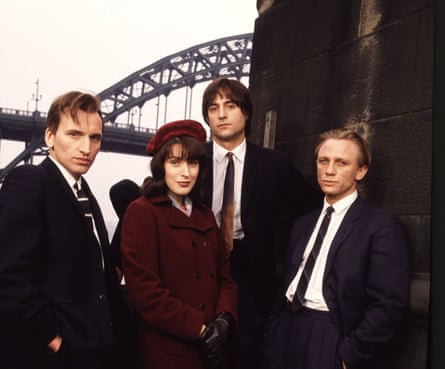
The scenes are from a new stage version of Our Friends in the North, the landmark nine-episode series first broadcast in 1996 on BBC Two. Set against a backdrop of Labour politics and police corruption, it charted 30 years in the lives of four working-class geordies and made stars of Mark Strong, Daniel Craig, Gina McKee and Christopher Eccleston. It was a hit with critics and viewers, won awards and regularly makes “greatest ever” lists.
Now it is back, after Live theatre’s artistic director Jack McNamara persuaded an initially reluctant Peter Flannery, the writer, to return to the characters he first created for a Royal Shakespeare Company play in 1982, before later rewriting and expanding the story for the screen.
“In a way, the production came from a sense of frustration, of always having to think small and manageable in a historically underfunded region,” says McNamara. “We needed a bigger gesture. A wider story for a larger audience that had a familiar outline, but still something no one has seen on stage before. Put simply, I wanted to direct 12 actors on a big stage in a brand new work. The significance and agility of Our Friends offers a rare opportunity for that to happen.”
Because of the scale of the show and its potential afterlife, it is a co-production between Live theatre, the Theatre Royal in Newcastle upon Tyne and the theatre producers Eastlake Productions.
Flannery has reworked two of the TV episodes, set in 1979 and 1984, into a two-act play. He has introduced a chorus and there are a couple of borrowings from other episodes for explanatory purposes. The stage design allows for it to be a fast-moving show.
On TV, McKee was the only one of the four principal players who was from the region. For the play, four actors from the north-east have been cast. Ryan Nolan is the political idealist Nicky (Eccleston on TV). Sam Neale is the quietly driven Mary (McKee). Jack Robertson plays the would-be entrepreneurial Tosker (Strong). Scott Turnbull is the luckless Geordie (Craig).
At the table read, a few days before rehearsals with the full cast begin, various scenes are stress-tested under the guidance of McNamara. There’s a long discussion about how best to make a particular joke land, and the two actors concerned try it in a number of different ways. In the script, one character is reprimanded for missing his son’s football final. “‘Football final’ is a bit of a cliche,” jokes Turnbull. “Maybe it should be a ‘bassoon recital’.” Everyone laughs.
The actors want to know whether McNamara expects them to model their performances on their TV predecessors, but he is not interested in impersonations. The way to pay tribute to the originators of the roles, he says, is to do their own thing. There’s a sense of relief but the four are acutely aware that Our Friends in the North is a cherished TV show, and there is a weight of expectation.
“I’m trying not to get into an anxiety spiral about it but it is there, looming,” says Neale, who recalls watching the show with her mum.
“I do feel like there’s a lot of pressure,” says Turnbull. “This needs to be executed well.”
after newsletter promotion
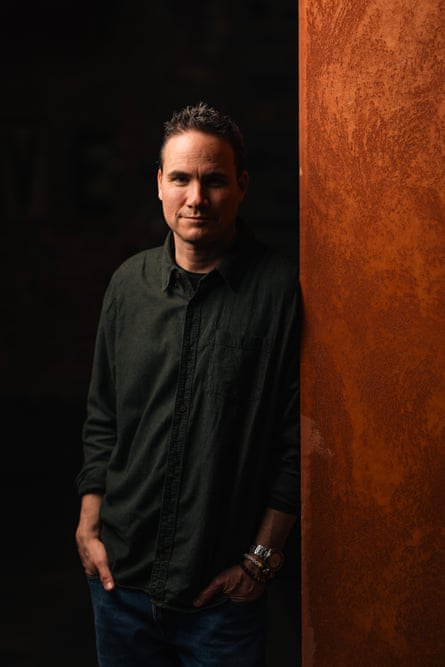
McNamara is well aware of the pressure the cast are feeling but he likes to keep things loose. “There is always an element of experimenting,” he says. “I don’t storyboard things down to a T. I like to have a little openness so that in rehearsals it feels like anything is possible.”
Understandably, McNamara can’t help but imagine where things might go next. There are hopes the show will have a life beyond its short run in Newcastle but “it has to land here and have real resonance before it goes anywhere else”, McNamara says.
Later, at the full-cast rehearsals, the energy level is palpably higher than at the table read. After a couple of hours, McNamara asks the performers to improvise various scenes. Improvisation is not a memory test, he reminds them, but a way of exploring intentionality. There are clear glimpses of what has the potential to be a powerful theatrical experience.
“The show is about friendship and how it evolves and fractures. And there’s a lot about political optimism and political failure and how they sit alongside each other,” McNamara says.
“The chances of real change through the Labour party is the central preoccupation of Our Friends in the North,” wrote the late campaigning journalist Paul Foot, but no one could consider the show – or the play – a paean of praise for politicians, especially their relationship with the police. In Our Friends – some of which was based on a scandal uncovered by Foot – decent Labour politicians are bested by cynical spivs and extremists. Honest police officers are outmanoeuvred, and perhaps outnumbered, by bent coppers. Lawmaking and law enforcement are rotten to the core.
Although it was well researched and based on fact, Flannery says some viewers of the TV series thought the police corruption strand of the story had been exaggerated. “I don’t know that anybody’s going to be shocked now like they were 30 years ago,” he says. “That [corruption] has got worse. There have been serving officers prosecuted for rape and murder since then.”
Of the political chicanery, Flannery says: “I can’t see what might have changed. The publicity around Neil Hamilton and Mohamed Al-Fayed and the ‘cash for questions’ affair must have made them change their tactics, but I think they’re still at it. There are so many paid lobbyists hanging around parliament now. What are they there for if not to suborn MPs and buy their votes and their support? It’s what’s ruined American politics and if we’re not careful it will ruin British politics as well.”
As he approaches 75, Flannery says this will probably be the last thing he writes. “I’m acutely aware that I’m handing the audience a fairly bleak view of society,” he says. “However, the characters are vibrant and they’re all survivors, even Geordie, who seems to be kind of indomitable. No matter what bucket of shit gets poured over him he gets up and has another go. I want the audience to take hope from the characters.”
Flannery insists he sees the arrival of Andy Burnham as prime minister as a positive thing. “I think the whole system is against him and he’ll find his road blocked at every turn. I’ve watched this rolling around again and again and there isn’t usually any real change. But, I’m an optimist. It is a triumph of hope over experience but until I’m proven wrong, I’ll hang on to that.”
Our Friends in the North: The Thatcher Years is at the Theatre Royal, Newcastle upon Tyne, 15 to 24 October.
KioskNews shows a cleaned-up reading view extracted from the publisher’s page — the original always lives on their site, not ours.