MLB trends: Elly De La Cruz's new trick, the Yankees' great find and an ABS challenge update
With less than two weeks of the regular season to go, let's take a look around the league

• 7 min read
Only one week and four days remain in the 2026 MLB regular season. Four teams (Brewers, Dodgers, Rays, Yankees) have clinched postseason berths, so eight spots remain up for grabs, and chances are at least a few of them will come down to the final weekend. There are also awards races to sort out. Only so much baseball remains, but there's still a lot to be decided.
Here now are three late-season trends to keep an eye on as the regular season winds down.

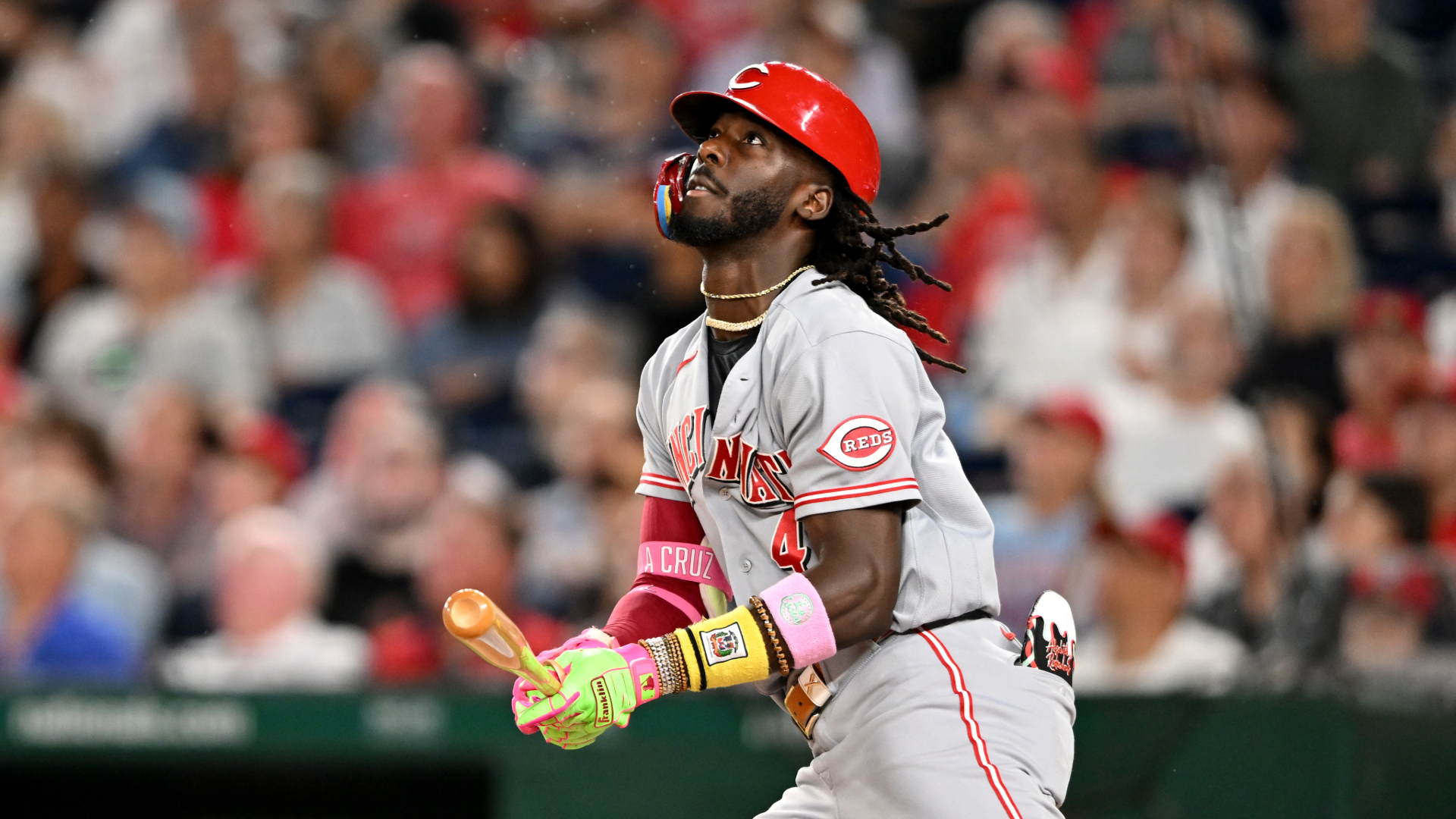
Elly De La Cruz has solved lefties
There are some players who look like they were put on this Earth to play baseball and only to play baseball, and Reds star Elly De La Cruz is one of those players. The natural gifts -- the power, the speed, the arm, the athleticism -- are so overt that it's almost frustrating to watch him play, because as good as he is, it feels like De La Cruz is still only scratching the surface of his talent.
Make no mistake, though, De La Cruz is a star. He went into Tuesday ranked third among position players in WAR, behind only Pete Crow-Armstrong and Bobby Witt Jr., and he's reached another level over the last few weeks. Since Aug. 22, De La Cruz is 36 for 86 (.419) with seven homers in 21 games, including a titanic two-run homer off two-time Cy Young winner Tarik Skubal last week.
As recently as last season, De La Cruz turning around a Skubal changeup like that may not have been possible. Despite being a switch-hitter and despite being so talented, De La Cruz was one of the worst hitters in baseball against left-handed pitchers over the first three years of his career. He was so bad against lefties that there was speculation that he'd drop switch-hitting and exclusively hit lefty.
De La Cruz flipped the script this season and has been one of the very best hitters in baseball against lefties. Here are his numbers against southpaws throughout his young career:
| AVG/OBP/SLG | OPS+ | K% | |
|---|---|---|---|
2023 | .184/.231/.263 | 34 | 40.2% |
2024 | .224/.307/.354 | 87 | 31.8% |
2025 | .236/.276/.342 | 76 | 29.0% |
2026 | .342/.407/.638 | 190 | 27.3% |
Back in April, Reds hitting coach Chris Valaika told The Athletic that De La Cruz has made some mechanical adjustments as a right-handed hitter, specifically keeping his front leg up a little longer during his leg kick, but much of his improvement against lefties boils down to approach and confidence. He's ready to hit from Pitch 1 and his confidence against lefties has ballooned.
"I think he's a little shorter to the ball. He's so long-levered to begin with that it allows him to make better swing decisions," Reds manager Terry Francona told The Athletic in April. "I think confidence plays a big part. I know you hear me say it a lot, but it's true. Just because you can't quantify something doesn't mean it's not real."
I don't believe De La Cruz is now a true talent .342 hitter and 190 OPS+ guy against lefties. No one is really that good. I do, however, buy into his improvement against lefties. There's a mechanical change, an approach change, and also experience. The more lefties you see, the more comfortable you'll get, and De La Cruz looks mighty comfortable against lefties these days.

The Yankees' new bullpen weapon
The Yankees clinched a postseason berth on Monday night and their pitching is the single biggest reason they'll play in October. They had one of baseball's lowest scoring offenses from June through August (i.e. when Aaron Judge was on the injured list), yet their pitching carried them to the American League's second-best record anyway. Only five teams have better records since June 1.
The late-inning bullpen trio of closer David Bednar, righty Paul Blackburn, and lefty Brent Headrick did a lot -- A LOT -- of heavy lifting for the Yankees throughout the summer. They were frequently handed small leads because that was all the offense could muster, and they made them stand up. Those three have a combined 2.05 ERA and 4.6 WAR in 219 ⅓ innings.
Bednar is a two-time All-Star who came over at last year's trade deadline. Blackburn is a former starter in his first season as a full-time reliever. Headrick was a waiver claim from the Twins last spring training. He missed time with an injury last year and rode the shuttle between Triple-A and MLB. This year, he is on the short list of baseball's best relievers.
| Reliever | WAR |
|---|---|
3.7 | |
3.0 | |
Adrian Morejon, Padres | 2.7 |
2.6 | |
Brent Headrick, Yankees | 2.2 |
Headrick was a starter coming up through the minors with the Twins and he made his MLB debut as a long reliever with Minnesota in 2023. The Yankees claimed him last spring and initially kept him as a multi-inning long relief guy. It wasn't until this season that he shifted into a more traditional one-inning relief role. The role change, plus three adjustments, have leveled Headrick up.
1. Higher arm angle. The Yankees tweaked Headrick's delivery, specifically getting him to pitch exclusively from the stretch. They also raised his arm angle. He was in the 35-degree range with the Twins. This year, it's 40 degrees. The higher arm angle has added more vertical break to Headrick's fastball (i.e. "life" at the top of the zone) and led to more swings and misses.
2. Improved splitter. Headrick has always thrown a splitter and the Yankees have a thing for splitter/changeup pitchers. Headrick was right up their alley then. New York's pitching gurus altered the grip of his splitter, which reduced the spin rate (a good thing for splitters) and created more tumble down below the zone. That in turn has added many more swings and misses.
3. New sinker. Headrick added a sinker this season and it is mostly an early count weapon against lefties. He uses it to jam them up inside, get some quick ground balls, and also to set up sliders away. Headrick's four-seam fastball is fly-ball-prone. The sinker gives him something with velocity and a little movement to avoid the barrel, and keep the ball on the ground.
The Yankees are getting their money's worth out of Headrick. Going into Tuesday, his 78 appearances were the second most in baseball, and an MLB-leading 62 of those 78 appearances were scoreless. Headrick has answered the bell time and time again. The Yankees turned a waiver claim into a reliable setup man who was instrumental in getting them to the postseason.
An increase in ABS challenges
Year 1 of the ABS system is almost in the books and challenges went from an event in April -- remember how excited the crowd would get when the home team won a challenge? -- to just part of the game in September. They almost blend into the background now. They're part of the game and that's great. They're quick and not at all disruptive.
April was a feeling-out process for everyone, including the players. Everyone was learning the system, especially hitters who had to recalibrate their own specific strike zone, as well as when to use their challenges. The No. 9 hitter probably shouldn't challenge a borderline pitch in an 0-2 count with two outs and the bases empty, you know? The leverage isn't high enough.
As players have become familiar with the system, ABS challenges have increased, and hitters in particular have gotten better at them. Only slightly better, but better nonetheless. Here are the monthly ABS challenge numbers ("fielder" includes both pitchers and catchers, but it's basically all catchers because pitchers rarely challenge):
| Hitter ABS per game | Hitter success rate | Fielder ABS per game | Fielder success rate | |
|---|---|---|---|---|
April | 0.96 | 46% | 1.11 | 60% |
May | 0.95 | 47% | 1.08 | 56% |
June | 1.03 | 50% | 1.13 | 59% |
July | 0.99 | 49% | 1.23 | 57% |
August | 1.01 | 52% | 1.29 | 57% |
September | 1.00 | 49% | 1.33 | 60% |
Hitters were down at 0.95 challenges per game with a 46% success rate in April and May. They've challenged slightly more often in the four months since and have boosted their success rate up above 50%. Fielders have hovered around 58% with their success rate all season, but look how much more often they challenge now. It's almost a 20% increase from April to September!
I don't love this. Fielders challenge more often and with a much higher success rate than hitters, which means more balls are being turned into strikes than vice versa. It has never been harder to hit in baseball history than it is right now. Pitchers are so nasty and their usage is optimized to the nth degree, and now ABS challenges have stacked the decks against hitters even further.
I'm not sure what the solution is here. Maybe we should separate hitter and fielder challenges? Give hitters two challenges per game and fielders one rather than two per team? I think ABS challenges are great. Let's get calls right. But also, ABS challenges are another tool being used against hitters at a time when offense is already down. Adjustments to the system are needed.
KioskNews shows a cleaned-up reading view extracted from the publisher’s page — the original always lives on their site, not ours.