The Master Builder review – false swagger and queasy infidelity propel Ibsen’s big-drop drama

This outing of Henrik Ibsen’s play, translated by playwright David Edgar, is reassuring after Lila Raicek’s oddly conceived West End version last year starring Ewan McGregor – as well intentioned as its feminist revisionism might have been.
Edgar’s is more faithful to the original in form and spirit (although he compresses three acts into two), and its strengths lie in drawing out the psychological aspects of the ageing, anxious master builder at its centre, whose fall from the heights of worldly acclaim is both real and symbolic in a play that blends both those realms together.
Halvard Solness (Greg Hicks) is determined to keep his place in the world but also plagued by midlife insecurity – and the protege Ragnar Brovik (Ryan Wichert) whom he perceives to be snapping at his heels – when he is confronted by Hilde Wangel (Louisa Binder), a young woman who has come to claim the “kingdom” he promised her in an encounter when she was 13.
Edgar deftly draws out the intimacies and tensions between characters in this curious story, with its enigmatic ending and its growing sense of otherworldliness. Except there is nothing otherworldly to the production: director Mehmet Ergen gives the characters a solidity in his modern-dress production.
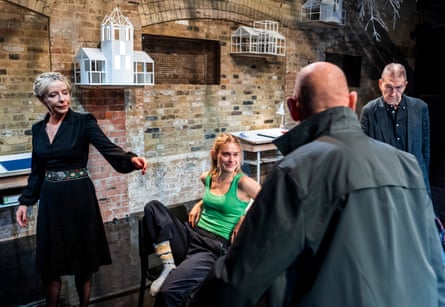
This world is recognisable, with Hilde real and a symbol of his past – or a consequence of it. She brings memories Solness claims to have forgotten and you can read the #MeToo subtext in his amnesia. It is queasy to hear about the kisses he gave her as a girl, and queasier still to feel the flirtation now between them.
Hicks is animated, almost antic, as a man at the height of his worldly pomp who is inwardly unravelling. Binder is marvellous as Hilde, almost swaggering as she runs rings around him. Sally George, too, is very believable as Solness’s wife, Aline, forever grieving the death of their twin children and well able to see her husband’s emotional infidelities with the women that float around him, including office assistant Kaja (Jade Williams).
Yet the drama still hits against the limits of Ibsen’s strange and static story: you do not quite know if Solness is to be admired or condemned, and what of Hilde’s final triumphalism as she sees him fall from his tower? The puzzle of the ending might be the workings of fate, the personal cost of success, or an Icarus-like comeuppance for a middle-aged man in thrall to a younger woman. This production does not feel like a tragedy. You do not feel for Solness, or his fall. But then, were you ever supposed to?
KioskNews shows a cleaned-up reading view extracted from the publisher’s page — the original always lives on their site, not ours.