Unions urge increase to minimum wage
By Lee Ching-hui / Staff reporter


Ahead of a minimum wage review scheduled for this week, a study has recommended an increase at least equal to the annual consumer price index (CPI) growth rate to ensure workers receive a fair share of economic growth.
The Minimum Wage Review Committee, which would determine the size of next year’s minimum wage increase, is slated to convene on Thursday at the Ministry of Labor, bringing together representatives from labor, business, government and academia.
Local media reported that minimum wage is expected to be increased for the 11th consecutive year, with the monthly wage potentially surpassing NT$30,000. The current minimum wage is NT$29,500 per month and NT$196 per hour.
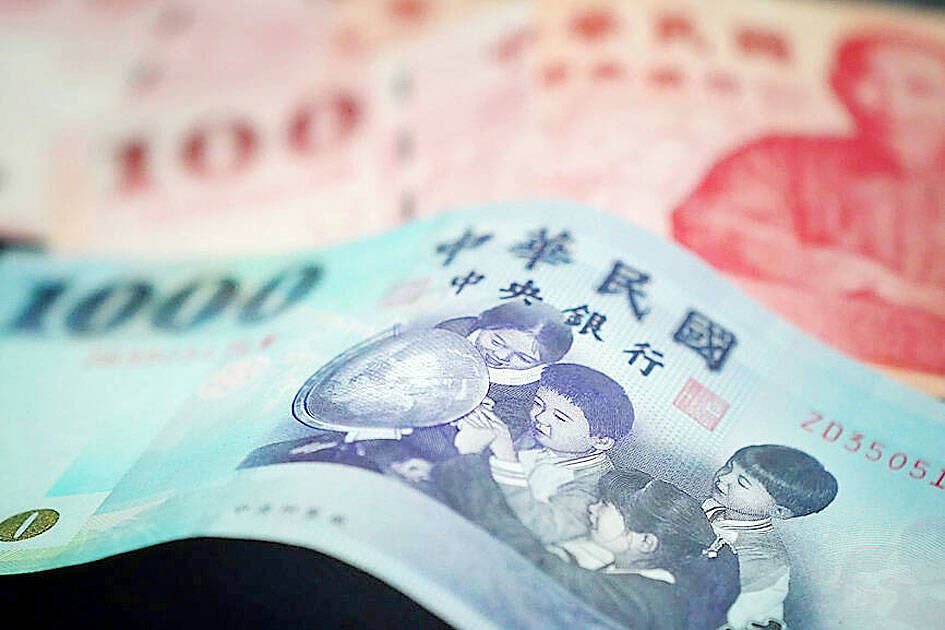
New Taiwan dollar banknotes are pictured in Taipei in an undated photograph.
Photo: CNA
Under the Minimum Wage Act (最低工資法), the minimum wage research group is required to submit a report ahead of the review.
The report highlights a growing imbalance in the distribution of GDP.
In 2024, employee compensation accounted for 43.1 percent of GDP, down 1.25 percentage points from the year before, it said, adding that corporate operating profits rose sharply to 35.06 percent of GDP, up 16.29 percent year on year.
The Directorate-General of Budget, Accounting and Statistics has raised its forecast for economic growth this year to 11.05 percent, putting the distribution of those gains at the center of negotiations between labor and management.
Under the Act, the indicators used to review adjustments to the minimum wage are divided into two categories: “required indicators” and “optional indicators.”
The “Minimum Wage Research Report and Adjustment Recommendations” estimates that the CPI would rise 2.07 percent year-on-year this year. Among the required indicators, the CPI for 17 key household necessities that have a particularly significant impact on low-income families rose an average 2.01 percent in the first seven months of this year. Egg prices jumped 11.58 percent, pork prices rose 4.84 percent and rice prices increased 2.9 percent, directly eroding consumers’ purchasing power, the report said.
For the lowest-income 20 percent of households, basic living expenses — including housing, utilities, food and medical care — account for as much as 65.58 percent of total consumption, it said.
The report recommends that any increase in the minimum wage should at least match the 2.07 percent CPI growth rate to protect workers’ purchasing power, while taking into account widening disparities in industry development and ensuring that workers receive a fair share of the benefits of economic growth.
The gap between labor and management over the size of the increase remains wide.
Third Wednesday Club chairman Lin Por-fong (林伯豐) said that an increase of “no more than 3 percent” would be more reasonable, drawing criticism from labor representatives, who called the proposal “insincere.”
Taiwan Confederation of Trade Unions president Tai Kuo-jung (戴國榮) said such an increase would give workers less than one-tenth of the gains from economic growth. The federation has called for a 7.77 percent increase, which would bring the monthly minimum wage to NT$31,792 and the hourly rate to NT$211.
KioskNews shows a cleaned-up reading view extracted from the publisher’s page — the original always lives on their site, not ours.