The 7 Most Thrilling Mystery Books of All Time, Ranked


At any given moment, Scott Simone has at least three books jockeying for his attention. He’ll never turn down a campus novel with a literary bent, nor will he hesitate to add yet another mystery to his Leaning Tower of Pisa-inspired to-be-read pile — which is built upon the bedrocks of too many short story collections, how-are-these-real true crime books, and classics waiting to be cracked open again. Topics that have him ripping through pages the fastest include closed-circle murders, unhappy professors, life-questioning philosophical deep dives, so long as they feature sharp sentences, a dark sense of humor, and at least a little malice.
He’s spent so much time in book shops over the years he is, to his wife’s chagrin, continuing to build a library that doesn’t quite respect the dimensions of the apartment meant to contain it.
Readers strike an odd bargain with mystery books. They know they’ll flip through hundreds of pages, many of which are weighed down by slow questioning: some will be false leads, some will seem meandering filler, but they’ll keep reading, all in the hope it all pays off. And sometimes the bargain pays off. The puzzle pieces lock together; the enigma unravels; all the built-up tension is released. But a clever solution isn't necessarily the mark of a thrilling mystery.
The most thrilling mysteries don't save all the excitement for the final chapter; the uncertainty itself becomes the attraction. Every new piece of information changes what we think we know, and just when we believe we're getting somewhere, the whole thing takes another turn. The best books don't need to manufacture excitement with a fresh revelation every twenty pages. The suspense comes not simply from what we don't know, but from what we begin to suspect, and by the time the truth emerges, getting there has been every bit as satisfying as the answer.
7 ‘Red April’ (2006)

Most murder mysteries make persistence a virtue; Red April makes it a potentially fatal flaw. Santiago Roncagliolo sets his novel in Ayacucho, Peru, where the horrors of the Shining Path insurgency are still fresh, and plenty of people would prefer to forget what happened. Assistant district prosecutor Félix Chacaltana has other ideas: he's a stickler for rules, paperwork, and proper procedure. Then more bodies turn up as the people who've spoken to him meet suspicious ends. And here’s the real trouble: Chacaltana never seems to realize the danger he's in.
The murders just keep getting uglier. All the while, the authorities appear ever more suspicious, and practically everyone Chacaltana questions gives him another reason to worry. It’s also never quite clear what, exactly, he’s dealing with: a deranged killer, the return of the Shining Path, or something else entirely. Every possibility is worse than the last. Roncagliolo also sets the escalating violence against the elaborate religious celebrations of Holy Week, giving the novel a sense of approaching disaster. With each new death, and as Chacaltana becomes more determined to get to the bottom of things, you almost want to reach into the book and tell the poor guy to stop.
6 ‘The Devotion of Suspect X’ (2005)

Most murder mysteries depend on keeping the killer's identity a secret — Keigo Higashino gives it away almost immediately in The Devotion of Suspect X, and somehow, it makes the reader more anxious. Yasuko Hanaoka kills her abusive ex-husband. Her neighbor Ishigami, a mathematician with a weirdly strong devotion to her, steps in to cover it up. As the police start asking questions, Ishigami remains irritatingly calm. Then a physicist named Manabu Yukawa, who knew Ishigami at university, begins to suspect there's more to his old friend's plan.
There's little action to speak of, but a discrepancy in someone's account can be enough to send the whole investigation in another direction. And all the while, we're caught in an awkward position: we want Yasuko to escape punishment, but the lengths Ishigami is prepared to go to protect her become harder and harder to stomach. Higashino saves the cruelest surprise for the end. When we finally understand the full extent of Ishigami's plan, the cleverness of it is almost beside the point.
5 ‘The Magus’ (1966)

It’s odd to call a 600-odd-page novel a page-turner. It’s even harder to do so when the first hundred-plus pages are mostly an introduction to the life and times of its protagonist. Yet, here we are. John Fowles' The Magus revolves around Nicholas Urfe, a smug young Englishman teaching on a Greek island. The warnings he’d gotten about the wealthy recluse Conchis only stoke his curiosity, so he obviously seeks him out. The relationship quickly turns into a psychological game.
There's something sinister about the whole arrangement that turns cruel as Nicholas begins to lose his grip on what's real. Conchis seems to be teaching him some grand lesson, though what that lesson might be, and why he's entitled to deliver it, is anyone's guess. Meanwhile, we're no closer to understanding his intentions. Fowles can be terribly indulgent, and there are stretches of this novel that test your patience. But he's also made us just as dependent on Conchis as Nicholas is, giving us every reason to keep flipping the pages.
4 ‘The Chestnut Man’ (2018)

Copenhagen has rarely seemed as miserable, or as dangerous, as it does in The Chestnut Man. Søren Sveistrup takes us through the city deep in the dreariest days of autumn. The streets are damp, daylight is in short supply, and even an ordinary back garden seems threatening. Yet the most frightening things in this gloomy landscape are little dolls made from chestnuts and matchsticks, a harmless Danish childhood tradition that children make every autumn — except here, they keep turning up at murder scenes.
The first doll is found beside the mutilated body of a woman. More disturbing still, it bears the fingerprint of Kristine Hartung, the missing daughter of a government minister who was presumed murdered a year earlier. Another entire mystery to unravel, compounded by the awful possibility that a grieving family has been wrong about what happened to their child. The killings continue, and detectives Naia Thulin and Mark Hess seem forever a step behind. Sveistrup gives us enough time with the people in danger that we begin fearing for their lives well before the detectives catch on, and every new killing makes the mystery that much more troubling.
3 ‘The Woman in White’ (1860)
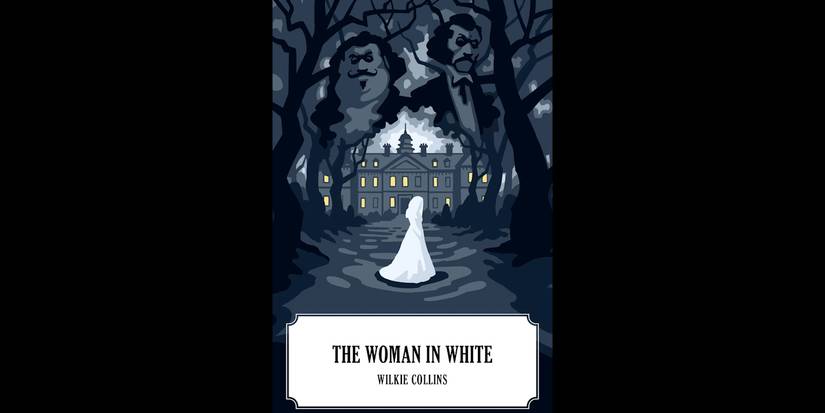
Knowing the truth is one thing. Getting anyone to believe you is quite another, especially if you're a woman in Victorian England. Wilkie Collins turned that terrible truth into one of the most nerve-racking mysteries of the 19th century. It begins with a woman who's escaped from an asylum, and whose resemblance to a wealthy young heiress, Laura Fairlie, raises some troubling questions. Laura, meanwhile, is engaged to Sir Percival Glyde, a gentleman with serious money problems and an equally serious interest in her fortune.
But Laura's half-sister, Marian Halcombe, is considerably more clever than either man gives her credit for. Even when she learns something useful, though, there's the question of what she can actually do with it. Knowing what these men are up to is one thing. Proving it is another, and the closer the women get to uncovering the conspiracy, the more danger they find themselves in. Collins takes this to extremes, until even a person's identity becomes something that can be taken away.
2 ‘Alex’ (2011)

Most thrillers would be perfectly happy to build an entire novel around the opening of Alex. Pierre Lemaitre treats it as the warm-up: a young woman is abducted from a Paris street, beaten, and imprisoned in a wooden cage suspended above the floor of an abandoned warehouse full of rats. The police, led by Commandant Camille Verhoeven, can barely establish who she is, let alone where she's being held. Lemaitre forces us to spend time with Alex as her chances of survival dwindle. Then, just when we think we understand where it's heading, he turns the whole thing on its head — and he's barely getting started.
The cleverness of Alex isn't simply that it has some terrific twists but that each one changes our understanding of the story we've been reading. Even the question of what justice should look like becomes increasingly difficult to answer. Yet Lemaitre keeps up a murderous pace, with Verhoeven struggling to make sense of a case that seems to change shape every time he gets somewhere. There's some truly stomach-turning violence here, but it's also difficult to think of another mystery that so thoroughly upends our expectations without losing its grip on the suspense.
1 ‘And Then There Were None’ (1939)

Agatha Christie was never more ruthless than when she did away with the detective. There's no Poirot to explain everything in And Then There Were None; instead, she strands 10 strangers on an island off the English coast, where a mysterious recording accuses each of them of having caused someone's death. Then the guests begin dying themselves, their deaths following the verses of a gruesome nursery rhyme. And since there's nobody else on the island, the murderer must be one of them. Everyone is a suspect, and everyone is a potential victim.
You'd think that with every death, the list of suspects would get a little easier to manage, but the fewer people left standing, the more suspicious everyone becomes. Worse, that nursery rhyme gives them a good idea of what's coming. Christie has us dreading the next death long before it happens. Even when we think we've worked out who's responsible, there's still the small matter of how on earth they've managed to pull it off. It's a nasty little novel, with none of the reassurance we usually get from a detective story. And at barely 300 pages, it scarcely gives us a moment to recover before another guest meets their end.
KioskNews shows a cleaned-up reading view extracted from the publisher’s page — the original always lives on their site, not ours.