Taipei mayoral race tightens as candidate blacklisted by Beijing gains ground
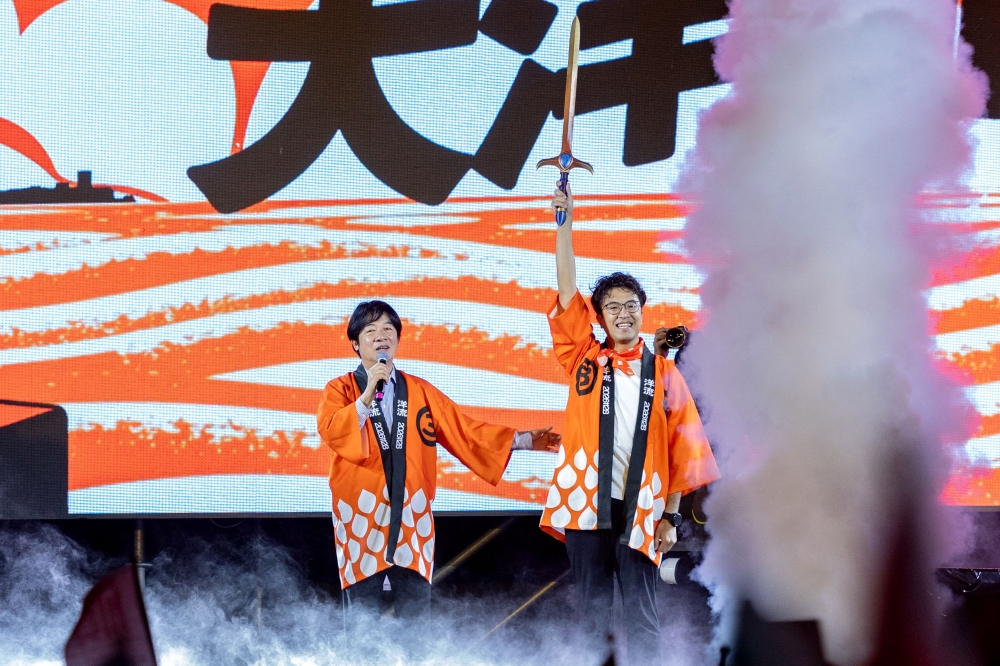

Taiwan’s President Lai Ching-te (left) and Taipei mayoral candidate Shen Pao-yang, also known as Puma Shen, of the Democratic Progressive Party (DPP) raise a ceremonial sword during an election campaign in Taipei on November 15, 2026. — AFP pic
First Published: Tuesday, 17 Nov 2026 7:00 AM MYT
TAIPEI, Nov 17 — A Taiwanese lawmaker wanted by police in China is running for Taipei mayor in an unexpectedly close race in the heartland of the Kuomintang party, which favours closer ties with Beijing.
Campaigning in night markets, temples and motorcades is underway for the November 28 elections that will decide races for mayors, magistrates and other posts across the island democracy.
The Kuomintang party (KMT) won 14 of Taiwan’s 22 cities and counties – including Taipei – in a huge victory in 2022, while President Lai Ching-te’s Democratic Progressive Party (DPP) secured five seats.
Puma Shen, the 44-year-old DPP candidate in Taipei, is seeking to flip what has long been considered a safe KMT post and become the first DPP mayor of the capital in nearly 30 years.
Shen, who became a lawmaker in 2024, had been given little chance of beating KMT incumbent Chiang Wan-an, 47, who is seen as a rising star and future presidential candidate for Taiwan’s oldest party.
But recent voter surveys show Shen closing in on, or even slightly ahead, of Chiang.
“I always believe I can win,” Shen told AFP in an interview at his office near Taiwan’s parliament, where he has been outspoken about Chinese influence and disinformation.
Shen is under investigation by police in China for alleged criminal “separatist activities” and is barred from entering the country.
Shen said his growing popularity among voters – which his campaign has dubbed an “Ocean Current”, in a play on the last character of his name – is partly due to his willingness to answer their questions.
“I think that’s the essence of democracy,” said Shen, who has used soapboxes and social media to engage directly with locals.
Chiang’s team declined AFP’s request for an interview with the mayor.
Albert Tzeng, a former KMT adviser, said the two candidates have very different personalities and political styles.
Chiang is a “decent politician” but “very conservative in articulating his view”, while Shen is more “outspoken” and better suited to social media, he said.
Beijing watching
Voter surveys also show a potential major upset in the mayoral race in New Taipei City, Taiwan’s largest city and another KMT stronghold.
Losing Taipei and New Taipei City would be a blow for the KMT ahead of the 2028 presidential election when the party will seek to prevent the DPP from securing a fourth term.
Some in Lai’s government worry that KMT losses in the two key cities could embarrass Chinese leaders who have close ties with the party and will be watching the election.
Chinese President Xi Jinping met with Kuomintang chairwoman Cheng Li-wun in April, the first KMT leader to visit China in a decade, in what was seen as his endorsement of her as head of the party.
A DPP victory in Taipei and New Taipei City might “look very concerning” to Beijing because it would show the party can gain seats previously seen as easy wins for the KMT, said Lev Nachman, a political science professor at National Taiwan University.
A poor performance by the KMT would also likely increase pressure on Cheng, whose strident pro-Beijing stance has angered many in her own party, to step down.
Most KMT candidates have kept their distance from Cheng during their campaigns and after the elections there will be a “very ugly struggle”, Tzeng predicted.
“There are many people who believe if Cheng Li-wun stays in power, the KMT will have zero chance in 2028.”
Local issues
Analysts cautioned that local elections should not be seen as a predictor of how people might vote in the presidential race, with history showing repeatedly that it can be the reverse.
“The things they (voters) weigh in local elections differ from what they weigh in national-level elections,” Hsiao Yi-ching, director of the Election Study Center at National Chengchi University, told AFP.
“Local elections should be relatively less affected by cross-strait tensions and geopolitical or international political factors.”
Shen and Chiang have avoided talking about China during their campaigns, focusing instead on local issues such as urban renewal, transportation, childcare and artificial intelligence.
Lo Hui-fen, a 67-year-old retiree and supporter of Chiang, said he thought the mayor was “excellent” and had achieved a lot during his first term.
“To me, he is like the son next door,” Lo said at a night market where Chiang was holding a campaign event.
“He’s very approachable and willing to get things done.”
Shen supporter Jamie Cheng, 35, said the DPP candidate made her feel like he was listening.
“I can have a formal exchange with him,” Cheng, a digital designer, told AFP at a rally for the opening of Shen’s campaign office.
KioskNews shows a cleaned-up reading view extracted from the publisher’s page — the original always lives on their site, not ours.