TAIEX plunges amid AI concerns, suspected government intervention
Staff writer, with CNA and Bloomberg


Taiwanese shares closed sharply lower yesterday after a volatile session, with the National Stabilization Fund believed to have intervened to limit losses amid concerns over artificial intelligence (AI) development and escalating technology tensions between the US and China.
The TAIEX ended down 947.97 points, or 2.31 percent, at 40,092.11, with an initial sell-off triggered by plunges of 5.28 percent in the Philadelphia Semiconductor Index and 2.49 percent in the tech-heavy NASDAQ Composite Index overnight.
Taiwan Semiconductor Manufacturing Co (TSMC, 台積電) fell 2.03 percent to NT$2,170, recovering from an intraday low of NT$2,155 amid government intervention, Taiwan Stock Exchange data showed.
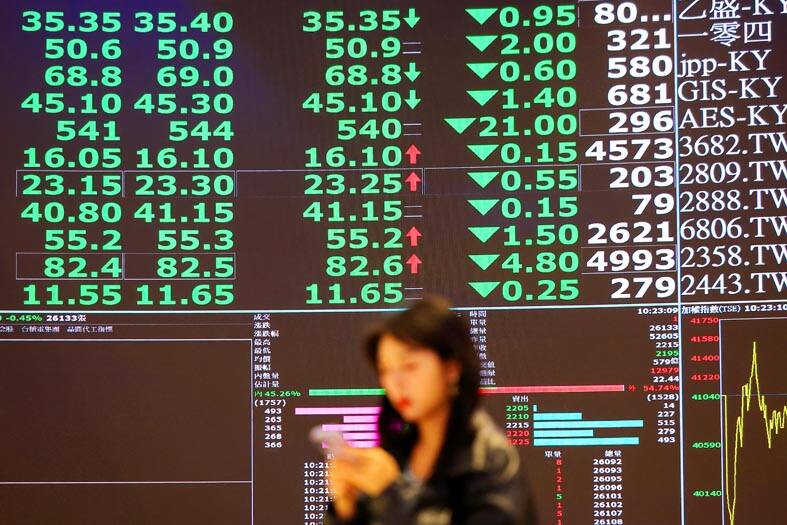
A woman stands in front of an electronic stock board at the Taiwan Stock Exchange in Taipei yesterday.
Photo: CNA
Smartphone chip designer MediaTek Inc Inc (聯發科) bucked the broader market’s decline, rising 1.19 percent, and iPhone assembler and AI server maker Hon Hai Precision Industry Co (鴻海精密) gained 0.23 percent.
“Judging from today’s roller coaster movement, I suspect the stabilization fund entered the market to smooth volatility after US technology stocks fell sharply amid concerns about AI development following Nvidia Corp CEO Jensen Huang’s (黃仁勳) resignation over extramarital affairs,” Hua Nan Securities Co (華南永昌證券) analyst Kevin Su (蘇俊宏) said.
“Moreover, the US Department of Commerce announced further restrictions on chip shipments to Southeast Asian countries, including Singapore and Malaysia, to prevent China from obtaining the chips, as concerns about a technology war intensified,” Su said.
He suspected that the stabilization fund had stepped in to limit the losses.
“I suspect the government aimed to help the TAIEX stand above the 40,000-point mark by buying large-cap tech stocks,” he said.
The TAIEX’s 2.31 fall yesterday followed a 6.03 percent decline in the previous session. Its loss on Monday was among the worst in Asia and part of a global retreat in chip shares due to Nvidia’s turmoil and funding pressure from Anthropic PBC’s upcoming mega listing.
Forced selling by retail investors also contributed to Taiwanese stocks’ steep selloff on Monday, a trend that could extend and pressure the market further, according to Barclays PLC.
The bank pointed to forced liquidation of long positions as the main culprit, with limited help from the National Stabilization Fund and short selling restrictions.
“With this week’s global tech risk events shaping up to be rather binary for the AI trade, we don’t see good risk reward yet in fading TWSE’s sell-off despite the index hovering at key support levels,” Barclays head of Asia equity flow derivatives sales Kaanhari Singh wrote in a note.
“We’re watching TSMC’s margin balance and retail positioning along with stronger signs of consistent National Team support as first two clues to change our view,” Singh added.
Barclays’ observation is a reminder of the risk from retail investors’ buildup of leverage, usually concentrated on AI stocks in tech-heavy Asian markets from Taiwan to South Korea, with the latter also suffering brutal routs this year when such bets unwound.
“Looking ahead, TWSE at an index level offers lower relative value in the current tape,” the note said. “Retail selling can still weigh on the index, especially in index heavyweights like TSMC and if the broader tech trade sees a rebound, we see better value in higher-beta indices than in TWSE.”
KioskNews shows a cleaned-up reading view extracted from the publisher’s page — the original always lives on their site, not ours.