Lanyon moved to block public watchdog hearings into police violence
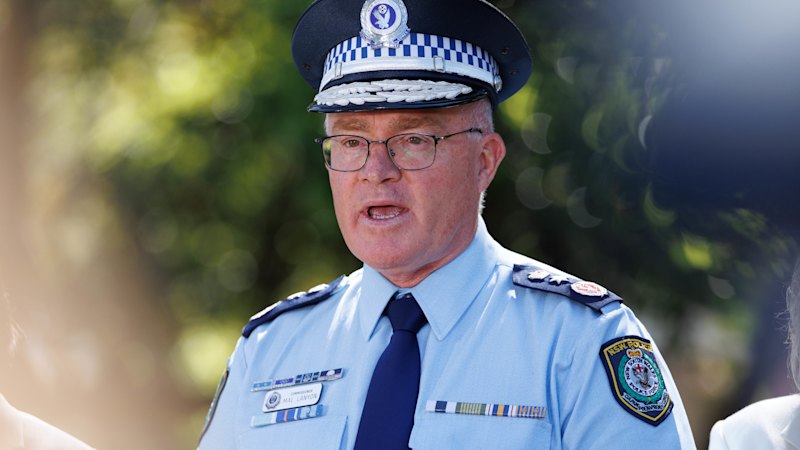
NSW Police Commissioner Mal Lanyon used an eleventh-hour intervention to try to prevent the state’s police watchdog from holding public hearings examining the conduct of officers during a demonstration against the visit of Israeli President Isaac Herzog.
The Law Enforcement Conduct Commission’s public examinations were due to start no earlier than September. On September 15, the commission said a “range of procedural issues” meant the Operation Makalu hearings would not proceed.
On Thursday, it announced they would begin after all, with an October 19 opening address. Private examinations will run for five weeks before public hearings of senior commissioned officers begin.
The probe will examine police behaviour after a series of violent clashes outside Town Hall in early February, including allegations of officer misconduct. Police face allegations they engaged in unnecessary brutality in dealing with protesters, with body-worn camera footage showing an officer revelling after a violent altercation.
More than 800 complaints were lodged over the way NSW Police handled Sydney’s anti-Herzog protests.
In a 63-page document released on Thursday detailing the rationale for using public and private hearings, the Law Enforcement Conduct Commission (LECC) revealed that Lanyon made submissions arguing witness examinations should be heard in private and not be livestreamed. His submission questioned “whether any examination is to take place in whole or in part in public”.
Lanyon’s submission argued that the police watchdog had “no express power” for counsel assisting – headed by Kirsten Edwards, SC – to make an opening statement.
In its submission to the commission, counsel assisting challenged Lanyon’s position that examinations should only be held in private and not livestreamed, arguing it would “leave the existing public account as the only public account until the commission’s report is published”.
The document noted the police commissioner had co-operated with the LECC, disclosing footage on September 7 collected from members of the public, which could be relied on during public and private hearings. It noted Lanyon “was not obliged to provide this substantial body of material ahead of the opening and examination”.
But the LECC said two days later the commissioner raised an issue about the use of public hearings. That challenge subsequently raised legal and factual arguments, “including legal arguments concerning the LECC Act never advanced before in the history of the commission and its work”.
The police watchdog noted there had been no objection raised from March 23, when Lanyon was first invited to participate in the commission’s investigation and the use of public examinations was foreshadowed, until the intervention in late September.
“The timing of these issues being raised by the commissioner of police is more than regrettable given its impact on the orderly progress of the investigation, the preparation for examinations and the efficient and effective use of public resources by both the commission and the NSWPF and the associated cost and disruption flowing from the delay,” the LECC wrote.
Sue Higginson, the Greens spokesperson for justice, condemned the six-month delay as an effort to derail the work being done by the independent police watchdog.
“This was an extraordinary attempt by the police to suppress the public examination of allegations of serious misconduct by uniformed police officers, and to prevent public scrutiny of the political decisions and command structures that led to police violence against protesters,” she said.
The commission, referring to the private evidence of a senior sergeant in mid-September, said the Operation Makalu investigation raised issues of a “potentially systemic nature” in the use of force in policing and in “the training, supervision and command” of the riot squad.
Police had raised concerns about officers involved in public hearings being identified, noting there was anxiety in attending these examinations and argued there was a potential “chilling effect” upon officers prepared to undertake public order work as a result of providing evidence.
However, counsel assisting the commission argued that “visible and fair accountability for the public order role is part of what sustains the community’s confidence in the NSWPF”.
The commission determined that at least some public examinations were appropriate, noting the large number of complaints lodged, and use of statutory powers exercised by police, but not all would be held in public.
“If the commission’s investigation was conducted entirely or almost entirely in public, it may have an adverse impact on the community by provoking community discord in a way that impacts negatively on social cohesion,” the LECC concluded.
Chief Commissioner Peter Johnson, SC determined that police witnesses up to the rank of inspector would not be identified during proceedings – they would be provided with pseudonyms – and their evidence taken in private examinations.
“I am not satisfied that effective measures can be put in place to guard against identification of those officers if their evidence is given in public,” he wrote.
NSW Police said it acknowledged the decision by the LECC to hold private hearings as part of Operation Makalu, and it awaited the findings.
The LECC has been publicly pushing for legislation to be strengthened to give it a “clear statutory entitlement” to access the information it needs to conduct investigations. This would allow the police watchdog to access crucial NSW Police documents.
Start the day with a summary of the day’s most important and interesting stories, analysis and insights. Sign up for our Morning Edition newsletter.
KioskNews shows a cleaned-up reading view extracted from the publisher’s page — the original always lives on their site, not ours.