Saudis probe how defense systems failed
TOO QUIET: The absence of public alerts prior to attacks this past week raises concerns about the country’s defenses and its ability to protect residents, officials and analysts said
Yemen’s Iran-backed Houthi rebels yesterday again blamed Saudi Arabia for airstrikes overnight that targeted areas along Yemen’s northern border with the kingdom and its western coastline, while Saudi Arabia has launched an investigation to determine how its air defenses failed to intercept a barrage of missiles and drones fired by Houthis.
The rebel-run al-Masirah satellite television yesterday said that two airstrikes hit the Houthi-held Red Sea island of Kamaran, while a third hit al-Qanawis district, 55km northwest of Hodeidah.
The station also reported airstrikes in the province of Jawf, which borders Saudi Arabia.
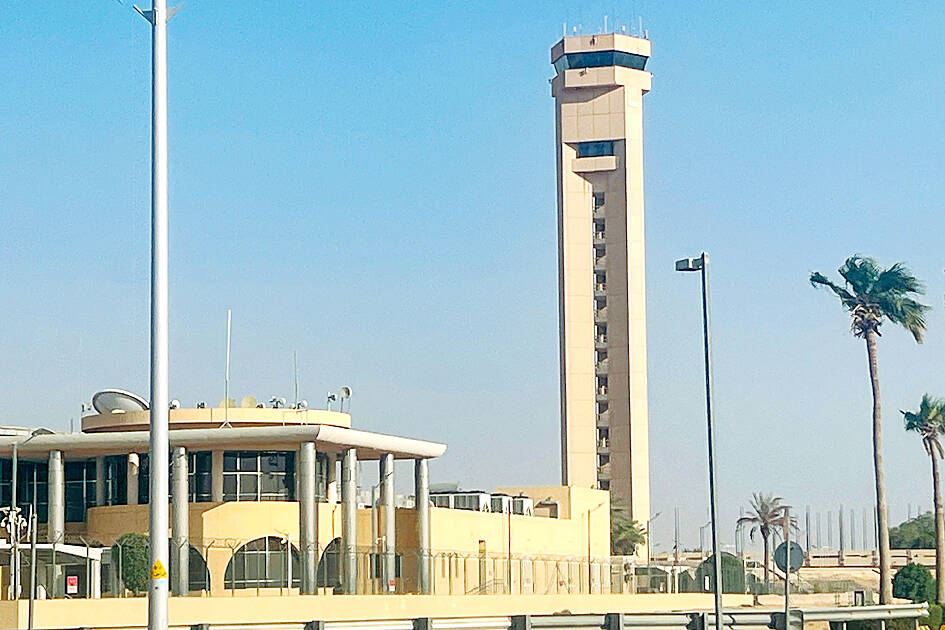
An air traffic control tower is seen at King Khalid International Airport in Riyadh on Sept. 19.
Photo: AFP
Al-Masirah blamed Saudi Arabia for the strikes, but did not provide further details.
Saudi Arabia did not immediately respond to the claim, but the strikes came hours after air raid sirens blared in the Saudi capital and explosions were heard.
Meanwhile, officials, who spoke on condition of anonymity because they were not authorized to comment publicly, said an initial probe showed that Houthis fired multiple drones to pave the way for a mix of cruise and ballistic missiles to reach Riyadh’s King Khalid International Airport, where at least 13 people were killed and more than 300 were wounded in attacks on Monday.
The Houthis possess ballistic missiles and advanced systems fitted with warheads that can change direction during flight and pose a challenge to Patriot interceptors and other defense systems used by the Saudis.
One of the officials said the investigation also aims to find out why air defense systems did not provide earlier warning of the attack in which the Houthi missiles and drones flew more than 1,000km to reach Riyadh.
The incident, one of a string of Houthi attacks since last week on Saudi airports, has exposed vulnerabilities in Saudi Arabia’s defense system and signaled a dangerous inflection point in an expanding Mideast conflict that began more than seven months ago when the US and Israel launched their war against Iran.
The Saudi-led coalition also said it had twice intercepted and destroyed ballistic missiles launched on Monday by the Houthis toward Riyadh. At least three explosions could be heard on Monday night in the city. Civil defense officials later said the danger had passed.
Saudi Arabia stopped issuing public warnings of imminent military attacks days before the series of deadly strikes on Riyadh airport, and the government has not said why there were no alerts in the past week.
The warnings had served to highlight the violence undermining the kingdom’s efforts to project an image of calm to its people and the world during its war with Houthis.
Their absence during the airport strikes raised questions about Saudi Arabia’s vulnerability to attack and about its ability to protect residents and visitors, four Western and Arab officials in the region and political analysts said.
It also reflected efforts to maintain a sense of normalcy, they said.
“They [the Saudi government] want to have it both ways: to launch a military operation and at the same time try to give confidence to the population and external stakeholders,” Middle East Policy Council senior resident fellow Sultan Alamer said.
KioskNews shows a cleaned-up reading view extracted from the publisher’s page — the original always lives on their site, not ours.