Where life happens: New exhibit showcases everyday moments when something goes wrong

"A concrete truck that got stuck in front of an exhibition opening at a gallery is much more than a concrete truck that got stuck,” says Matan Ben Cnaan. “It’s an encounter between worlds that can’t possibly meet.”
The painting is called Shitty Day, and it hangs in his new solo exhibition at Rothschild Fine Art in Tel Aviv: ‘Everything’s wonderful,’ I said. I lied. The mixer stands at dusk on a wet city street, its chute lowered to the sidewalk. Beside it, a gallery window glows yellow, and figures crowd the light of an opening night. Outside, in the dark, a man stands with his back to us, a phone at his ear. On the asphalt behind the truck, a red warning triangle.
“I have a friend who tells me, ‘I think you’re the only painter or artist who’s interested in a concrete mixer,’” he says.
Ben Cnaan asks us to read Shitty Day like a detective. “It’s evening, so he’s probably been stuck there for many hours, because nobody pours concrete in the evening, you do it very early in the morning. And what happened to the concrete? It’s supposed to harden. He has already started unloading it onto the sidewalk, and he’s standing there, stuck, on the phone. It becomes a whole story. And it comes from trying to feel him, what helplessness this is.”
The exhibition, which runs until October 10, is full of moments like that one. It gathers some two dozen paintings, most of them painted this year and most of them small. In the title painting, a man standing in a narrow kitchen holding plastic shopping bags looks down at what has spilled on the floor at his feet.
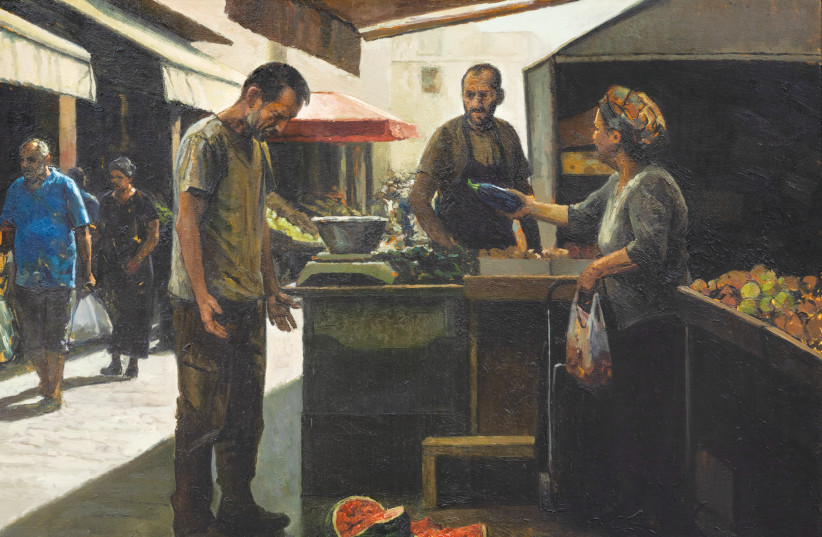
Ron Bartos, who wrote the exhibition text, calls them “incident paintings”: a car stuck, fuel spilled, a watermelon split open on the floor of a market, someone waiting, someone angry, someone leaving. Not much happens. But something has already gone off balance.
BEN CNAAN (b. 1980) won first prize at the BP Portrait Award at the National Portrait Gallery in London in 2015 for Annabelle and Guy, the first Israeli to do so. The painting, which shows his friend Guy and his stepdaughter Annabelle in the blinding light of the Jezreel Valley, was inspired by the biblical story of Jephthah’s daughter. In 2017, he won the Haim Shiff Prize for Figurative-Realist Art, which brought a solo exhibition at the Tel Aviv Museum of Art.
Ben Cnaan made his name with large, meticulously staged scenes
In 2021, the Israel Museum showed his monumental painting The Bureaucrat (2018-2020), 2 by 4 m., alongside a text written about it by David Grossman, and in 2024, the Negev Museum of Art in Beersheba held a solo exhibition of his work. He teaches at Bezalel Academy of Arts and Design and at the University of Haifa, and his paintings are held in public and private collections in Israel and abroad.
Ben Cnaan made his name with large, meticulously staged scenes, many of them biblical stories recast with present-day Israelis. For The Bureaucrat, he assembled close to 100 people in a field and directed them, down to the last detail. The new paintings were found rather than staged, on the way to taking his children to school, by staying awake and attentive. “To listen with my eyes, with my whole body really,” he says. “Suddenly, in this marginal event, something happens that is much bigger than the event itself.”
In Not the Eggplant’s Problem, a man stands under the awning of a market stall, palms turned out, looking down at the watermelon that has just slipped from his hands and burst on the ground. The vendor looks at him. Next to him a woman, unmoved, holds out an eggplant to be weighed. Behind them the street is white with sun. The man stands in the shade, and the red of the split fruit at his feet returns in a market umbrella over his shoulder. “This moment, his watermelon smashed,” Ben Cnaan says. “But the eggplant doesn’t care. There’s also this humor in our DNA.”
“There’s a second of disaster,” he says. “You stand in front of the watermelon that exploded. What now? What do you do?” After October 7, he admits, he kept measuring such moments against the national catastrophe. “You come in with a kind of proportion. You got stuck for a moment, so what? But then you understand that such small things can happen to you that for you, right now, they are the worst thing in the world.”
The show’s title comes from Mashina’s 1990 hit “Az Lama Li Politika Achshav” (“So why do I need politics now”), written by Shlomi Bracha. “This specific line is so loaded,” he says, “because there’s a kind of self-recognition in it. He understands that he’s living in an illusion, that he said everything is fine, but everything is not fine.”
And it is not only about him. “It’s all of us. We lie to ourselves about a lot of things because it’s convenient to say everything is good. But no, everything is not good. There will only be hope if we acknowledge it.”
Choosing how to look at the world is political
THE WORKS are not political in the Left-Right sense, he says, though choosing how to look at the world is political, too. “In that sense, it’s very political. But it’s not a David Reeb painting. I don’t know how to bring the right arguments. There will always be someone who argues better. I know how to look with my own eyes and feel where it meets me: injustice, alienation, helplessness. And that is not a place for arguments.”
The formats have shrunk, some panels no bigger than 23 sq.cm., painted in oil on birch and linen. “Supposedly it’s easy to work small, but it really isn’t,” he says. “To suddenly squeeze a world into something so small, where every brushmark determines an expression. You have to be very, very precise.” When he first saw the gallery space, he admits, his knees buckled, and the works grew a bit since.
In Annabelle and Guy, the light of the Jezreel Valley is almost blinding. In the new paintings, most of the space is dark, and the light does the work. It comes from one place, a gallery window, a gap in the shutters, a sunlit street beyond an awning, and the figure often stands just outside it.
Many of the scenes have also moved indoors, into the artificial light of a garage, a laundromat, a food stall, a shop, or a room, and the crowd of The Bureaucrat thins to single figures, couples, and small groups. The staging, Bartos writes, remains as meticulous as ever, and what is left is what is essential: the lighting, the gestures, the relations between the figures, the objects, and the brushwork. Many of the paintings are silent. In one after another, the figure lowers its gaze.
Bartos points to Ben Cnaan’s virtuoso brushwork and an exceptional command of light and composition. Up close, the realism loosens into thick, quick strokes: the reflections on a wet street, the fruit in a crate, a curb painted yellow and blue are laid down in dabs of paint that settle into a scene only from a step back.
A shirtless man stands against a sunlit white wall, his skin burned copper, while a policeman beside him writes in a notebook. On a country road at sundown, a man leans on the door of a broken-down car as a young woman waits at the edge of the asphalt, her shadow stretched across the road. In a dim room, a shaft of greenish light cuts through the shutters onto a man at a piano, his back bare, while a woman watches from the doorway.
At times, Bartos notes, the silence gets a voice through the titles. Some are everyday speech: Nothing to Fix Here, You Here Too?, C’mon, What Am I Going to Do With You? Others come from musical memory, like Pretty Yardena and the exhibition title itself.
'I need to distill a moment that contains past, present, and future'
WHEN I TELL HIM his paintings look to me like films, he agrees at once. “It’s totally cinema,” he says. “But I’m not lucky. I don’t have the sequence, an hour and a half, 10 minutes, even one minute of development. I need to distill a moment that contains past, present, and future.”
One of the films that shaped his thinking is Quentin Tarantino’s Reservoir Dogs, where for long minutes the viewer doesn’t know what happened in the robbery, and then understands it doesn’t matter. “Everything that happens inside this hangar, that arena becomes the story itself,” Ben Cnaan says. “It’s the world.”
Take Nothing to Fix Here, in which a group of men gathers around a Volkswagen van stranded in a field. “You could make an hour-and-a-half film about three brothers, or three friends, who set out on a journey,” he says. “How do I turn that into one painting, so that it’s an hour-and-a-half film in one frame? That’s the challenge I keep trying to crack.”
David Grossman once told him that writers have the luxury of hundreds of pages. “I don’t have that luxury. I need one frame, one brushmark sitting in the right place, and that changes everything.” He thinks of Edward Hopper. “I don’t need all the thousands of tiles on the roof. I need the red roof in that place. My thing is to clean, clean, clean, so the viewer doesn’t get lost in a forest of details that don’t serve the essence.”
He is jealous of directors, he says, and would study directing now if he could. Staging The Bureaucrat, he had to improvise. “I don’t have 70 actors who prepared and read a script,” he says. “We gather in the field, I tell them the big thing, then I take key people aside. And then I see someone who isn’t quite there, and I whisper in his ear: You’re in line at the health clinic, the wait is getting longer, and you start losing patience.” Back in the studio, with thousands of photographs, he directed the scene all over again.
The Canadian photographer Jeff Wall also stages his pictures, catching the moment a man sticks out his leg and another man falls in the street. For Ben Cnaan, that is alienated. “I want to see the man who stuck out his leg, a moment after the other one has fallen. What is he thinking? Wait, what did I do? I didn’t even realize I’d stuck my leg out. What did I do? I acted on instinct. That’s the moment that preoccupies me. Now how do I reconstruct it, how do I stage it all over again? How do I touch it?”
He distinguishes between pity, “my tool for distancing myself from reality,” and compassion. “The hard one is compassion. There you have to be all in. You have to be able to feel the other person’s pain.”
BUREAUCRACY, THE SUBJECT of his monumental painting The Bureaucrat, is in his view “the policeman of compassion.” What preoccupies him is the moment a person stops seeing the human being in front of him, and the systems and procedures that make that possible.
He follows that question from any clerk behind a window all the way to Adolf Eichmann, not out of compassion for the perpetrator. “He was born a child. What led him to the point where he became arbitrary and murderous? I’m trying to understand at what stage he lost this thing.” He asks it of himself too, going back to his army service. “I didn’t hold up in every situation.”
Technique, for him, is never an end in itself. “The technique serves my voice,” he says. “Need is the mother of invention, and need is what justifies every brushmark.”
Visitors ask him why the people in his paintings are so sad. Not everyone is sad, he says; inside the darkness there is a lot of light. But a laughing figure is flat, and so is a crying one. “That happy figure, the glamorous Instagram profile, and you know it’s not a good life. I lied, exactly. So where does life happen?”
He answers himself: “In the middle.”
‘Everything’s wonderful,’ I said. I lied.■
Rothschild Fine Art, 2 Moshe Maor Street, Tel Aviv.
Until October 10. For details: rgfineart.com
KioskNews shows a cleaned-up reading view extracted from the publisher’s page — the original always lives on their site, not ours.