Yilan residents file suit to slow HSR review
WORRIES PILE UP: The planned extension would generate nearly 10 million cubic meters of excavated soil, the disposal of which has not been explained, a former EPA official said
By Esme Yeh / Staff reporter


Yilan County residents, backed by civic groups, on Wednesday filed an administrative lawsuit to overturn the environmental impact assessment (EIA) approval for the Yilan-bound high-speed rail (HSR) extension.
They filed the lawsuit after the Executive Yuan on Sept. 11 rejected an administrative appeal.
Former Environmental Protection Administration (EPA) deputy minister and lawyer Thomas Chan (詹順貴) said the project’s EIA review was one of the hastiest he had ever seen during his 30-year career in environmental law.
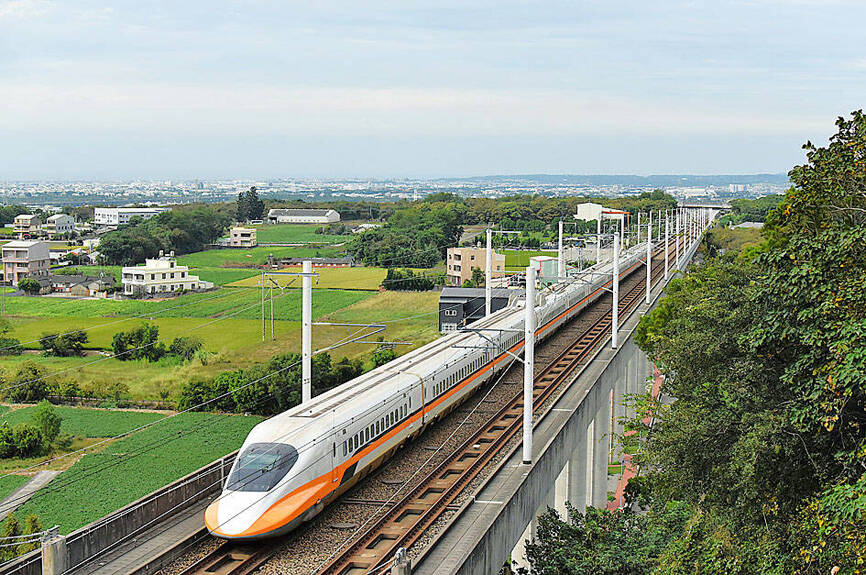
A high-speed rail train is pictured in an undated photograph.
Photo: Wu Liang-yi, Taipei Times
Construction of the line would generate nearly 10 million cubic meters of excavated earth and rock, the disposal of which has not yet been explained to the public, he told a news conference at the Taipei High Administrative Court on Wednesday.
Although Chan describe the project as being more than 90km long, the Railway Bureau puts its length at 60.6km.
An earlier Taipei-Yilan direct railway plan for a 36km route through the Feitsui Reservoir (翡翠水庫) watershed with much less excavated soil was rejected during environmental review in 2006, Chan said.
The new project would also involve a proposed 420-hectare district near the HSR Yilan station, for which the precise extent of farmland expropriation remains undetermined, he said.
Such a large-scale agricultural land expropriation seems unnecessary and might attract land speculation, he said, adding that the special district near the Taichung HSR covers less than 300 hectares.
Most land in the proposed station district is within a local special agricultural zone, he said.
The project would affect the agricultural environment and agricultural workers’ livelihoods, but those issues were not addressed in the EIA, Chan said.
Many EIA committee members have expressed concerns over excavated soil disposal, route planning and the impact of the extension on Taiwan Railway Corp’s operations and Taiwan High Speed Rail Corp’s finances, he said.
Nevertheless, the project quickly passed its second-stage EIA review without properly addressing these concerns, Chan said.
The Railway Bureau on Aug. 30, 2019, submitted a comprehensive Taipei-Yilan direct railway plan — in which the line would run parallel to Chiang Wei-shui Memorial Freeway (Freeway No. 5) — to the Ministry of Transportation and Communications, which requested an assessment of the HSR extension option three months later, and on Nov. 22, the bureau began assessing an HSR extension, former transportation minister Hochen Tan (賀陳旦) said.
“That was a crude decision,” he said.
The HSR extension project did not initially undergo a separate feasibility study before comprehensive planning, a procedural choice Hochen criticized, although subsequent reviews involved the National Development Council.
The project also used what he considered disproportionate assessment weighting in comparisons of railway route options.
It gave low weighting to assessment criteria, such as transportation time reduction (0.054), traffic distribution (0.045) or construction costs (0.026), while the weighting for impact on water-source protection areas was disproportionately high (0.145), Hochen said.
He said a 2005 EPA-commissioned study showed that Freeway No. 5 had little effect on water quality in the protected watershed, an interpretation later questioned by the Control Yuan.
“The cross-sectional area of railway is smaller than the freeway’s and would have less of an impact,” he said.
KioskNews shows a cleaned-up reading view extracted from the publisher’s page — the original always lives on their site, not ours.