Aichi-Nagoya Asian Games comes to a close in vibrant but muted fashion
NAGOYA – A quick burst of pyrotechnics lit up the night sky above the Paloma Mizuho Stadium on Oct 4 as the 20th edition of the Asian Games came to a close in vibrant fashion with a 90-minute closing ceremony.
But the visibly striking rows of empty seats amid a muted atmosphere at the venue perfectly encapsulated the continental meet in Japan.
For more than two weeks, Tokyo and Nagoya witnessed world records, standout performances and high-quality sporting action, but also sparse crowds and a string of organisational issues.
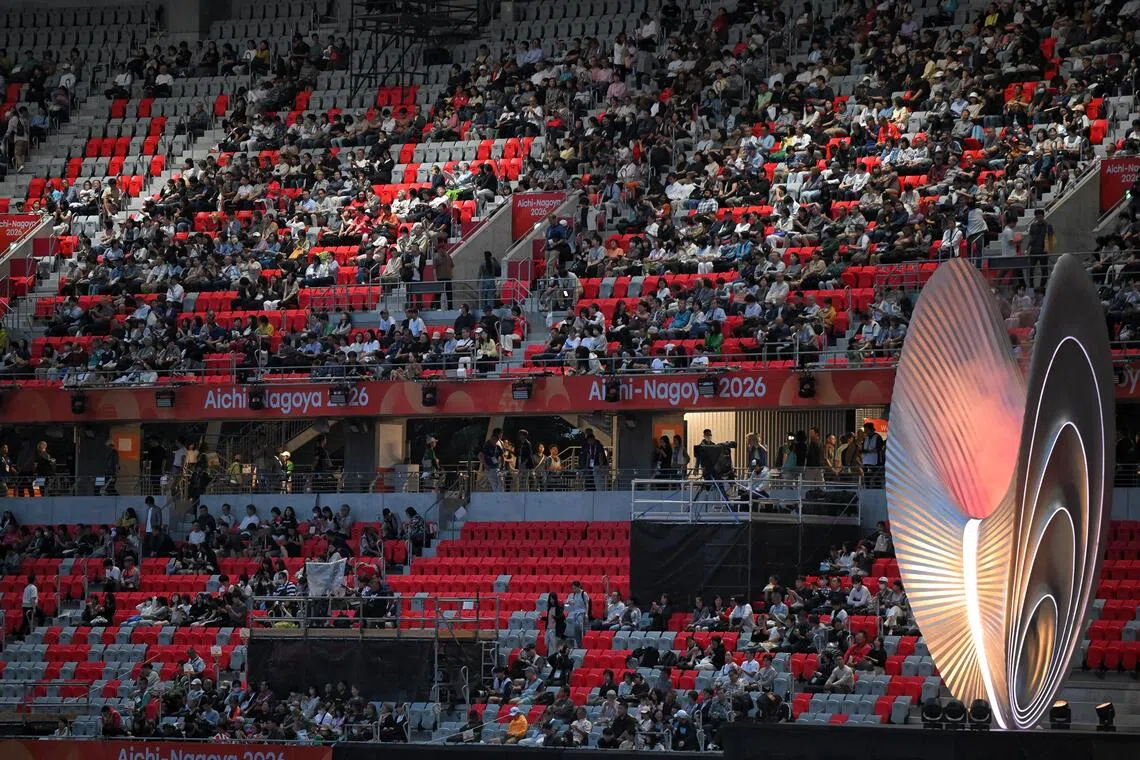
Empty seats in the stands at about 15 minutes ahead of the Asian Games closing ceremony held at the Paloma Mizuho Stadium in Nagoya, Aichi, on Oct 4.
ST PHOTO: MARK CHEONG
Japan’s return as Asiad host marked the first time in 32 years that the nation has staged the Games since the 1994 edition in Hiroshima.
But even before the Games officially opened, the event was beset by a host of logistical issues, ranging from a shortage of accommodation to unsatisfactory conditions on the cruise ship and in the temporary wooden containers housing athletes.
Several issues persisted during the Games as complaints from disgruntled teams continued with transport and accommodation difficulties and further mix-ups with anthems and flags.
Organisers formally apologised to the South Korean delegation after North Korea’s national anthem was mistakenly played before a men’s hockey match on Sept 18.
On Oct 3, South Korea’s Asian Games football captain called it “disappointing” after the country’s flag appeared to get stuck during the victory ceremony after they beat Japan in the final. Footage showed ceremonial officials struggling to raise South Korea’s flag on the flagpole, sparking boos from South Korean fans.
Adding to these issues were sparse crowds at most events. At the women’s football semi-final between hosts Japan and South Korea, there were 998 spectators in a 50,000-capacity stadium.
But these Games did not disappoint on the sporting front.
More than 50 world records were broken in sports including swimming, shooting and weightlifting while there were more than 70 Asian records surpassed, according to the Olympic Council of Asia.
Japan’s return to hosting duties also yielded a record-breaking haul of medals for the host who amassed a total of 269 medals – 83 gold, 95 silver, and 91 bronze. This surpassed both their previous record of 78 gold medals set at the 1966 Bangkok Games and their previous largest tally of 218 medals at the 1994 edition.
Perennial powerhouses China topped the medal table once again with 169 gold, 89 silver, and 83 bronze medals, continuing their streak of leading the quadrennial competition since the 1982 edition.
A whopping 54 medals – 30 golds, 13 silver and 11 bronze – were won in swimming alone by China.
Underlining their domination in the pool was swimmer Yu Zidi, who was named the Games’ female Most Valuable Player (MVP) on Oct 4.
The 13-year-old prodigy won all three of her individual events, and all in Games-record times, as she triumphed in the women’s 200m butterfly, 200m individual medley and 400m individual medley.
Yu, who will be 15 when the 2028 LA Olympics comes around, is likely to be a major medal threat.
She said after her latest award: “I will continue to train hard, push myself and work alongside young athletes across Asia to inspire more young people to love and take part in sports, especially swimming.”
Thailand’s double gold medallist Puripol Bonsoon was named the male MVP, after breaking the Games record twice en route to clinching the 100m crown and winning the 200m title in an Asian record-equalling 19.88sec.
The 20-year-old said: “I’m very happy and very honoured, for my family, my country, and the Asian running community. Hopefully we can do even better and fly the flag even higher on the global stage. I already plan to defend my titles.”
Team Singapore, led by flag bearer and men’s rugby sevens athlete Marah Ishraf, had 91 athletes and officials at the closing ceremony.
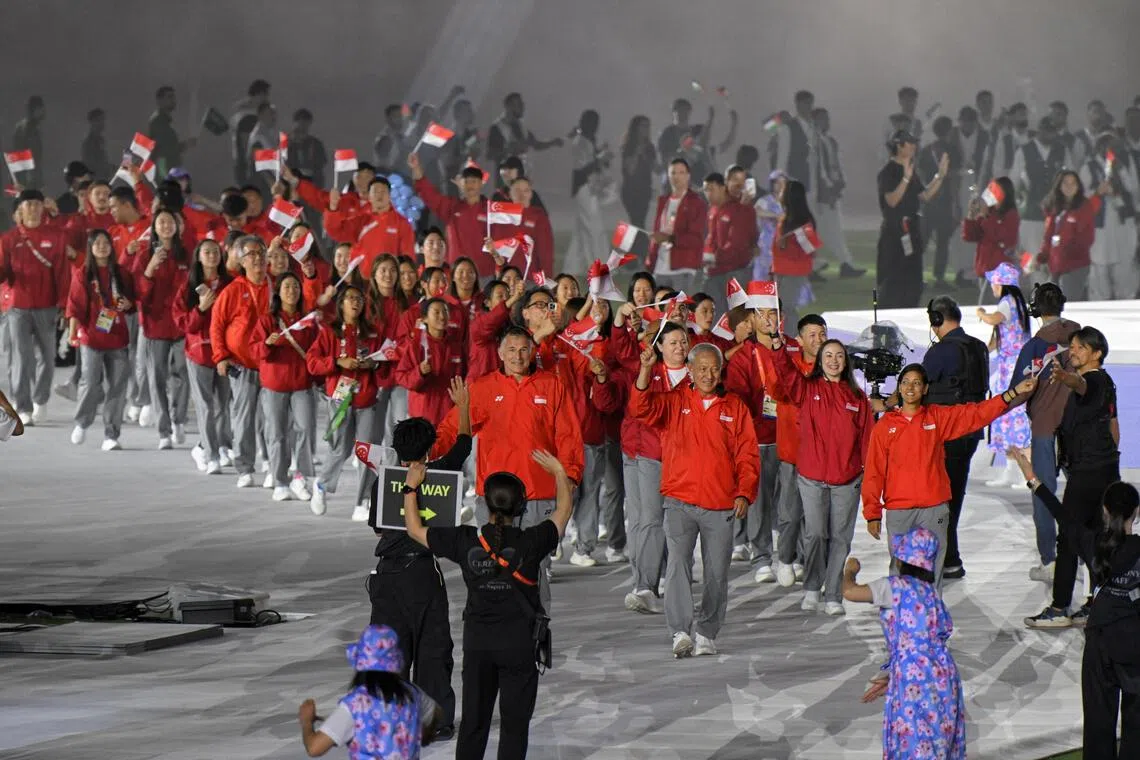
The Singapore contingent marches out during the Asian Games closing ceremony held at the Paloma Mizuho Stadium in Nagoya, Aichi, on Oct 4.
ST PHOTO: MARK CHEONG
Marah described it as a “moment I’ll cherish for the rest of my life”.
He added: “I am not only representing rugby but all sports in Singapore, and this will be one of the greatest honours of my sporting journey.
“This Asian Games has been an unforgettable experience. I am grateful for this opportunity and for my family’s unwavering support. I can’t wait to return home and share these memories with my kids.”
The Republic fielded 300 athletes and finished 21st out of 46 teams.
Shanti Pereira’s successful and historic defence of her women’s 200m title – which was featured in a highlight reel of the Games’ best moments on the two large screens here – and a maiden gold medallist in mixed martial arts exponent Tiffany Teo meant that Singapore ended with two gold, nine silver and seven bronze medals.
One of the highlights of the ceremony was when Qatar’s equestrian athlete Jassim Al Kuwari rode in on a horse with the Olympic Council of Asia flag.
On a night which also featured spectacular light displays, vibrant performances and a celebration of Japanese culture, the symbolic finale came when the Asian Games flame – the cauldron that was lit up at the opening ceremony – was extinguished, marking the end of the Asiad as the baton was passed to Qatar, which will host the next edition in Doha.
Then, in a festive farewell, performers, athletes and officials broke into the Bon Odori, a traditional Japanese folk dance before Matsuken Samba II, a Japanese pop hit was performed by Japanese singer Ken Matsudaira.
The stadium gradually emptied and media and attendees filed their way out with smiles on their faces.
After the Tokyo Olympics took place largely behind closed doors in 2021, the return of live sporting action and ceremonies offered a refreshing experience for athletes, fans, and media alike, despite the logistical challenges.
KioskNews shows a cleaned-up reading view extracted from the publisher’s page — the original always lives on their site, not ours.