‘Half my day’s pay goes to filling up my car now’: diesel crisis ripples across Britain

The smoke rising from the Kapotnya oil refinery to the south-east of Moscow marks one of Ukraine’s biggest air raids on the Russian capital since the start of the war, and the latest salvo in an energy crisis that threatens to affect households and businesses across the globe.
More than 1,500 miles away, British motorists are braced for the ripple effect from that conflict, and the US-Israel war on Iran. Average UK diesel prices are expected to reach record highs within days – while across Europe and the US, pump prices have already surpassed all-time highs.
In a call on Sunday, Donald Trump pressed Ukrainian president Volodymyr Zelenskyy to halt strikes on Russian refineries over concerns that the attacks are pushing up global fuel prices, the Financial Times reported. On Truth Social, Trump said Russia has “unfortunately lost control of its Diesel Oil Industry” and called for an end to “this ridiculous and never ending war”.
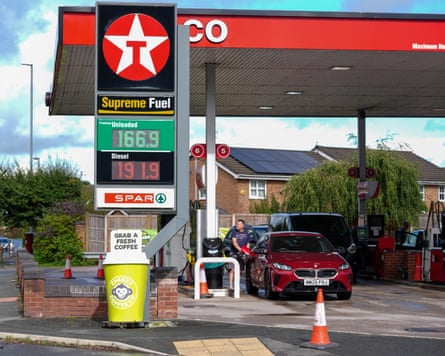
While Brent crude oil prices remain in flux – down nearly 3% at just over $100 a barrel on Monday - already hard-pressed households and small firms face a far greater cost threat at forecourt pumps as the combined impact of Russia’s war-damaged refineries and the Middle East crisis has erased about a fifth of the world’s diesel supplies.
“Around half my day’s pay goes to filling up my car now,” says Jon Barden, a former humanitarian adviser turned handyman, who says his fuel costs have doubled. His diesel Ford estate, once used for camping trips, is now used to carry heavy tools to jobs around Tottenham in north London.

Across Britain’s forecourts, the average price of diesel has climbed by 54% to 196.28p a litre since the Middle East crisis began in late February. It is expected to reach a record £2 a litre within days, with some forecourts already charging above the psychologically important mark.
In Europe, pump prices have already hit record highs in recent weeks, leading to unrest and growing calls for government leaders to protect consumers from the surge in cost.
While the popularity of fully electric and hybrid petrol vehicles may be on the rise in the UK and Europe amid attempts to move away from polluting fossil fuels, diesel remains the overwhelmingly dominant fuel. It is the single biggest cost for many independent traders and small business owners, powering transport, tools and services. It is also the economic lifeblood for farmers, and logistics and haulage businesses, layering costs on to grocery bills and consumer purchases.
“I’ve had to put my prices up,” says Barden. “I don’t want to because the people around here don’t have a lot of money. But when fuel prices go up everything else follows. The things I need to buy from Wickes to do a job will cost more before I even fill up,” he says.
In part, the surge in fuel prices is due to the rise in global oil prices following Iran’s effective blockade on the Strait of Hormuz, a vital trade route for Gulf oil. The price of Brent crude has climbed to a four-year high, raising the cost of refined oil products such as diesel and gas oil.
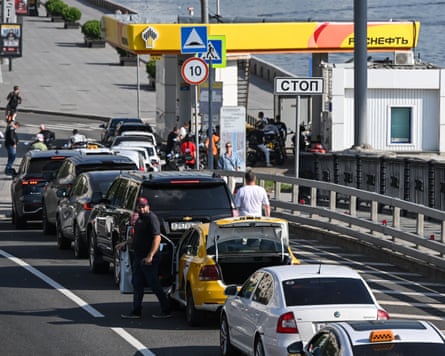
Yet the most pressing energy crisis is not a shortage of crude, but a shortage of the refining capacity to turn crude into the fuels consumers need. The Middle East crisis has severely damaged to many of the region’s refineries, which once supplied 10% of the world’s fuels. What little can be produced has struggled to circumvent the blocked trade artery.
Output from Russia’s war-damaged refineries has fallen by almost a third over the past year to reach a 20-year low following sustained drone attacks by Ukraine, according to the International Energy Agency. The latest strike on Kapotnya came after a similar attack by Ukraine in June.
Although Russian oil exports have been subject to toughened EU sanctions since 2022, a reduction in exports to other parts of the world, including Asia, is likely to push up global prices.
In China, which hosts the world’s largest refining capacity, and had been the largest importer of Iranian crude, exports of refined oil products have been capped since March to safeguard the country’s domestic supply.
The global refining slump has helped to keep oil market prices down by dampening the demand for crude. But this is cold comfort for economists who warn that the ‘crack spread’ – or the price difference between crude oil and its refined products – has climbed above $100 a barrel on the continent for the first time and is likely to rip through the economy by raising the cost of all transported goods, as well as household bills.
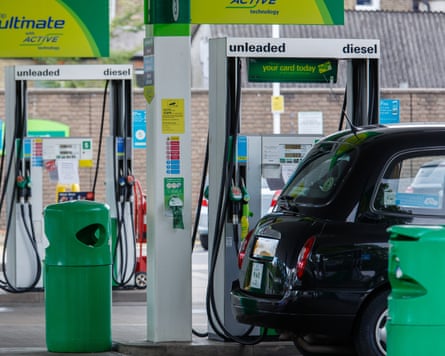
Diesel in particular is “the workhorse fuel that powers business, haulage, deliveries and rural communities”, according to Luke Bosdet, the AA spokesperson on fuel prices. “Increased fuel costs are passed on to customers, and then on to consumers, which adds to inflation.”
While sales of new diesel passenger cars have plummeted over recent years as motorists increasingly opt for petrol, hybrids, and electric vehicles, the UK’s consumption of diesel has continued to climb because of its role as a crucial industrial fuel.
“Almost everything on supermarket shelves got there on a lorry,” Richard Smith, the managing director of the Road Haulage Association said. “When diesel goes up that cost has nowhere to go but on to the price of goods.”
The AA’s chief concern is for “small businesses, such as taxis and vehicle-based services, and rural communities who already do higher mileages even before diesel costs went through the roof”, Bosdet adds. “They don’t get to add diesel surcharges to invoices, like many of the big companies, for fear of losing customers.”
Mehmet, from Clacton, began driving black cabs in central London 35 years ago. “When I first started, diesel cost 10 bob a gallon,” he laughs. In modern terms this would be 11p a litre, or a fraction of the looming £2 a litre average expected nationwide within days, while cab fares remain capped.
Diesel taxis are easily outnumbered by EVs in London, but they still make up about a third of the black cabs. Drivers were told in February that they would be allowed to raise their fares by 4% this year. At the time, the rise was above inflation – amid concerns over an exodus of black cab drivers. However, the US-Israeli bombardment of Iran ignited a war that has caused fuel costs to surge and inflation to remain well above the Bank of England’s 2% target, at 3.1% last month.
“We’re stuck with it,” says Mehmet. “We don’t want the meter price to go up, because then we lose custom. But we can see oil companies making billions in profit while we take home less. How can that be right?”
The UK may be acutely exposed to the global squeeze on road fuel supplies. The number of refineries in the UK has dwindled since the start of the century from nine to four, causing the UK’s reliance on diesel imports to climb from 14% of the UK’s diesel consumption in the early 2000s to 54% last year, according to Fuels Industry UK.
Elizabeth de Jong, chief executive of Fuel Industry UK, said: “Our latest annual statistics, published earlier this week, show that UK demand for petroleum products increased by 1% in 2025 to almost 61m tonnes, while the closure of the Grangemouth and Lindsey refineries reduced UK refining capacity by almost a quarter.
“We are currently having to import about 55% of our road diesel, meaning a growing dependence on overseas supply. Global events such as the conflict in the Middle East demonstrate the vital role that UK refineries play and why they are crucial to our economy,” she said.
KioskNews shows a cleaned-up reading view extracted from the publisher’s page — the original always lives on their site, not ours.