Minimum safety standards, independent testing are a must to build trust in AI: UN special envoy
SINGAPORE - As artificial intelligence models grow more capable and autonomous, building trust based on minimum safety standards, independent testing and open sharing of cybersecurity incidents is no longer negotiable.
Amandeep Singh Gill, the United Nations Under-Secretary-General and Special Envoy for Digital and Emerging Technologies, made this call on the opening day of the 11th Singapore International Cyber Week on Oct 13.
In his special address attended by tech executives, government officials, cybersecurity professionals, he said: “Trust in our domain is often treated as a soft concept...in this AI world, trust should be seen as hard infrastructure.”
Specifically, he called on every nation to build a minimum safety infrastructure, citing Singapore’s AI Safety Institute as a model.
The institute, which was established in 2024, develops evaluation methods to test frontier and generative AI models for risks like data leaks, cybersecurity threats, fraud, and harmful content. It also tests whether AI safety guardrails and filters hold up across languages other than English.
Other countries like the UK have also build AI safety infrastructure that works with the private sector to tackle threats and keep policymakers informed, said Gill.
He added that such efforts needs to be expanded to the rest of the world, regardless of whether the country develops their own, borrows or buy AI models.
Gill also called for the development of minimum standards for AI testing similar to accounting and financial standards, and for independent auditors to be certified to identify acceptable AI baseline behaviour and actions.
“Perhaps most importantly, we need sharing of information, incident reporting, and transparency...this cannot be done through ad-hoc arrangements,” said Gill.
He cited a multilateral AI risk management framework proposed by UN secretary-general Antonio Guterres in September as an example of an international mechanism to oversee such sharing. The proposed framework aims to establish global consensus on AI governance.
To that end, Singapore in September joined more than 20 countries and the European Union to sign a declaration calling for binding international government oversight and control over frontier AI models to replace corporate self-regulation.
During the UN General Assembly held in New York that month, Singapore’s Foreign Affairs Minister Vivian Balakrishnan also proposed a UN framework convention on AI safety.
Developing testing standards and human oversight over AI is crucial in building up trust in the technology, said Gill, adding that trust should no longer be viewed as a “soft concept”.
“We trust a digital system when we can understand what it is designed to do, can test what it claims is being done...and when the system fails, human beings retain the ability to intervene,” said Gill.
He cited public trust in AI as one of the biggest obstacles to adoption of the technology, and added that people need to be able to trust outputs, and governments need to be able to trust systems deployed in critical sectors that are developed in other countries.
During a keynote address at the conference, US White House national cyber director Sean Cairncross said trust is the foundation to America’s cooperation between the government and private sector, which designs, builds, and operates systems that modern society relies heavily on.
“True sovereignty in the digital age is measured by the capacity to defend one’s own networks, protect critical systems, and ensure that supply chains remain free of adversarial influence and hidden dependencies,” said Cairncross.
He also called on nations to strengthen their own defences so as to reinforce the broader network of allied security.
“The new cybersecurity reality cannot be turned over to the international institutions or global governance frameworks with slow-moving, bureaucratized deliberation, or appeasing indecision. It must and will be shaped by trusted and willing partners who refuse to wait for the lowest common denominator agreement.”
Gill and Cairncross were among the first speakers on the first day of SICW. The three-day conference is expected to draw over 15,000 attendees from 90 countries and regions who will discuss the growing impact of AI on cybersecurity, diplomacy and international cooperation.
A panel discussion moderated by Singapore’s chief AI officer He Ruimin on Oct 13 saw foreign government officials and industry representatives agree on the need for evaluation frameworks, external testing, and for all stakeholders to be held accountable in the safe deployment of AI.
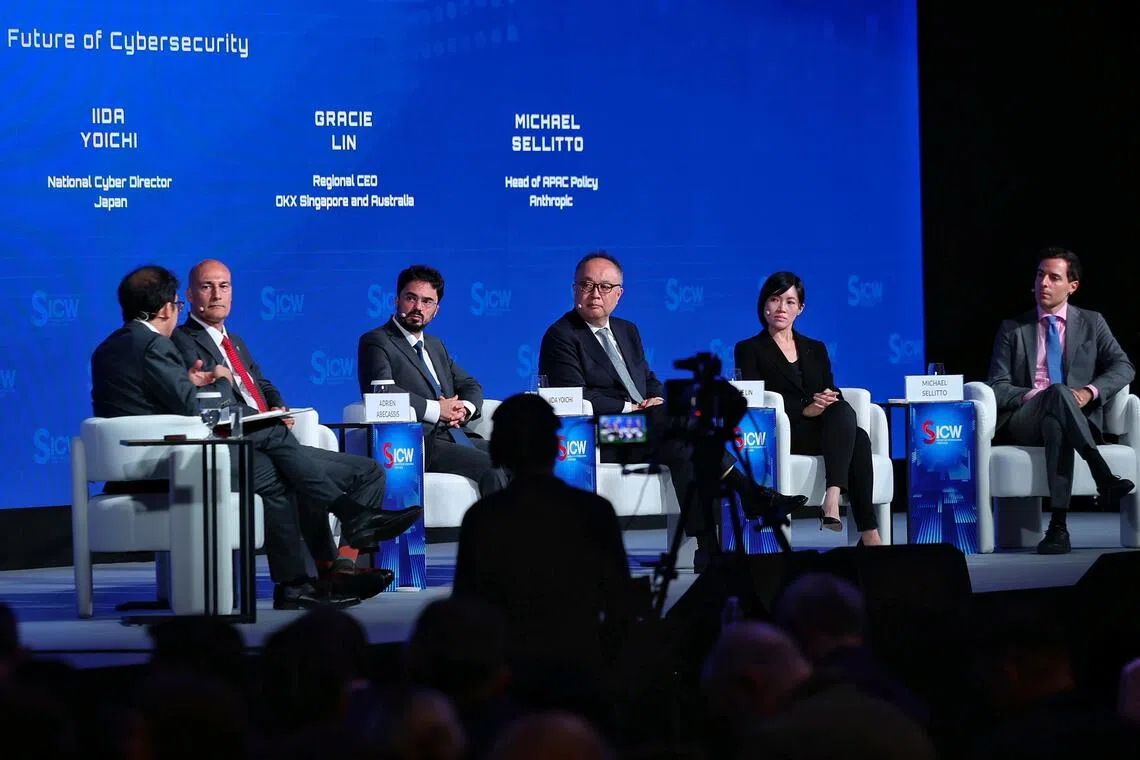
A panel discussion at SICW on Oct 13 saw foreign officials and industry representatives agree on the need for external testing and accountability across all stakeholders to oversee the safe deployment of AI.
ST PHOTO: KEVIN LIM
“The important thing for us is not to redo what the developers and independent third-party evaluators have already done,” said panelist Gracie Lin, regional chief executive of crypto exchange OKX Singapore and Australia.
She added that companies should receive sufficient access to test AI models based on their individual use case.
Asked who should take more responsibility when an AI system is exploited in a cyber attack, Anthropic’s head of Asia-Pacific policy Michael Sellitto said it depends on factors such as whether the system was deployed in a way that was intended.
“I think it’s very difficult to say in advance, there’s going to be this exact liability (framework) that’s going to apply in all scenarios, as models can be used for really everything and anything. So I think it’s very fact specific.”
KioskNews shows a cleaned-up reading view extracted from the publisher’s page — the original always lives on their site, not ours.