How Bengal’s Durga Puja came full circle: From private patronage to public celebration and back
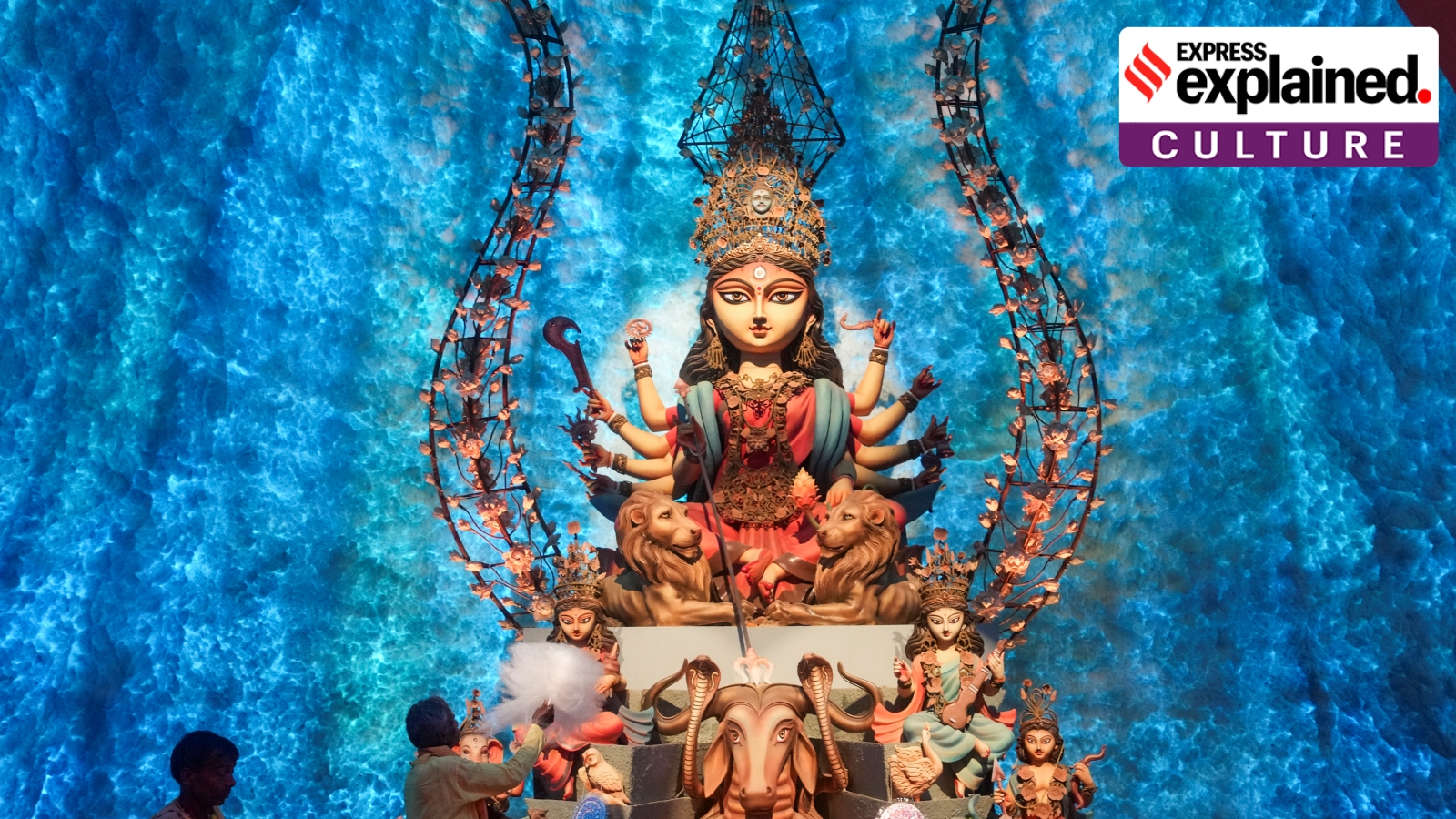
It began as a private ritual within the estates of zamindars and aristocratic families. Today, Durga Puja is a mass cultural phenomenon, generating an estimated Rs 50,000-65,000 crore in annual economic activity in West Bengal alone (roughly 2.5% to 3% of the gross state domestic product).
The latest chapter in the festival’s centuries-long evolution — from private puja to neighborhood community initiatives to “themed” art spectacles — appears to be its shift back towards private money. The past several years have been marked by the festival’s deepening corporatisation, especially in West Bengal. Private companies are moving beyond simple banner sponsorships to direct patronage, such as the Adani Group’s Rs 2-crore grant programme this year.
Here is a deep dive into how Bengal’s grandest festival went from elite household ritual to a corporate-funded economic engine.
Bonedi puja: Worship in aristocratic households
The documented history of organised Durga Puja in Bengal goes back to the early 17th century. The Sabarna Roy Choudhury family’s puja in Kolkata’s Barisha is traditionally dated to 1610. And in 1757, Raja Nabakrishna Deb is also believed to have organised a puja at Shobhabazar Rajbari in Calcutta, around the time the East India Company established its dominance in Bengal. Deb’s mansion still hosts what is known as “Company Puja”.
During this era, the worship was fully funded by aristocrats using agricultural surplus and trade wealth. Wealth was redistributed locally through feasts, donations of clothing to tenant farmers, and seasonal employment for traditional drum beaters (dhakis), potters and priests.
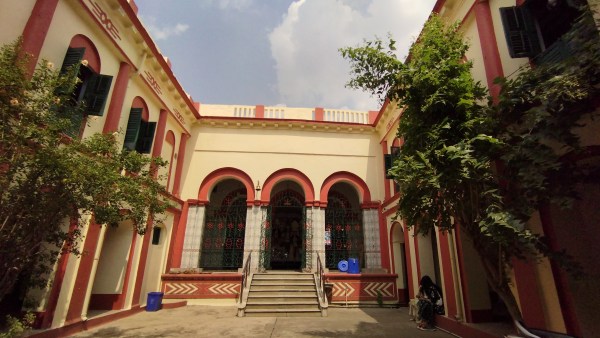 A ‘bonedi puja’ site in Bengal’s Chinsurah town. (Express)
These celebrations took place within private Thakur Dalans (courtyards for worship in zamindari homes). Although commoners were allowed to view the deity, ownership and access rested firmly with the feudal landowning elite.
Story continues below this ad
Soumit Narayan Deb of Sobhabazar Rajbari Pujo told The Indian Express: “Culturally, there is no difference then and now. One difference is that when this puja started, it was the era of monarchy. So, that grandeur is no longer there. Earlier, a fair used to be held for a month; now there is no fair.”
Another difference has to do with animal sacrifice. “Earlier, goats were sacrificed, because this is a puja where blood is required on the day of Navami. This practice was stopped in 1858 by Sir Raja Radhakanta Deb Bahadur, who took pity on the animal,” said Deb. From the following year, only magur mach, or catfish, were sacrificed.
These bonedi (or aristocratic) pujas still retain their appeal. Deb says the Sobhabazar Rajbari Pujo, organised with a budget of Rs 30 lakh, attracts a footfall of lakhs each year.
The barowari shift: Beginning of community puja
By the late 18th century, a different tradition emerged — that of the barowari puja, or community Durga Puja. The story goes that twelve friends in the village of Guptipara in Hooghly collected public donations to organise a community-led puja in 1759, breaking away from aristocratic patronage.
Story continues below this ad
The name of the format, according to folk etymology, comes from the word baro (twelve). By the time the trend reached Kolkata, most notably with the Balaram Bose Ghat Road Durga Puja in 1910 and Bagbazar Sarbojanin in 1919, it had fundamentally democratised the festival.
Funding shifted entirely to neighborhood subscriptions, making the local community both the primary funder and owner. During the independence movement, these public pandals frequently served as grounds for nationalist mobilisation and social solidarity.
The 1990s and the rise of themed pujas
By the mid-1990s, economic liberalisation transformed urban spaces across Kolkata. The conventional idol-and-pandal setup gave way to conceptual public design, led by art college graduates and visual artists who turned temporary structures into immersive installations. Pandal construction shifted from basic canvas and bamboo setups to elaborate architecture reproducing global and regional heritage.
Story continues below this ad
Idol styling moved from traditional ekchala clay work (a style where the Goddess and her four children are modeled together beneath a single arch) toward conceptual, multi-material sculptures.
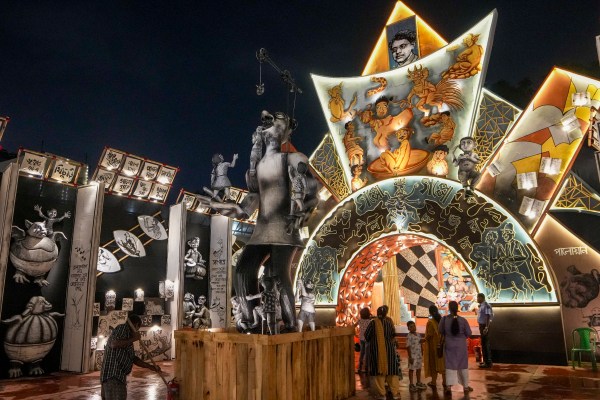 A Kolkata Durga Puja pandal themed on the poems of Sukumar Ray. (PTI)
To fund this transition, committees pivoted from relying solely on local subscriptions to securing corporate sponsorships, title advertisements and brand tie-ups, engaging a specialised labour force of architects, interior designers, lighting engineers and sound specialists.
Creative economy and UNESCO recognition
In 2021, UNESCO included Durga Puja in its Intangible Cultural Heritage list, recognising its growth as a global cultural platform. A baseline study commissioned by the British Council estimated the creative economy surrounding Durga Puja in West Bengal at Rs 32,377 crore in 2019, a figure that has grown to an estimated 65,000 crore in later, broader trade assessments.
Story continues below this ad
This economic footprint is distributed across retail and fashion (accounting for nearly 35-40% of festive spending), food and beverage services, event production, creative design, and corporate media advertising.
Commercialisation and the Adani entry
Corporate involvement in the festival initially relied on traditional banner advertising, gate sponsorships, and brand-sponsored award competitions. Recent years, however, have seen major changes.
A clear example is the Adani Group’s Aagomoni initiative, which introduced direct structural grants of Rs 25 lakh each to eight selected puja committees across Kolkata, Bidhannagar and South Dum Dum. Out of these grants, specific funds were earmarked directly for artists, sculptors and lighting architects — thus infusing corporate capital directly into the creative production process. Additionally, the introduction of curated, invitation-only “preview shows” prior to official public inaugurations points towards the emergence of an access economy tailored for crowd-free viewings.
One such puja committee is Telipukur Nagerbazar Yubak Sangha which was selected and given a grant by the Adani Group.
Story continues below this ad
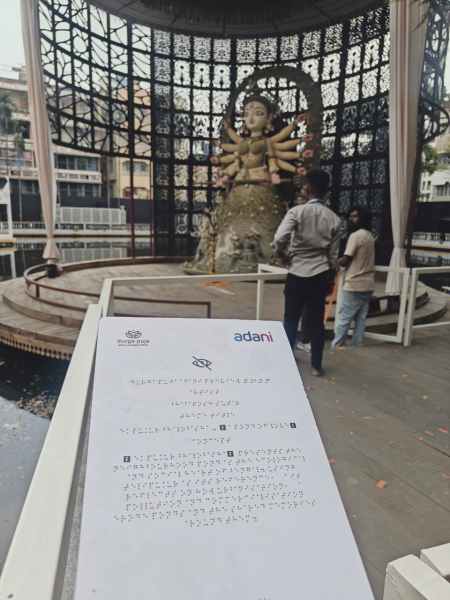 The Telipukur Nagerbazar Yubak Sangha pandal, which received a grant from Adani. (Sweety Kumari)
Shubham Saha, additional secretary of the club, denied that tickets were being sold to people to view the puja. “A preview show was also held for crowd-free viewing before the inauguration. Durga Puja in Kolkata can never be so commercialised that people are asked to pay to visit a pandal. It is not someone’s puja, it is everyone’s puja,” said Saha. “Artists applied for the Adani Group grants, and eight pujas were selected. The company awarded Rs 10 lakh to the artists and Rs 15 lakh to the puja organisers,” he said.
The micro-economy behind the festival
While the headlines focus on multi-crore budgets and corporate grants, the festival also functions as a vital micro-economic livelihood engine across multiple tiers of informal labour.
Clay modeling hubs in Northern Kolkata, such as Kumartuli, generate their primary annual income during the four-month manufacturing window leading up to the festival. Rural illumination networks, particularly in Chandannagar, employ thousands of electricians and programmers who design specialised light displays.
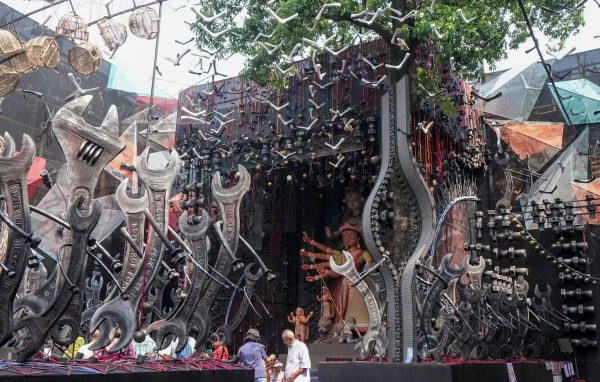 A ‘theme’ pandal Kolkata. (PTI)
Rural artisans from districts such as Midnapore, South 24 Parganas and Bankura spend months in Kolkata constructing complex pandals. Food stall operators, hawkers and local transport drivers experience significant income spikes throughout the five days of festivities. “On a single day of puja, I sell 15,000 phuchkas, earning about Rs 50,000,” said Ram Yadav, a phuchka-seller outside a famous Dumdum Park puja pandal.
Story continues below this ad
The growing involvement of major corporations through direct grants and sponsorships reflects Durga Puja’s evolution into a major economic enterprise, well beyond the festival’s cultural and religious significance.
KioskNews shows a cleaned-up reading view extracted from the publisher’s page — the original always lives on their site, not ours.