Chandrayaan-3 finds 3 distinct layers in Moon’s soil
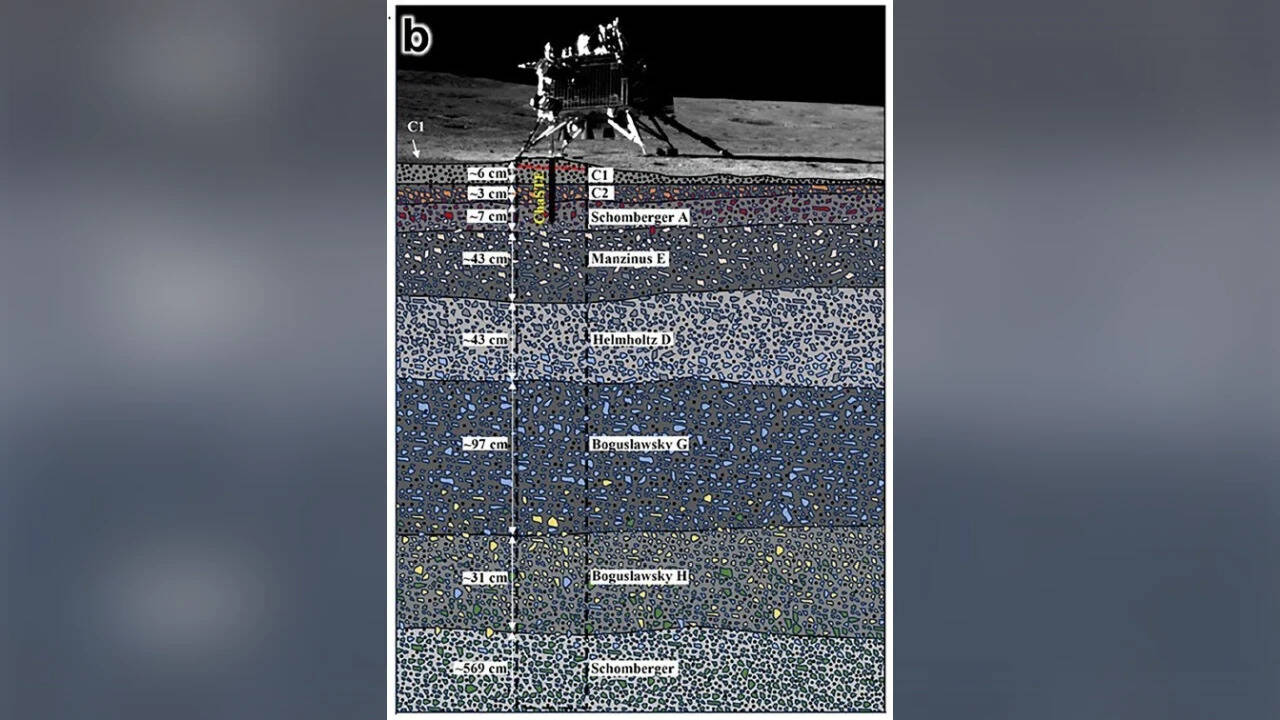
Proposed sequence of impact events that may have formed the layered soil at Chandrayaan-3’s landing site (Shiv Shakti Point).
BENGALURU: The Moon's surface may look like a uniform blanket of dust and broken rock, but what lies just beneath it is more complicated than scientists had expected. An analysis of data from Chandrayaan-3's Vikram lander has revealed three distinct layers with different physical and thermal properties within just 10 cm of the lunar soil at Shiv Shakti Point.The finding, published in Nature Portfolio journal npj Space Exploration, is based on observations by the Chandra's Surface Thermophysical Experiment (ChaSTE). The study, led by K Durga Prasad of Physical Research Laboratory (PRL), Ahmedabad, identifies a highly porous upper layer extending to about 3 cm, a middle layer between 3 and 6 cm with higher thermal conductivity, and a denser bottom layer between 6 and 10 cm with intermediate thermal conductivity.The researchers argued: “What we have found is that the regolith is not uniform even within the top 10 centimetres. It has very different geotechnical and thermophysical properties at different depths. Such fine-scale layering was neither observed nor expected earlier.”The discovery also builds on the team's earlier work published in April, which analysed ChaSTE measurements after Vikram's historic hop manoeuvre.
The lander's engine firing had disturbed the uppermost 2–3 cm of soil at the new location, exposing the underlying layers. That study identified a two-layer structure. The new analysis of measurements from the original, pre-hop location has now revealed the complete three-layer profile, including the extremely porous surface layer.The uppermost soil has an estimated porosity of about 80% and a bulk density of around 600 kg per cubic metre.
Its density increases to about 1,500 kg per cubic metre at 10 cm. The soil's cohesion also rises with depth, reaching about 1,350 pascals at 10 cm, substantially higher than estimates from earlier lunar missions.The findings offer the first direct thermophysical profiling of the Moon’s southern high-latitude region. One striking observation is a temperature gradient of about 73 kelvin across the top 10 cm at local noon, with the three layers responding differently to solar heating.The researchers propose that successive impact events involving nearby craters, including Schomberger A, C2 and C1, may have deposited material with different properties, producing the fine-scale layering. This is a geological interpretation based on modelling and analysis of the surrounding terrain.
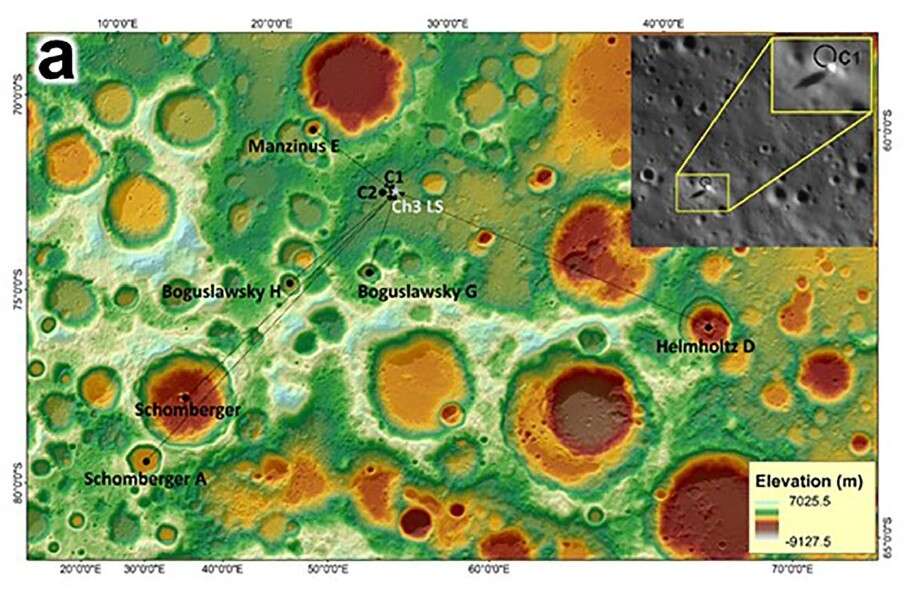
Location of craters whose ejecta may have contributed to the layered soil at Shiv Shakti Point.
The implications extend beyond understanding lunar geology. The porosity and thermal conductivity of shallow soil can influence whether water migrating into the subsurface is retained or lost through sublimation.
“Every location can be unique. The amount of water retained could depend significantly on the shallow subsurface structure,” as per researchers.The temperature profiles could also help engineers identify suitable depths for future habitats and equipment. A few centimetres below the surface, temperature variations can be markedly different from those at the top, potentially reducing the need for active thermal management.
For future lunar missions, the study provides an important ground-truth reference against which scientists can assess other landing sites. It also offers constraints for modelling the Moon's shallow subsurface, an area where knowledge has so far depended largely on laboratory studies and theoretical estimates.
KioskNews shows a cleaned-up reading view extracted from the publisher’s page — the original always lives on their site, not ours.