Generation of Australian cricketers at war as sandpaper scars ripped open
After brewing for years, the storm of “Sandpapergate” is now raging again in all its fury, and a generation of Australian players is officially at war.
Eight years on from the Cape Town ball-tampering scandal, the fall-out has returned to the front and back pages with almost as much ferocity.
Lingering resentment over the price paid by a select few has placed long-time teammates and friends at odds and relationships may never properly recover.
In a press conference that was extraordinary for its 68-minute duration as well as its subject matter, Test captain Pat Cummins may have hoped to settle the simmering dispute with Usman Khawaja and David Warner about the events in South Africa.
As it turns out, it has only escalated tensions – quite possibly to the point of no return.
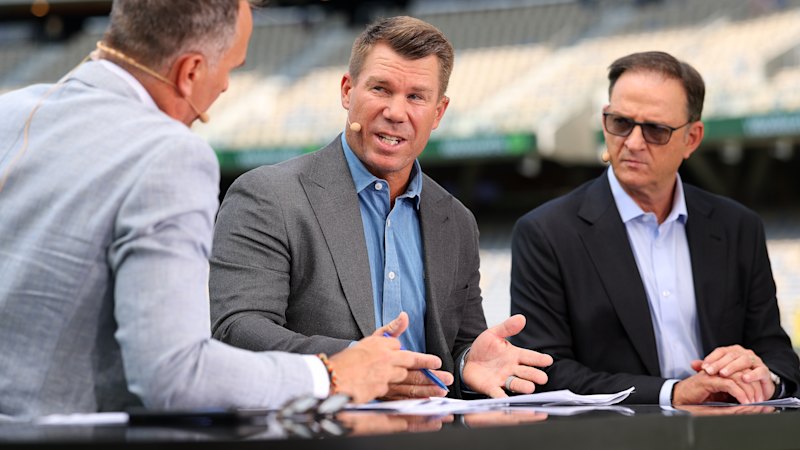
Flanked by fellow ex-players Adam Gilchrist, Mark Waugh and Michael Vaughan on a pre-game Kayo Sports panel before Friday’s one-day international between Australia and England in Perth, Warner came out firing like he did in his pomp with the bat.
Accusing Cummins of throwing Khawaja “under the bus” with his criticism of the batsman over claims in his new book, Warner declared he was not prepared to “move on”.
Warner was banned for a year as the so-called architect of the plot to use sandpaper on the ball in Cape Town in 2018, while then captain Steve Smith was also suspended for a year and Cameron Bancroft copped nine months.
“We’ve been served a life punishment, so when other people have talked about [how] they’ve been affected by it, there’s nothing worse for me, Steve and Cameron, who have to walk out there every single day and we cop abuse,” Warner said.
“Yes, we accepted it. But at the end of the day, my wife and I paid a great price as well. We lost a baby [to a miscarriage] during that time, and that’s why it really hurts me the most until the truth is accepted.”
Warner has backed allegations in Khawaja’s memoir that there was broader knowledge among the Test team of Australia’s cheating than just that trio, and that Bancroft also used sandpaper to alter the condition of the ball in the second Test of the series as well as the infamous third match at Newlands.
Cummins’ rejection of Khawaja’s claims, strongly denying any prior knowledge of the use of sandpaper or attempts by the Australian team to tamper with the ball, has only wound him up more.
“Each person can have their differences, but I’m not going to accept them until the truth is out there,” Warner said.
“There’s a lot more detail there that I think Uzzie speaks about in his book that is very hard to grasp that people don’t know.”
The former vice-captain has been stewing on the treatment dished out to him, Smith and Bancroft ever since and has been freed to go on the front foot publicly after Khawaja, his childhood friend, took up the strike.
He is not only seething about the sanctions dealt out and the ring-fencing of three players as the culprits on day three in Cape Town, but also about what he perceived as the indifference of teammates towards the trio in subsequent years.
“I think the main part about this is in that eight years not one of those people that were in that change-room besides those three have spoken to us about that,” Warner said.
“I think that’s the mateship that we talk about, the honesty that you have with each other. There’s been no contact or questions about it. We’re all adults and we’re open to conversation, we’re open to that.
“I’ve played golf with Pat Cummins a couple of times. I’ve been in the change-room since then and played some World Cups, and it’s just never been questioned or asked about. At the end of the day, Pat’s not going to agree with me, I’m not going to agree with him. He’s obviously spoken about what he thinks about Uzzie’s book, but I stand by Uzzie’s comments.”
With Cricket Australia refusing to re-open an investigation that Khawaja and Warner alleged was rushed and botched, the prospect of reconciliation appears slim.
The result is that the long shadow of Sandpapergate will continue to linger. Warner will keep campaigning for redress and will at some stage release a book of his own, in which he will no doubt come out swinging.
Others might also have their say. Smith and Bancroft are yet to weigh in about the contents of Khawaja’s book, although Cummins said he had spoken to Smith and indicated he wanted to move on from it all.
Then there is back-up bowler Chadd Sayers, who has also thrown his weight behind Khawaja, saying he believes what he said, but has not gone into detail about what he and others knew.
The bottom line is there will never be consensus over awareness of the cheating plot, but that doesn’t mean there won’t be more to the story.
The broader subject of who was ultimately to blame is one area that merits further examination.
Warner, Smith and Bancroft were all guilty in their own way, but they were also products of a broken system which, with the benefit of hindsight, was careering towards an inevitable cliff.
On this front, Cummins gave a little ground on Friday, pointing to the existence of “silos” within the team at the time and an atmosphere of “lawlessness” during the South Africa series when asked how he felt about the trio taking the rap.
“Perhaps there’s some guilt maybe from how the team was, but then three people got punished for the actual act,” the fast bowler said, conceding the penalties were “way over the top”.
KioskNews shows a cleaned-up reading view extracted from the publisher’s page — the original always lives on their site, not ours.