Impeachment court OKs presentation of dollar accounts in Sara Duterte trial
Make this your preferred source to get more updates from this publisher on Google.
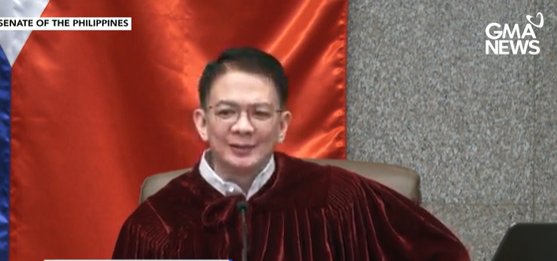
Senate impeachment court presiding officer Francis Escudero on Monday denied the objection to present foreign currency-denominated accounts in the trial of Vice President Sara Duterte.
This was after Senator-Judge Imee Marcos objected to Anti-Money Laundering Council (AMLC) Executive Director Ronel Buenaventura, a witness presented by the House prosecution panel, reading details on a non-peso account during the trial.
“It’s very, very clear, well established in both the [former president] Erap [Estrada] and [former chief justice Renato] Corona impeachment that foreign currency accounts are excluded,” Marcos said.
Escudero, however, maintained in an extended ruling that the confidentiality afforded to foreign currency deposits does not exempt it from the reporting and inquiry provisions under Republic Act No. 9160 or the Anti-Money Laundering Act.
Citing Section 76(2) of the Bangko Sentral ng Pilipinas’ Manual of Regulations on Foreign Exchange Transactions, the presiding officer said that the absolutely confidential nature of foreign currency deposits under the Foreign Currency Deposit Act shall not apply to a covered institution that reports foreign currency deposits in covered transaction reports or suspicious transaction reports to the Anti-Money Laundering Council (AMLC), pursuant to Section 9(c) of Republic Act No. 9160, as amended.
“Thus, the suspicious transaction reports or covered transaction reports submitted to the AMLC do not acquire the status of absolute confidentiality merely because they contain information concerning foreign-currency deposit accounts,” Escudero said.
“In Republic of the Philippines v. Sandiganbayan, the Court ruled that the AMLC cannot invoke the confidentiality provisions under the AMLC to prevent disclosure of information on covered and suspicious transactions. The Court did not distinguish between peso and foreign-currency-denominated transactions,” he added.
Escudero also clarified that the impeachment court is not, at this point, compelling any bank or covered institution to disclose information concerning foreign-currency deposits maintained by the Vice President.
He said Buenaventura is only being asked to testify on records and financial information that are already in his lawful possession, through reports submitted by covered institutions to his office.
“The confidentiality of foreign currency deposits cannot operate to place information lawfully reported to the AMLC beyond the reach of the impeachment court,” the presiding officer said.
“A contrary interpretation would be untenable. While covered institutions are required to flag transactions regardless of currency denomination to the AMLC, and are, in that instance, exempt from the confidentiality provisions of the FCDA. The AMLC, despite being the government body legally authorized to receive and analyze those reports, would be prevented from explaining or authenticating lawfully acquired information before a competent tribunal,” he continued. —AOL, GMA News
KioskNews shows a cleaned-up reading view extracted from the publisher’s page — the original always lives on their site, not ours.