India’s Asian Games medal map changed: 20 Hangzhou golds gone, 13 new routes to gold
India’s Medal Route to Gold
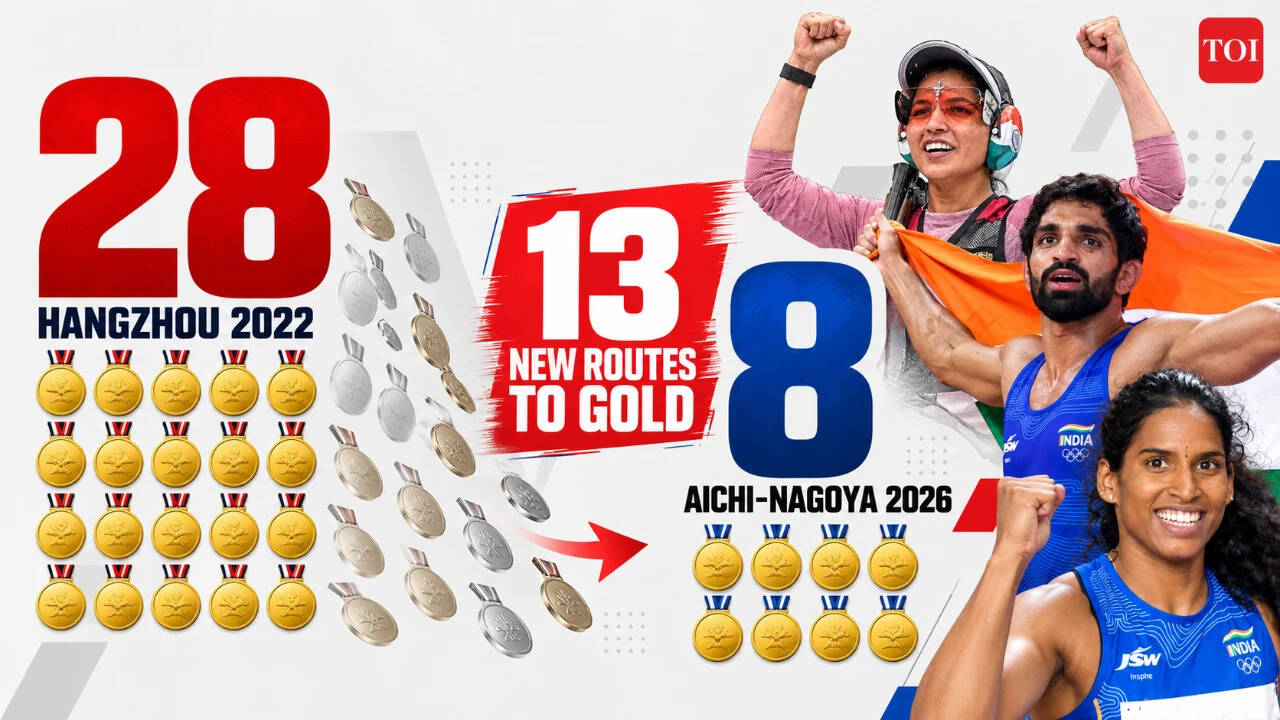
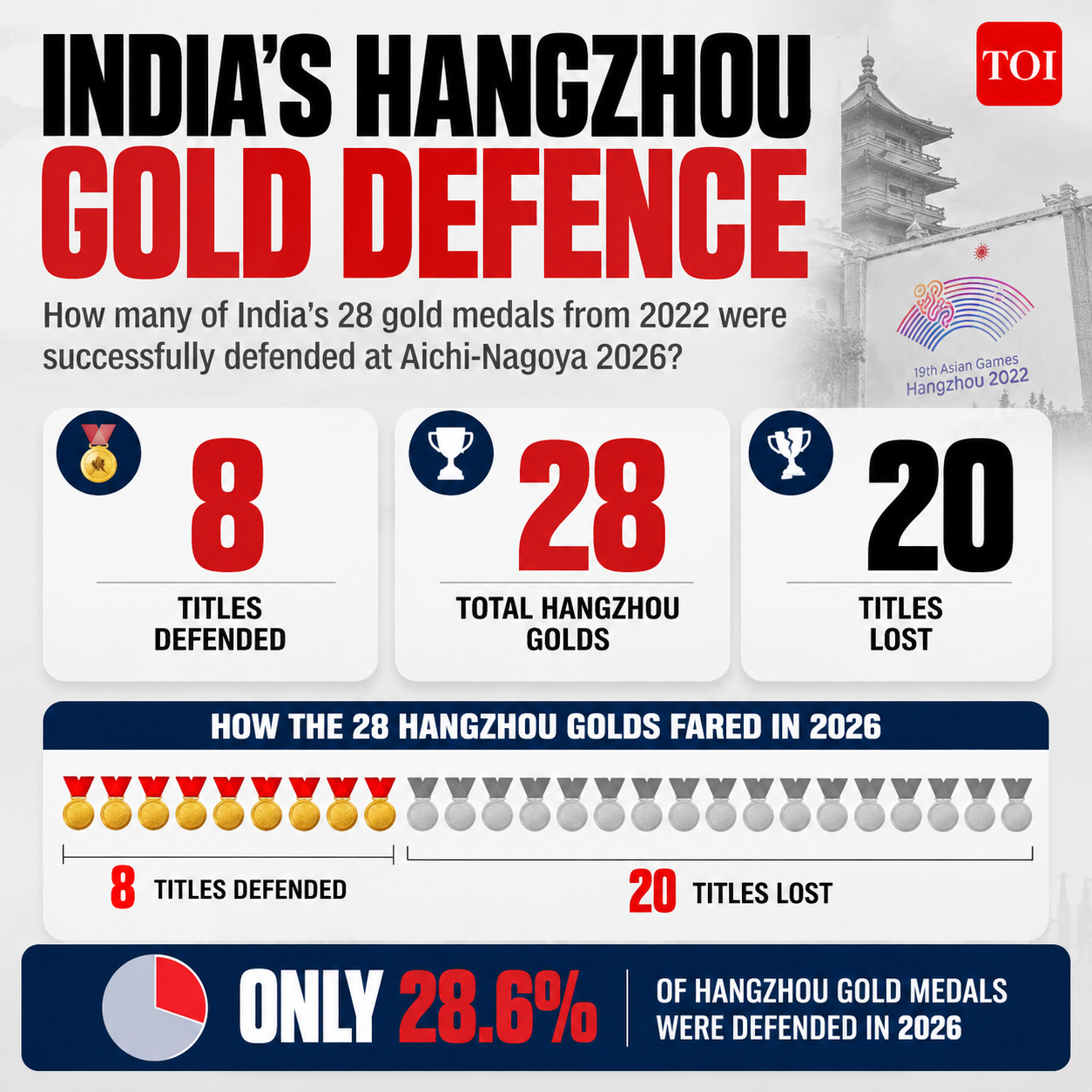
NEW DELHI: India won 28 gold medals at the 2022 Asian Games in Hangzhou. Four years later, the question in Aichi-Nagoya was how many of those titles it could retain. The answer? - Eight, out of the 28 Hangzhou golds.
That’s 28.6 per cent of the total. Twenty titles changed hands.The biggest changes came in the sports that had driven India's record campaign in Hangzhou. All seven shooting golds were lost, while all six athletics titles changed hands and, India also failed to retain either of its two individual compound archery golds.But just the gold-medal count does not tell the whole story. India retained the three compound team archery titles, both kabaddi golds, both cricket titles and the men's hockey crown.
The other golds came from a different mix of events and athletes. Some had won silver or bronze in Hangzhou and moved up to gold in Japan. Others won titles in events where India had not been on the podium four years earlier.So while 20 of India's 28 Hangzhou champions failed to retain their titles, the gold medals themselves were replaced from a much wider pool. The Aichi-Nagoya campaign, in that sense, was less about defending the Hangzhou haul and more about how India's medal map had changed in four years.
India’s Gold Defence
Shooting: from seven golds in Hangzhou to three in Aichi-Nagoya
While Shooting had produced seven golds and 22 medals for India at Hangzhou, In Aichi-Nagoya, the overall medal tally fell to 15. The gold count dropped from seven to three, while silver moved from nine to eight and bronze from six to four. The biggest change was that none of India's seven Hangzhou golds was defended in the same event.Instead, India found gold elsewhere. Neeru Dhanda won the women's trap individual title and then partnered Kynan Chenai to win mixed trap.
Kamaljeet and Suruchi Singh added the mixed 10m air pistol gold.The rifle teams that had delivered two of India's Hangzhou golds - men's 10m air rifle and men's 50m rifle 3 Positions - returned with silver in Japan. There was also a new medal in mixed skeet. Anantjeet Singh Naruka and Parinaaz Dhaliwal won bronze, giving India its first Asian Games medal in the event.So while India's shooting haul was smaller in Aichi-Nagoya, the change was not just in the numbers.
The seven golds from Hangzhou were gone, and the three titles in Japan came from a different set of events.
Shooting Medal Journey: Hangzhou to Aichi-Nagoya
Athletics: The medals stayed, the golds disappeared
While India won 29 athletics medals in Hangzhou, Four years later, the tally in Aichi-Nagoya was 24. The bigger change, though, came in the gold count.Six golds in Hangzhou became one in Japan and that lone title came in the women's 4x400m relay, four years after India's men's relay team had won gold in Hangzhou. Silver medals fell from 14 to nine, while bronze medals increased from nine to 14.There was still plenty of continuity among India's medallists. Murali Sreeshankar again won silver in the long jump. Tajinderpal Singh Toor, the Hangzhou gold medallist, finished with silver this time. Tejaswin Shankar moved from silver to bronze in the decathlon, while Ancy Sojan retained her long-jump silver.Vithya Ramraj again won bronze in the 400m hurdles. Gulveer Singh improved on his Hangzhou performance in the 10,000m, moving from bronze to silver.
He also added silver in the 1500m and bronze in the 5000m.So the athletics podium did not disappear in Aichi-Nagoya. India still won 23 medals outside gold. The difference was that performances that had produced six titles in Hangzhou produced only one gold four years later.
Athletics Medals: Golds Disappeared
Archery: The tally remains the same, but in different events
India matched its Hangzhou tally in archery, winning nine medals again - five gold, two silver and two bronze. The medal distribution, however, changed considerably.The three compound team golds were retained and beyond those events, India had a different set of medal-winning performances in Aichi-Nagoya, particularly in the women's recurve events.Kumkum Mohod won individual recurve gold, while the women's recurve team moved from bronze in Hangzhou to gold in Japan. That left the overall numbers unchanged, but the events behind those numbers were different.The individual compound events also saw a change. India had won medals in both the men's and women's individual compound events in Hangzhou.
In Aichi-Nagoya, the men's individual compound event was the notable gap.
Archery: The Tally Stayed the Same
Boxing: From no gold in Hangzhou to three in Aichi-Nagoya
Boxing went in the opposite direction to shooting and athletics. India had returned from Hangzhou with four medals - one silver and three bronze - but no gold, but In Aichi-Nagoya, the haul rose to six, including three gold medals.Lovlina Borgohain upgraded her silver in the women's 75kg category in 2023, to gold four years later, while Parveen Hooda and Ankush Panghal added two more titles in categories where India had not won gold at Hangzhou.
The bronze tally remained unchanged at three.
Boxing’s Medal Leap to 2026
Wrestling: Six medals again, but two golds this time
Wrestling also finished with six medals, the same tally as Hangzhou. But the distribution changed completely. India had won one silver and five bronze medals in 2022, without a gold. In Aichi-Nagoya, that became two golds, two silvers and two bronze medals.Aman Sehrawat and Sujeet Kalkal supplied the two freestyle golds, while Nitesh, added a historic silver in Greco-Roman, and Antim Panghal upgraded her bronze from the 2022 Games to silver in 2026.The bronze tally fell from five to two (Sunil Kumar and Deepak Punia), but India added two golds and one silver.
Wrestling’s Medal Comeback
Squash: Five medals again, but both golds are gone
Squash finished with five medals in both Hangzhou and Aichi-Nagoya. But the two golds from 2022 were gone.India's tally changed from two gold, one silver and two bronze to two silver and three bronze. Abhay Singh retained the men's singles silver, replacing Saurav Ghosal on the podium. Anahat Singh added a women's singles medal.The men's team and mixed doubles titles from Hangzhou slipped to bronze in Japan. The women's team retained its bronze, while the mixed-team bronze was not repeated. The overall medal count stayed at five. The two golds did not.
Squash Medals: Five Again, Golds Gone
Kabaddi & Cricket: Four titles, no change
India had won all four golds available across the two sports in Hangzhou - the men's and women's cricket titles and the men's and women's kabaddi titles and it repeated that sweep in Japan.In the kabaddi double, both Indian teams came through against Iran in the finals, with the women winning 37-34 and the men 40-34.
For the women's team, the victory extended an impressive Asian Games record. India has now won the women's kabaddi gold at every edition it has entered except the 2018 Jakarta Games, when Iran took the title and India settled for silver. The 2026 victory was therefore its fourth gold in five appearances.The men's side has an even longer record. India's 40-34 win over Iran was its ninth Asian Games gold in the men's event across 10 editions.
The only time it failed to win the title was in 2018, when Iran took gold. India had returned to the top at Hangzhou and retained the crown in Nagoya.Cricket followed with its own repeat. India's women's team opened the 2026 Games by defending the title it had won at Hangzhou, beating Sri Lanka in the final. The men's team then completed the cricket double on October 3, beating Pakistan to retain the men's gold as well.
India’s Four-Title Sports Triumph
Hockey: Men's gold defended, women's bronze turned into gold
Hockey produced two very different stories in Aichi-Nagoya.
The men's gold was defended. The women's bronze became gold.For the men's team, the 2026 title was significant beyond the medal itself. India beat Malaysia 5-1 in the final to retain the Asian Games crown for the first time, becoming only the second country after Pakistan to win consecutive men's hockey golds. The victory also secured direct qualification for the Los Angeles 2028 Olympics.The women's title was a different story altogether. India had finished with bronze in Hangzhou.
In Japan, it beat defending champions China 1-0 to win the Asian Games gold for the first time since 1982. The victory ended a 44-year wait for gold and also secured direct qualification for LA 2028.It also produced a first for Indian hockey at the Asian Games. For the first time, both the men's and women's teams won gold at the same edition.
India’s Hockey Gold Rush
Golf: A new gold, and a new first for Indian women
At Hangzhou, Aditi Ashok won silver, giving India its first women's golf medal at the Asian Games.
Four years later, Pranavi Urs went one better.She won individual gold, becoming the first Indian woman to win an Asian Games golf title. Urs then joined Aditi Ashok and Diksha Dagar to win India's first women's team medal in the sport. India's overall golf haul doubled from one medal in Hangzhou to two in Aichi-Nagoya.The individual gold also ended a 24-year wait for India. Shiv Kapur had won the men's title in 2002; Pranavi became the first Indian golfer since then to win an individual Asian Games gold.
Golf: A New Gold for India
Sailing: Three medals again, but different eventsSailing produced the same number of medals in both editions. India won three medals in Hangzhou and three again in Aichi-Nagoya. But the events behind those medals changed.Two new skiff events produced podium finishes in Japan, replacing the men's windsurfer and men's dinghy medals from Hangzhou. The women's dinghy medal also changed colour, from silver to bronze.
Badminton: Three medals became one
Badminton saw one of India's biggest drops between Hangzhou and Aichi-Nagoya. The medal tally fell from three to one. India's 2022 haul included Satwiksairaj Rankireddy and Chirag Shetty's men's doubles gold, the men's team silver and HS Prannoy's singles bronze.Four years later, the men's team remained India's only podium finisher. But even that medal changed colour, with the silver becoming bronze.Neither of the two individual medals from Hangzhou was defended.
There was no individual podium finish in Aichi-Nagoya, leaving India with just one medal from a sport that had produced three in the previous edition.
Badminton Medals: Hangzhou to Aichi
Rowing: Five medals fell to one
Rowing's fall was even more pronounced. Five medals in Hangzhou became one bronze in Aichi-Nagoya. In 2022, India had taken two silver and three bronze medals across five events. In Japan, only Satnam Singh and Salman Khan's men's double sculls reached the podium.None of the five events that had delivered medals at Hangzhou did so again.
And the build-up itself was unsettled, with last-minute changes to crew combinations and event entries. Arvind Singh, a 2022 silver medallist in the lightweight double sculls, was moved into the quadruple sculls, while Balraj Panwar shifted from the quadruple to the single sculls.
Tennis: Two medals became none, and a 36-year streak ended
Tennis went from two medals in Hangzhou to none in Aichi-Nagoya. The bigger change was the end of India's 36-year medal streak at the Asian Games.India had continued to find tennis medals across different generations, from Leander Paes and Mahesh Bhupathi to Sania Mirza, Rohan Bopanna and the current doubles players. That run ended in Japan.India had three quarterfinal opportunities but could not convert any of them into a medal. Sumit Nagal went out in the singles quarterfinals, while India did not have a women's singles entry. The result was India's first medal-less Asian Games tennis campaign since 1986.
Tennis Medal Streak Ends
Equestrian: Two medals became none
Equestrian went from two medals in Hangzhou to none in Aichi-Nagoya. India had won one gold and one bronze in 2022. There was no podium finish this time.The campaign was also affected by selection disputes, the absence of an approved show-jumping team and a setback in eventing. The result was a complete reversal from Hangzhou, with a two-medal haul turning into none in Japan.
Equestrian Medals: From Two to None
MMA and Soft Tennis: Two new entries on India's medal map
Aichi-Nagoya also added two new sports to India's Asian Games medal list.
Suchika Tariyal won bronze in the women's traditional MMA 60kg category, giving India its first Asian Games medal in mixed martial arts.Jay Meena added another first in soft tennis, winning bronze in men's singles. For Meena, the medal came after two previous Asian Games appearances without a podium finish. He had competed at the 2018 and 2022 Games but returned without a medal on both occasions. In Nagoya, he finally reached the podium.Neither medal replaced a gold lost from Hangzhou. They came from sports that had not previously contributed an Asian Games medal to India.
India’s New Medal Map
Weightlifting: 28 years later, Mirabai completes the collection
Weightlifting produced another long-gap story. Mirabai Chanu's silver in the women's 49kg category was India's first Asian Games weightlifting medal since Karnam Malleswari's silver at Bangkok 1998.There was also a personal milestone. Chanu had Olympic and World Championship medals and Commonwealth Games titles, but an Asian Games medal had remained missing.
The silver in Nagoya completed the collection.
Kurash: Back on the podium
India had not won a kurash medal at the previous Asian Games. Pincky Balhara put the sport back on India's medal list in Aichi-Nagoya, winning bronze in the women's -78kg category. It was a return to the podium rather than a title defence, adding another sport to India's 2026 medal tally.Wushu, Table Tennis, sepak takraw: Medals from the wider fieldWushu again produced a medal through Roshibina Devi, who won silver in the women's 60kg sanda - her third Asian Games medal.Table tennis added bronze through Diya Chitale and Manush Shah in mixed doubles, while World No.3 men’s pair of Manush Shah and Manav Thakar flattered to deceive.India also retained its bronze in sepak takraw, with the men's quadrant team finishing on the podium again.The other side: Four sports drop out of India's medal listThe Hangzhou-to-Aichi-Nagoya comparison also has a different side. Some sports that had contributed medals in 2022 did not produce one in Japan.Chess, bridge, roller sports and canoeing had together contributed six medals to India's Hangzhou tally - two silver in chess, one silver in bridge, two bronze in roller sports and one bronze in canoeing. None of those four sports were part of the Aichi-Nagoya programme.
Firsts for India at Asian Games 2026
The changing medal map also showed up in the number of firsts India recorded in Aichi-Nagoya.
- Suchika Tariyal: Won India's first Asian Games medal in mixed martial arts, taking bronze in the women's traditional -60kg division.
- Jay Meena: Became India's first Asian Games medallist in soft tennis after reaching the semi-finals in men's singles.
- Neeru Dhanda: Won India's first individual gold medal of the Games in the women's trap event.
- Baranica Elangovan: Became the first Indian pole vaulter to win an Asian Games medal, taking bronze.
- Ankita Bhakat, Kumkum Mohod and Kirti Sharma: Won India's first women's team recurve gold at the Asian Games
- Kumkum Mohod: Became the first Indian woman to win individual recurve gold at the Asian Games.
- Pranavi Urs: Became the first Indian woman to win an Asian Games gold medal in golf.
- Sawan Barwal: Won India's first marathon medal since 1982, while setting a national record.
- Sarvesh Kushare: Ended India's 56-year wait for a high jump medal at the Asian Games.
- Anahat Singh: Became the first Indian to win a women's singles silver medal in squash at the Asian Games.
- Lovlina Borgohain: Became the second Indian woman boxer after Mary Kom to win Asian Games gold.
- India women's hockey team: Won the Asian Games title for the first time in 44 years.
- Mirabai Chanu: Won India's first Asian Games weightlifting medal since Karnam Malleswari's silver at Bangkok 1998.
- Seema Kumari: Ended a 16-year Indian medal drought in the women's 10,000m.
- Vithya Ramraj: Broke a 42-year-old national record in the women's 400m hurdles while winning bronze.
The gold rush was not simply a repeat
Thirteen of India's 2026 gold medals came from events in which India had either won silver or bronze at Hangzhou, or had not won a medal at all.
That included three shooting golds.The mixed 10m air pistol moved from silver to gold, while Neeru Dhanda won the women's individual trap and mixed trap titles in events where India had not won gold in Hangzhou.Athletics produced another upgrade, with the women's 4x400m relay moving from silver to gold.Archery's women's recurve team went from bronze to gold, while Kumkum Mohod added the individual recurve title.Boxing produced three more. Lovlina Borgohain moved from silver to gold in the women's 75kg category. Parveen Hooda and Ankush Panghal won titles in categories where India had not taken gold in Hangzhou.Wrestling followed the same pattern. Sujeet Kalkal won the men's 65kg title, while Aman Sehrawat moved from bronze in 2022 to gold in the 57kg category.In golf, Pranavi Urs turned Aditi Ashok's women's individual silver from Hangzhou into gold.
Women's hockey completed another major upgrade, moving from bronze in Hangzhou to gold in Aichi-Nagoya.
India Found 13 New Golds
Taken together, these 13 golds explain why the 2026 campaign cannot be judged simply by counting how many Hangzhou champions retained their titles.India did lose 20 of its 28 Hangzhou golds, but several of those losses were replaced by athletes who had finished lower on the podium in 2022, or had not reached it at all.The fact that India defended only eight of its 28 Hangzhou golds does not mean the 2026 campaign simply replaced the previous one with a broader or better model. Hangzhou had a heavy concentration of gold at the top. Shooting won seven. Athletics won six. Archery won five. Together, those three disciplines accounted for 18 of India's 28 gold medals in 2022. That made Hangzhou's medal profile very different from Aichi-Nagoya.
And the disciplines that lost the most golds in Japan did not disappear from the podium. Shooting remained one of India's biggest medal contributors with 15 medals. Athletics produced 24, while archery matched its Hangzhou total of nine. So the change was not that India's traditional strengths stopped producing medals. They simply produced fewer golds.
KioskNews shows a cleaned-up reading view extracted from the publisher’s page — the original always lives on their site, not ours.