Mapped: Worst places in UK to be young and unemployed – as one town has just one vacancy per 22 young people
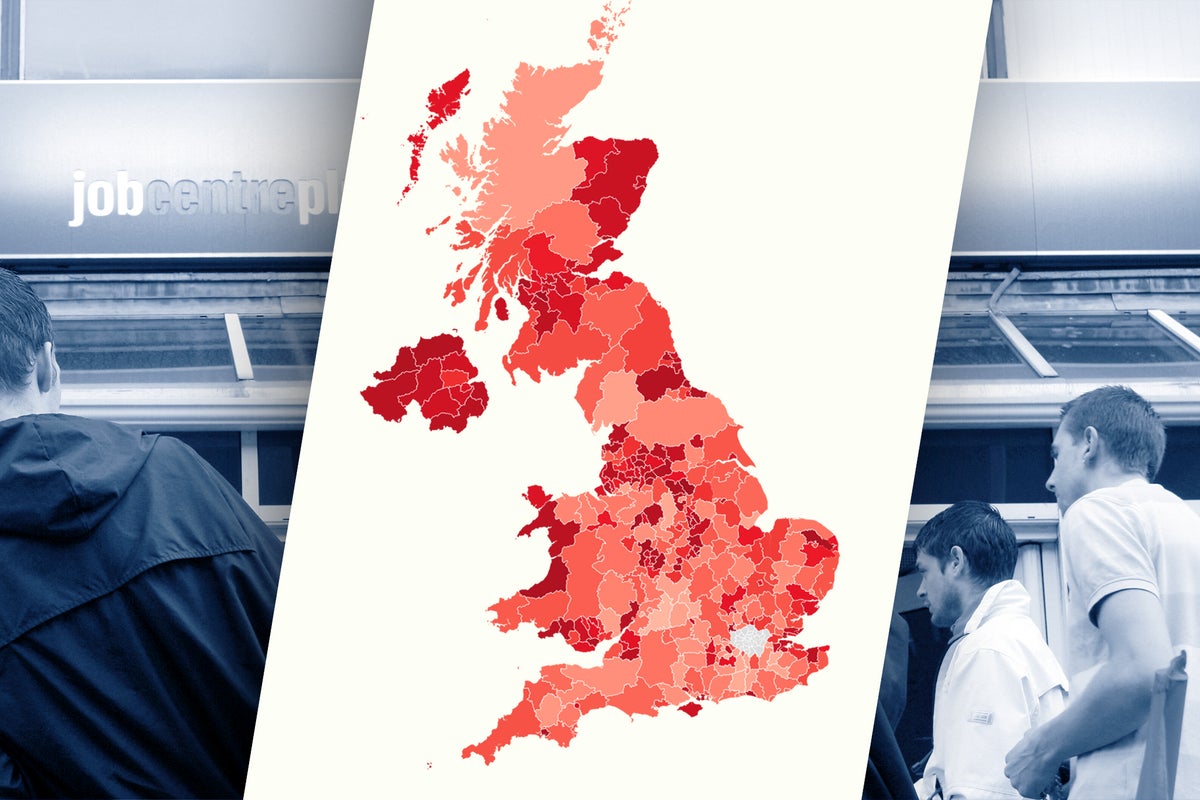
Young people across the UK face major regional disparities in finding work, new research has found, as the worst areas to be not in education, training or employment (Neet) are revealed.
Some places have just one vacancy for every 22 young people, the findings from the IPPR show.
The think tank warned that the crisis over the high number of young Neets cannot be solved without creating opportunities in the places that lack them.
The number of young considered Neet currently hovers around the one million mark, recording a slight fall between April and June from 1.01 million to 981,000.
Rotheram in South Yorkshire was found to be the local authority with the fewest suitable vacancies, at just 46 for every 1,000 young people – 58 per cent below the UK average.
This was followed by East Renfrewshire in Scotland (53 per cent below), Broxtowe in the East Midlands (47 per cent), and Newcastle-Under-Lyme in the West Midlands (47 per cent).
Of the 20 areas with the lowest number of suitable vacancies per young adult, the East and West Midlands had the most with four each. This was followed by the East of England, Scotland, and Yorkshire, with no southern regions appearing this low.
Meanwhile, 14 of the 20 with the highest number of suitable vacancies were found to be in southern regions. The highest was the Cotswolds, at 165 per cent per cent above the national average, followed by Woking (151 per cent above), Gloucester (139 per cent), Tonbridge (137 per cent), and Horsham (129 per cent).
Commenting on the findings, former employment minister Lord Jim Knight said that it “dispels the myth that nearly a million young people are out of work because they lack aspiration”.
“Young people in Rotherham are not six times less talented than those in the Cotswolds; they face six times fewer suitable vacancies.
“Leaving young people in certain regions with the fewest opportunities on the economic scrapheap would be both a moral tragedy and far more costly in the long run.”
Speaking before becoming PM, Andy Burnham said he would deliver “good growth in every postcode” in the role. In the first few months of his premiership, he introduced education reforms which he said were designed for the country to value “the hard hat as much as the graduation cap”.

In light of its findings, the IPPR has called on the government to create a targeted job creation scheme, delivering government-funded entry-level jobs to the places with the highest Neet rates.
It also argues that there has been a “major failure” to use apprenticeships consistently as a route into skilled work, calling for more opportunities which are easier to access.
The government has indicated that it will take further action to tackle the UK’s Neet crisis following the publication of a review into youth unemployment by Alan Milburn later this year.
Delivering his interim report earlier this year, the former Labour health minister said that young people were being “abandoned” to a life on welfare. The current system presents a “perverse choice” his report found, with those on health benefits able to find a “higher income, less hassle and lower risk” than if they took up work.
Reacting to his comments, several charities and campaigners have urged the government not to pursue changes to the welfare system which would see health benefits cut only for young claimants.
Looking at welfare, the IPPR report calls for changes to universal credit which would establish a single rate for young people regardless of their work capability, with new protections for certain disabled claimants. They add that young people should also be able to retain their allowance whilst undertaking education or training.
A Government spokesperson said: "Where you're from should never determine where you end up in life.
“The Milburn Review will lay the foundation for further youth employment reform, but thanks to our £2.5 billion investment we are already taking action, including reprioritising apprenticeships for young people and rolling out youth hubs to every community, helping us create one million work and training opportunities.
“We are also supporting businesses to back young talent by offering hiring incentives worth up to £8,000 and continuing the National Insurance exemptions for under 21s and apprentices under 25.”
KioskNews shows a cleaned-up reading view extracted from the publisher’s page — the original always lives on their site, not ours.