POSTPONEMENT SOUGHT: Biko family wants to halt inquest into activist’s death
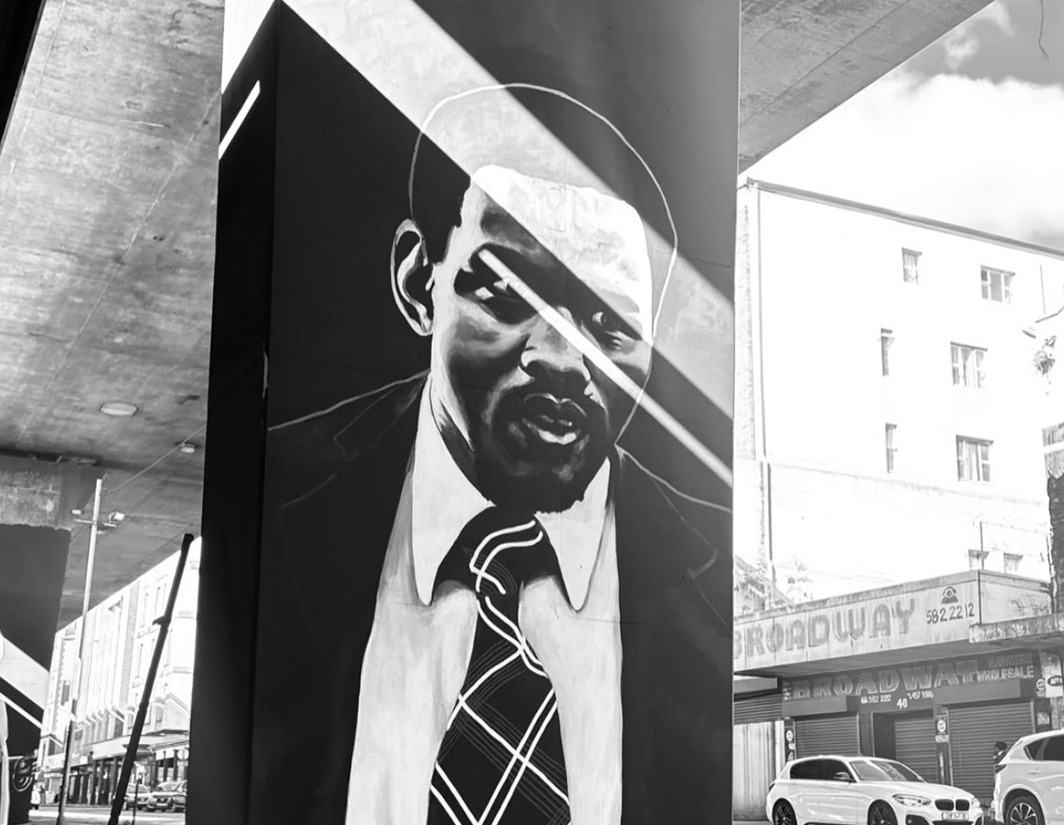
A court bid is looming to prevent the reopened inquest into the 12 September 1977 death of then 30-year-old anti-Apartheid freedom fighter Steve Biko, the founder and leader of the Black Consciousness Movement, from forging ahead.
The family’s application to halt the proceedings was expected to be heard in the Gqeberha High Court on Tuesday, but will now be heard on Wednesday. Advocate Dali Mpofu SC is expected to argue the application.
Ngqiqo Sakhela, who represents the Biko family at the inquest, said the application had initially been set down for Tuesday but was postponed to allow the legal team to place proof of service before the court.
“We did that, we did depose to an affidavit and that affidavit was placed before the court. Now the court has to satisfy itself that indeed everyone was served before the matter is heard,” Sakhela said.
/file/attachments/orphans/IMG_5945copy_981935.jpg "Anti-apartheid leader Steve Biko’s son, Nkosinathi Biko (in green), with Ngqiqo Sakhela, who is representing the Biko family at the Steve Biko Inquest, currently under way in the Gqeberha High Court on 25 August 2026. (Photo: Deon Ferreira)")
‘Not ready to proceed’
At the outset of the reopened proceedings, the family indicated that they believed the matter was not ready to proceed.
On 25 August, Sakhela brought an application for a postponement, citing, among other concerns, the need to have a “voluminous” record running into thousands of pages translated from Afrikaans into English.
The legal team also said it needed sufficient time to consult with Biko’s widow, Nontsikelelo “Ntsiki” Biko, and prepare an affidavit. During the unopposed application, it emerged that Nontsikelelo held information that could be relevant to the inquest.
In the court papers, Nontsikelelo and Biko’s son, Nkosinathi Biko, are listed as the applicants, while the respondents are Judge Isaac Madondo, National Director of Public Prosecutions Advocate Andy Mothibi, Minister of Justice and Constitutional Development Mmamoloko Kubayi, and former apartheid security police officers Daniel Petrus Siebert and Jacobus Johannes Oosthuysen Benecke.
Judge dismissed postponement
Judge Madondo, who is presiding over the inquest, dismissed the postponement application on 26 August.
Among the reasons given was the advanced age of the two surviving persons of interest in Biko’s death and the concern that further delays could result in their memories fading.
/file/attachments/orphans/IMG_6001copy_228053.jpg "Retired judge Mjabuliseni Isaac Madondo, who served as the deputy judge president of KwaZulu-Natal Division of the High Court, is presiding over the Steve Biko Inquest currently under way in the Gqeberha High Court. He is pictured on 25 August 2026. (Photo: Deon Ferreira)")
The two men – 80-year-old former security branch officer Daniel Petrus Siebert and 76-year-old Jacobus Johannes Oosthuysen Beneke – have already indicated that they cannot remember certain events surrounding Biko’s death.
Their evidence has included apparent discrepancies between what they now recall, and what they previously told the Truth and Reconciliation Commission in 1997, and the original inquest into Biko’s death in November 1977.
Following the dismissal of the postponement application, Sakhela indicated that the family would approach the Judge President of KwaZulu-Natal and the Acting Judge President of the Eastern Cape in an urgent bid to halt the proceedings.
Biko junior (Nkosinathi) previously stressed the importance of getting the reopened inquest right.
“We have one shot at dealing with the inquest of Steve Biko. One shot. If the toss-up has to be between scheduling and rigour, our preference is that this is done correctly.
“The inquest itself is a possible basis for a prosecution. And because we are dealing with elderly people, we have a diminished chance at prosecution. So the inquest is everything. It’s everything,” he said.
Beneke: Biko meeting ‘purely coincidental’
While the legal battle unfolded in one courtroom, the inquest continued in another courtroom with Beneke testifying virtually on Tuesday, accompanied by his legal representative, Advocate Marius Van Zyl SC, who also represents Siebert.
Beneke told the inquest that his encounter with Biko on 6 September 1977 was “purely coincidental”.
He said he had no prior involvement in Biko’s investigation, interrogation or activities, and had never had any personal contact with him before that day.
Beneke was working at the State Security Branch offices in the Sanlam Building – now the Steve Biko Precinct – when he heard a “commotion” coming from an office next door. He said he went to see what was happening “out of sheer curiosity”.
Inside, he found several members of the security branch, including Harold Snyman, Siebert, Rubin Marx, Gideon Johannes Nieuwoudt and Biko.
Beneke said Biko was standing upright and appeared to push a chair towards Siebert.
Siebert, he testified, blocked the chair.
Beneke then said Biko appeared to throw a punch in Siebert’s direction. He came to the conclusion that Biko was attacking Siebert, Beneke testified.
He said he intervened by moving towards Biko and striking him with his shoulder.
A ‘fight broke out’
The two bumped into a wall and, according to Beneke, Biko resisted. A fight then broke out, involving some of the other security branch members in the room.
Beneke described Biko as being of “fairly large stature” and “very strong”.
But he said he could not see what the other members were doing and could not remember the details of the fight.
He did remember that he, Biko and some of the other members fell once or twice.
Beneke also recalled Nieuwoudt striking Biko with a hosepipe.
Beneke said the scuffle ended with Biko sitting on the floor, his back against the wall.
According to Beneke, an instruction was then given for Biko to be handcuffed. He recalled Biko’s left arm being cuffed to a railing, although he could not remember whether he had noticed any injuries on Biko at that stage.
Beneke was subsequently instructed by Colonel Goosen to supervise Biko. It was during this period, he testified, that he noticed Biko speaking unclearly.
Beneke said he loosened Biko’s handcuffs and instructed Nieuwoudt to report the situation to Goosen. He was later told that Goosen would arrange for Biko to be examined by a doctor.
Beneke said that when he went off duty, he had no further contact with Biko.
Beneke denied that he had intended to assault or kill Biko, maintaining that his actions were aimed solely at restraining Biko.
Siebert confronted over ‘contradictions’
On Monday, evidence leader Devendran Govender confronted Siebert with several inconsistencies in his evidence and at one point put it to him that he was “making this up” as he went along.
One issue concerned the chair that Biko allegedly pushed or threw during the confrontation on 6 September 1977.
Siebert had previously testified that Biko pushed or threw the chair towards him.
During his evidence on Monday, however, Siebert said Biko had pushed or thrown it in “our” direction, referring to himself and Beneke.
Govender also questioned Siebert about the circumstances surrounding Biko’s transfer to Pretoria North Prison on 11 September 1977.
Siebert testified that they only realised Biko was wearing only underwear when they were about 100km outside Port Elizabeth.
He said they had stopped to eat and that, when he went to offer Biko food, he realised the activist was not properly clothed.
/file/attachments/orphans/Kyran-BikoInquest_249371.jpg "Former Security Branch captain Daniel Petrus Siebert (left), a person of interest in the death of Black Consciousness Movement leader Steve Biko in September 1977, testified on Friday at the reopened inquest into Biko’s death. (Photo: Kyran Blaauw)")
But Govender pointed out that Siebert had previously told the TRC that they realised Biko was wearing only his underwear much earlier – about 13km outside Port Elizabeth, near Bluewater Bay.
Siebert had also previously testified that no attempt was made to dress Biko because he was being reluctant and difficult.
Govender questioned why they would not simply have turned around and returned to Walmer Police Station to obtain clothing if they were still only about 13km from the city.
Siebert responded that there was “no way to tell” whether they could have done so and sought to justify the decision by saying there had been sufficient blankets in the vehicle.
Injuries testimony
The evidence was further complicated by testimony from forensic pathologist Dr Shakeera Holland.
Holland reviewed the original autopsy conducted by Dr Johann Loubser on 13 September 1977, the day after Biko’s death.
She testified that Biko had sustained numerous injuries, including a wound that appeared consistent with an object such as a hosepipe.
According to Holland, there were 10 injuries on Biko’s body that were consistent with injuries that could have been caused by a hosepipe.
She further testified that the injuries appeared to be made at different times.
Some appeared to have been sustained only hours before Biko’s death, while others appeared to be as old as a day – and possibly even weeks old.
In Holland’s view, the injuries could not all have been inflicted on a single day or during one incident.
Govender put it to Siebert that, when considered alongside Holland’s evidence, the injuries did not support the version of events involving a single scuffle.
He also suggested that Holland’s evidence indicated that Biko may have been subjected to violence during interrogation before 6 September 1977.
Siebert rejected the suggestion.
He vehemently denied that he and the other security branch members had assaulted Biko to such an extent that the assault caused his death.
KioskNews shows a cleaned-up reading view extracted from the publisher’s page — the original always lives on their site, not ours.