U-Turn, Extra Lane, Google Maps: Delhi's Plan To Fix Barapullah Traffic Chaos
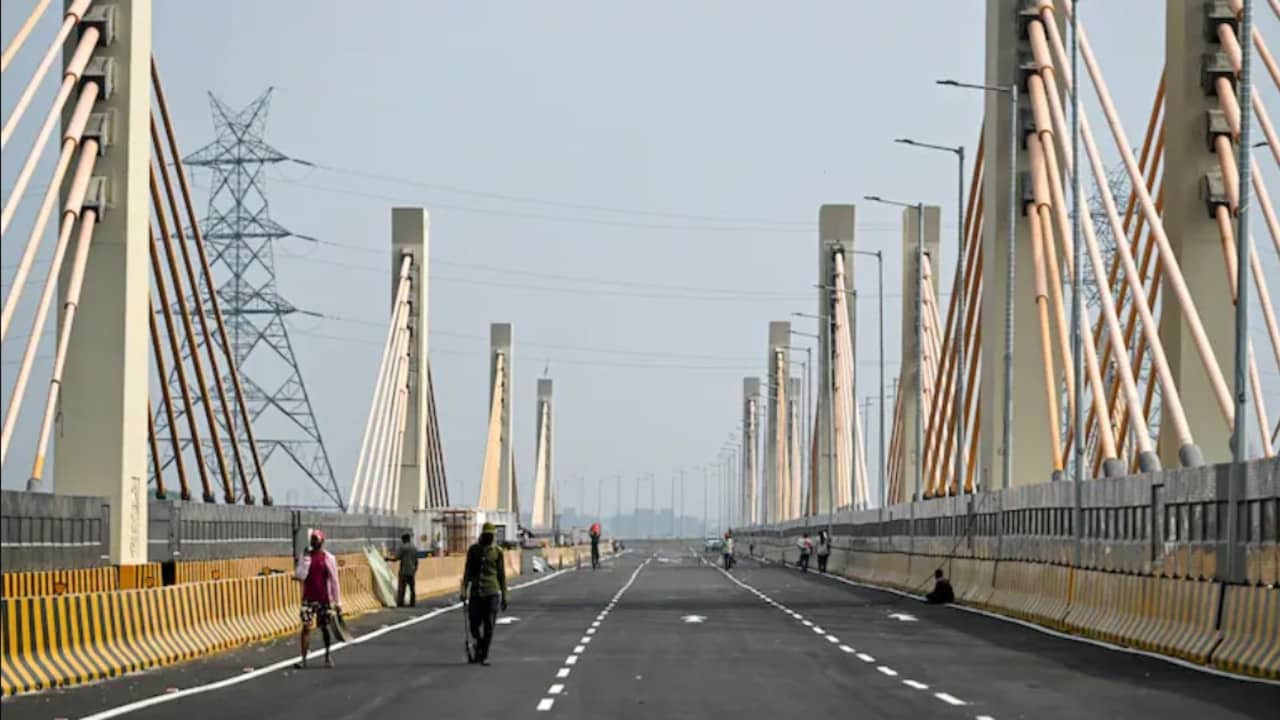
A new U-turn, a possible additional traffic lane, changes at crucial merging points and talks with Google over real-time traffic information are part of Delhi's plan to ease the traffic chaos on the newly opened Barapullah Phase III corridor, Public Works Department (PWD) Minister Parvesh Verma said on Wednesday.
Commuters should begin seeing an improvement within the next 10 to 15 days, with PWD already working on measures suggested by the Delhi Traffic Police and its consultants, Verma said.
The announcement comes after the Traffic Police wrote to PWD seeking changes to the corridor, including a redesign of the merger near Sundial Park and a dedicated U-turn near Gurudwara Bala Sahib. Police have flagged a mismatch in lane capacity and the geometry of the merger as key factors behind the congestion.
The 15-Day Traffic Fix
Verma said a meeting was held with Traffic Police and consultants on Tuesday to identify immediate solutions.
"The Traffic Police has asked us to make a U-turn and we have started working on it. The U-turn plan is near the gurudwara," he said.
The proposed U-turn near Gurudwara Bala Sahib has also been formally suggested by the Traffic Police to give motorists from Siddharth Extension access to the old Barapullah corridor without using a ramp in the wrong direction.
Another proposal, according to Verma, is to modify the footpath along a stretch between Sarai Kale Khan and ITO so that an additional traffic lane can be created.
"There are places where four lanes become three and then become four again. They have suggested that if the footpath on the side is removed and another lane is added, four lanes can continue. We have started working on it," he said.
PWD has also appointed a consultant to study traffic movement, the minister said.
"Whatever changes the consultant tells us to make in the design, as far as they are possible, we will make them," he said.
READ | Barapullah Was Built To Beat Delhi Traffic. Why Is The New Flyover Causing Jams?
A Traffic Police drone survey carried out after the corridor opened found that at several points two three-lane roads were feeding into a single three-lane corridor. At the point where the new corridor meets the existing Barapullah flyover near Sundial Park, police also found a sharp merger instead of a smooth curvature, contributing to the bottleneck.
Verma said the government has separately spoken to Google after concerns that navigation information was not accurately reflecting congestion on the new road.
"Google told us that their software takes around 15 days to study the traffic pattern on a new road. After that, real-time data comes in," he said.
Delhi Traffic Police has also been working with Google Maps to ensure more accurate real-time traffic information for the corridor after complaints that the app was showing the route as relatively clear even during severe congestion.
Verma acknowledged that the government had not anticipated congestion of this scale.
"We did not have any such study. We did not have an indication that this kind of traffic situation would arise," he said.
He also suggested that some of the initial traffic could be because motorists were keen to try the newly opened road.
"People are excited to travel on a new road. Everyone wants to see the new road," he said.
Barapullah Phase III, connecting Mayur Vihar with Sarai Kale Khan and the existing Barapullah corridor, was opened on September 29 after years of delays. Built at a stated cost of Rs 1,635 crore, the corridor was projected to provide signal-free connectivity towards South Delhi and cut travel time for commuters.
Instead, severe congestion emerged soon after it opened, particularly around Sarai Kale Khan and the point where traffic from Mayur Vihar, the Sundial loop and the DND side converges before entering the older Barapullah network.
READ | Barapullah Phase 3 Traffic Jam: Delhi Traffic Police Blames Google Maps
'Design Fault Ours? How Is That Possible?' Verma Attacks AAP
Verma used his first detailed response to the traffic problem to hit back at the Aam Aadmi Party (AAP) over criticism of the corridor's design.
"The Opposition, particularly the Aam Aadmi Party, is repeatedly saying there is a fault in the design," he said.
Verma claimed that the number of lanes, technical specifications and the detailed design were decided during the previous government's tenure.
"Today they are going there and making videos saying the design fault is ours. How is that possible?" he said.
He claimed that when the BJP government came to power in February 2025, most of the structure had already been built.
"A total of 298 pillars had to be constructed. Of these, 288 pillars were already standing when our government came. Around 80 per cent of the work had already been completed," he said.
The minister argued that the government could not have redesigned a substantially completed flyover at that stage.
The project's administrative history, however, began before the AAP government that took office in February 2015. Barapullah Phase III was approved in 2014 and construction began in 2015, with the project initially targeted for completion in 2017.
READ | 3-km-Long Traffic Jam On Delhi's Barapullah Phase-III Day After Opening
Verma's claim relates specifically to the detailed design, lane configuration and technical specifications, which he said were approved during the AAP government's tenure.
Questioning the capacity originally planned for the corridor, Verma said infrastructure of this scale should have been designed keeping traffic growth over several decades in mind.
"If you are spending more than Rs 1,000 crore of taxpayers' money, are you making it for only two years?" he said.
"You have to see how much traffic there is in 2015, what the population will be after 10 years and how much it will increase after 20 years. You should at least think about the next 50 years."
He argued that additional lanes could have been accommodated when the corridor was originally designed.
"If two additional lanes had been provided at the beginning, it could have comfortably served traffic for decades," he said.
Verma also targeted former Delhi Chief Minister Arvind Kejriwal with a reference to the political controversy over his former official residence.
"If a gold-plated chandelier falls in the 'Sheesh Mahal', will that be our design fault?" he said.
From Rs 964-Crore Tender To Rs 1,635-Crore Project
The PWD Minister also questioned the project's long delay and the increase in its cost.
He said the construction tender was around Rs 964 crore and work began on April 28, 2015, with a 30-month completion period. The project was initially expected to be completed in 2017 but opened only in 2026.
The Rs 964-crore figure cited by Verma refers to the construction tender. The project's original approved overall cost was Rs 1,260.63 crore, while its revised cost subsequently rose to Rs 1,635.03 crore.
Verma alleged that escalation and arbitration payments during the previous government's tenure contributed substantially to the increase in expenditure.
"The tender amount was around Rs 964 crore. After escalation and arbitration, the amount reached around Rs 1,600 crore," he said.
He also questioned why arbitration awards were not challenged by the previous government, alleging that repeated payments imposed an additional burden on taxpayers.
The project's delays, cost escalation and arbitration payments are already under investigation. The Delhi Anti-Corruption Branch registered an FIR in January in connection with alleged "delay, cost escalation, and arbitration payments" in the Barapullah Phase III project.
Verma said the BJP government's priority after coming to power was to clear pending administrative hurdles and complete the long-delayed project.
"Wherever there were forest clearance issues or other administrative issues, our government sat down and cleared them," he said.
"If there had been further delays, more payments could have had to be made to the contractor."
For a longer-term solution to traffic pressure in the area, the minister pointed to the government's proposed elevated Ring Road.
"The DPR for the elevated Ring Road has already been completed. We gave a presentation to the Chief Minister around 15 days ago," he said.
The proposed project includes two more crossings over the Yamuna, he said.
"When that road is built, it will help the traffic movement coming across the Yamuna," Verma said.
KioskNews shows a cleaned-up reading view extracted from the publisher’s page — the original always lives on their site, not ours.