RI needs tech pivot to rival Vietnam's economic growth: Airlangga
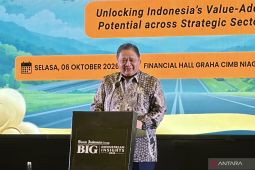
Jakarta (ANTARA) - Indonesia must shift aggressively toward technology-driven industries and trade agreements to match the rapid economic growth achieved by countries like Vietnam, Coordinating Minister for Economic Affairs Airlangga Hartarto stated.
Airlangga highlighted Vietnam’s impressive year-on-year growth of 9.95 percent in the third quarter of 2026 as a target benchmark for Indonesia, which has historically maintained an average growth rate of around 5 percent.
"If we want to catch up with Vietnam, which can reach 9 percent, we must pivot toward digitalization, semiconductors, and artificial intelligence—areas where Vietnam leveraged opportunities earlier than Indonesia," Airlangga said during an address in Jakarta on Tuesday.
Beyond technological investment, the minister attributed Vietnam's rapid momentum to its expansive Special Economic Zones (SEZs) and favorable investment climate.
While Indonesia currently operates roughly 24,000 hectares of SEZs, Vietnam has designated 2 million hectares, offering investors greater scale and policy predictability.
"They are operating on a much larger scale and are bolder. In terms of business certainty, they provide excellent service to investors," he stated.
Airlangga also highlighted Vietnam’s proactive trade strategy, noting its early execution of key international agreements such as with the European Union and favorable trade tariff terms with the United States.
However, Airlangga observed that unlike Indonesia, Vietnam lacks strong internal consumer demand—making export performance the primary driver of its economy.
"This is what drives Vietnam’s exports to grow faster than ours; since they lack a large domestic market, investors in Vietnam are compelled to focus on exports," he noted.
To capitalize on Indonesia's domestic market strength, Airlangga stressed the need to expand the industrial sector beyond natural resource downstreaming to include automotive, textiles, fast-moving consumer goods (FMCG), and manufacturing.
He noted that downstreaming represents only one element of a broader industrial strategy required to transform the economy.
"We need to boost these areas significantly so that the industrial sector's contribution to GDP can rise above 20 percent," Airlangga concluded.
Related news: Indonesia boosts small industries with appropriate technology
Related news: BRIN highlights Indonesia's potential as regional space industry hub
Related news: Danantara targets 15,000 semiconductor talents in 3-5 years
Translator: Arnidhya Nur Zhafira, Yashinta Difa
Editor: Azis Kurmala
Copyright © ANTARA 2026
KioskNews shows a cleaned-up reading view extracted from the publisher’s page — the original always lives on their site, not ours.