The dreadful decline of hosting at home: ‘I feel shame any time a friend comes over’

‘I really loved hosting at home years ago, before I had kids, when my house wasn’t filled with toys and I had lots of time to plan and shop,” says Rehanna, 41, from Birmingham. Now, if she’s catching up with friends, she would rather go out. “I can’t host and cook at the same time, so if I have people over it will usually be a cold buffet I have made earlier. There are so many really nice restaurants where I live that I’d prefer to go out and try something new than make an old favourite at home.”
Personally, I’d never say no to a cold buffet – but Rehanna’s story is not unusual. In the US, the number of people who regularly host friends or family fell from 42% in 1975 to 12% in 2026 – a 70% drop over the last 50 years. In the UK, the numbers are not much better: last year, a poll of 2,000 adults found that more than four in 10 British people avoid hosting at home due to the clean-up it requires. And while chef Nigella Lawson is back on TV screens demonstrating her culinary prowess on The Great British Bake Off, it wasn’t long ago that the self-proclaimed domestic goddess revealed even she had “got out of the habit” of hosting formal dinner parties.
But why have we become so unwilling to invite others into our homes – and what do we lose by only catching up in communal “third spaces”?
“When you host, quite often it feels like you’re just a spectator to your friends’ evening,” says Simon, 37, from Glasgow. In the past, he’s found that, as host, he spends so much time making sure his guests are catered for that it can be difficult to connect with them on anything other than a superficial level. “You’re not fully present because you’re either trying to anticipate their next needs or you’re not even in the same room – you’re ferrying back and forth to the fridge and you just can’t get deep in the conversation. It can feel like everybody else has more of a bond at that time, because the host is just a wee bit separate.”
We haven’t always felt this way about having people over. In fact, anthropologist Robin Dunbar, best known for “Dunbar’s number” – a theory that suggests humans can only really maintain about 150 stable social connections at once – believes we would still rather entertain at home given the choice, but circumstances often conspire against it. “One reason is that our social networks may have become more scattered as cities have got larger,” he says. “If we live in smaller villages and towns, it is easy to visit for casual get-togethers. There is a thing called the 30-minute rule: if someone lives more than 30 minutes away, we pretty much stop seeing them regularly. The time/effort required becomes too great.”
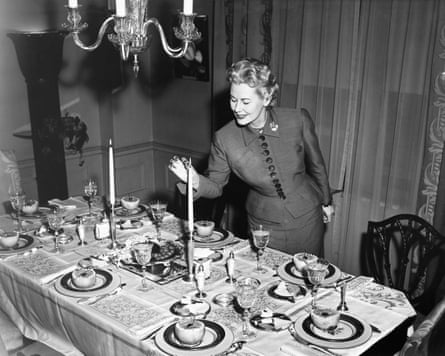
It’s an idea echoed by Kamalyn Kaur, a psychotherapist and member of the British Association for Counselling and Psychotherapy. “I’m an 80s child and when I was younger, people used to pop over to my mum and dad’s house – just for half an hour, for a cup of tea,” she says. By the time she reached her early 20s, she noticed guests had started phoning beforehand, and home visits became more of a pre-arranged event, “which is good because you’re being respectful of someone’s time and energy and space, but the downside is that people don’t have that spontaneous checking in, everything has to require a lot of planning”.
Even for those who have experienced the fun of a successful soiree, it can still feel intimidating rather than inspirational. “My boomer mother was an incredible entertainer and was always having these dramatically complicated parties,” says Caz (not her real name), who spent her childhood on the fringes of these gatherings, peeking in through the door. “Living up to that feels impossible. But also, she claimed she enjoyed hosting very much, but she was always so stressed out beforehand and she’d yell at all of us all the time, and I don’t want to do that.”
There is also the expense: while most of us usually spend far less on a home-cooked meal than we might at a restaurant, it’s a different story when catering for a crowd. In 2023, Retail Times reported on data from restaurant booking site The Fork that found cooking a three-course dinner at home for a group of six typically cost the host more than £82, compared with the average cost per head at a restaurant of just over £30.
In May this year, the Spectator claimed the dinner party was also being killed off “by the modern curse of the ‘dietary requirement’”; both food intolerances and voluntary restrictions appear to have increased over the past 20 years, and so cooking for others might certainly feel like more of a challenge.
Expectations can often feel heightened when hosting, not just when it comes to the food, but also the home environment. I’d venture that the rise of tablescaping has a lot to answer for – and a quick browse of Instagram reels throws up numerous other “requirements” for hosting success: elaborately garnished cocktails, trendy taper candles, handwritten menu cards, a huge dining table. Whereas hosts might once have simply given surfaces a quick wipe and emptied the bins, there are now tips for curating the perfect playlist, and rules for creating an aesthetically pleasing “theme”.
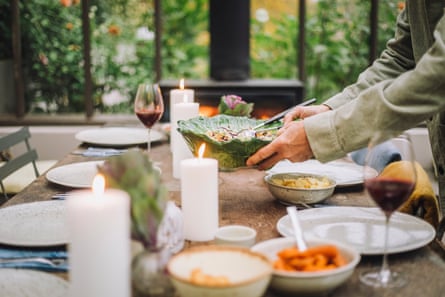
“I think there’s a lot of pressure on people to have ‘presentable’ homes,” says Kaur. “On social media, you see everyone with these amazing mansion-style houses. It creates unrealistic expectations about how a home should look. People may start worrying about their home not meeting that standard.”
Caz has two children under the age of 10 and says her house is therefore always “a complete nightmare zone”. Of course, her friends don’t actually care about the mess. “I know this deep in my heart,” she admits, “but it doesn’t stop me from feeling shame every time anyone comes over.”
Sydney-based chef Therese Lum also cites TV cooking shows as one of the reasons many may feel a dinner party has to be a perfectly curated five-course production. “Add small apartments, busy weeks and the cost of feeding a crowd, and going out starts to feel easier,” she says. “Hosting has started to feel like work.”
Derek Thompson, who delved into the US data for the Atlantic, raises the idea that more intensive parenting styles could be partly to blame for the decline in hosting at home. “Americans used to have many kids whom they cared for sparsely,” he suggests. “Now they have fewer children, to whom they devote every minute of their life.”
Dunbar broadly agrees: “Until the 1960s, things like homework from school was limited, and children kind of looked after themselves – playing in the street together and turning up only when they needed to get fed. Now the little darlings are under your feet until they go away to university.” In addition, he notes that there is now an “endless stream” of extracurricular clubs and activities that children are encouraged to take part in, which means “families have to be free to do a lot of ferrying”.
What’s more, since the pandemic and the rise in working from home, many people have come to think of their living space differently. Socialising at home might feel more like hosting dinner in the office. As Kaur puts it: “You want a change, otherwise it doesn’t feel like a break. It’s harder to mentally switch off.” But even before Covid, the proliferation of all things hygge – the Danish concept centred on cosiness – encouraged much of the western world to think of home as somewhere to retreat and relax, rather than invite others in. “Your home is your cosy place, so socialising there can feel like a disruption of your private space,” says Kaur.
Thompson also touches on the idea that it’s now “too much fun to be home alone”. Whereas we might once have invited friends over to stave off boredom – and faced social pressure to attend such events, even if we did not much care for the hosts – today we are “cocooned within personalised entertainment fortresses”. This does not mean we no longer benefit from social connection, though: the World Health Organization reports that isolation and loneliness are now widespread, which in turn can have a significant impact on physical and mental health – even if we are not “bored” as such.
At the opposite end of the spectrum, there’s the problem of, to put it bluntly, guests outstaying their welcome. “My wife and I do enjoy hosting under very controlled circumstances,” says Simon. “We tend to have people over for drinks before going out for dinner because it sets an end time. Hosting at home can mean you lose control of when the night ends – if someone wants to sit there drinking whisky until 3am, you kind of feel compelled to join them.” There’s clearly a reason why the phrase “Please leave by 9pm” has become something of a recurring motif on interior decor accessories in recent years.
Kaur acknowledges that, as host, it can be difficult to do anything other than wait for the evening to come to a natural end. “I’m more than happy to go to bed at half eight but, for my friends, this might be when they’re all coming to life,” she says. “It can feel really suffocating to have people in your space and not be able to ask them to leave.”
Should we simply accept that it’s become far easier, less stressful and sometimes less expensive to go out? “There’s a vulnerability to letting someone see you in your own home, and by not hosting at home we reveal less of ourselves to others, which can then affect the depth of our friendship,” Kaur warns. There is certainly something more intimate about catching up with a friend on their sofa – a sneak peek behind the scenes of their life that you’d struggle to gain in a more neutral space.
Kaur hosts regularly, but says that’s largely because she has known her closest friends for more than 20 years. “We’ve all grown up together; we’ve seen each other at our best and our worst,” she says. “I’ve been to my friend’s home when the floor is covered with a hundred Lego pieces because their kids have been playing with it. And my friend is like: ‘Yeah, you’re just going to have to walk through that.’” But, for some, she recognises that hosting, whether it is a well-planned evening or spontaneous get-together, may remain a source of anxiety. “I would always encourage people to do whatever suits their own energy levels and mental health,” she says. “Otherwise it becomes counter-productive.”
Lum, meanwhile, believes that the effort that goes into hosting is precisely what makes it so worthwhile. “Because it’s one of the most generous things you can do, it builds a kind of connection that’s hard to get anywhere else,” she says. “In my family, food was always how we showed love, and a shared table still feels that way to me.”
It’s also worth bearing in mind that going out, especially for dinner or drinks, will usually mean following the venue’s rules. “At home nobody rushes you off the table, and the conversation goes wherever it wants,” says Lum. “My best nights have nearly always happened around someone’s kitchen table. Guests don’t remember whether the napkins matched; they remember feeling looked after.”
KioskNews shows a cleaned-up reading view extracted from the publisher’s page — the original always lives on their site, not ours.