Chinese maritime control a growing issue
STRENGTH FROM THE SEA: As China is in the process of trying to pull the entire western Pacific into its sphere of influence, other nations must be wary, an academic said
By William Hetherington / Staff writer, with CNA


China’s efforts to expand its maritime activities in waters east of Taiwan are a shared concern for Taiwan, Japan and the Philippines, a Japanese specialist on China’s maritime policy said.
The three sides should cooperate to assess Beijing’s intentions and protect their respective interests, Chisako Masuo, a professor at Kyushu University’s Graduate School of Social and Cultural Studies, said in an interview on Wednesday last week.
Masuo said Taiwan and Japan lack close cooperation, while concern in Japan over a contingency involving Taiwan has faded amid growing optimism that an armed invasion would not occur. Such views have spread following the removal of senior Chinese military officers from the Chinese Communist Party (CCP), she said. Attention to maritime issues has also slackened under Japanese Prime Minister Sanae Takaichi’s government.
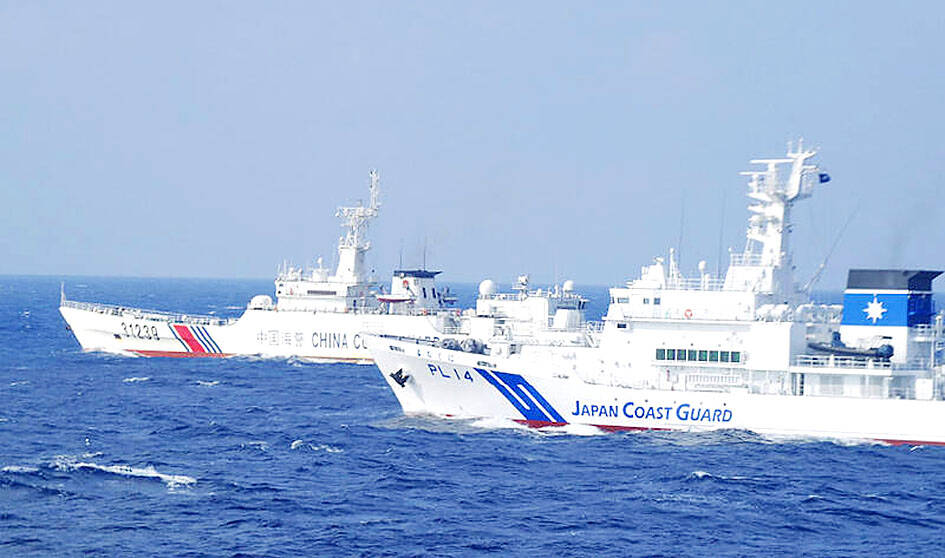
An undated photo shows a Japan Coast Guard cutter and a China Coast Guard ship.
Photo courtesy of Japan Coast Guard via AFP
However, China’s maritime “law enforcement patrols” east of Taiwan could become more sophisticated and would “absolutely not disappear,” Masuo said.
She added that Japan’s and the Philippines’ exclusive economic zones overlap in the same maritime area, connecting it to Japan’s interests.
Taiwanese and Japanese generally view each other favorably but “surprisingly do not know each other well” and make little effort to understand one another, Masuo said. Both sides assume they understand the other, yet have not exchanged views on some of the most important issues. The two sides need to deepen their mutual understanding, she said.
Chinese President Xi Jinping’s (習近平) top priority was domestic politics, while he sought to fulfill two missions: reshaping the international political order and unifying Taiwan with China, Masuo said. Military unification was not a predetermined course of action, she said, but Beijing would “absolutely not abandon this option.”
China would likely increasingly combine “gray zone” tactics that stop short of triggering armed conflict, she added.
Since becoming CCP general secretary and Chinese president, Xi has launched various reforms that have expanded the tools available to him, Masuo said. In maritime policy, these include fisheries reform, port development and marine environmental protection, as well as a system for using people in the fishing industry as maritime militia members.
China has gained new partners by strengthening its scientific and technological capabilities and rebuilding its socialist system, while more people at home have recognized its new missions and fallen in line, she said.
These developments have given Xi more ways to pursue “gray zone” operations, while his growing incentive to use them has made China’s activities increasingly apparent, she added.
Masuo said China wants to break away from the US-centered international system and establish a separate regional order in Asia anchored in Beijing. Its activities in the Pacific suggest it means to bring the western half of the ocean under its hegemony.
To achieve this, China is preparing to respond, even in a worst-case scenario of an armed conflict with the US, she said.
“The Taiwan issue is not an isolated one and could become a flashpoint for a future war between the US and China,” Masuo said.
In the event of a war in Taiwan, the Japanese Self-Defense Forces would have difficulty directly assisting Taiwan under Japanese domestic law. However, Masuo said that “the continued functioning of the Japan-US alliance is also extremely important to Taiwan in practice.”
KioskNews shows a cleaned-up reading view extracted from the publisher’s page — the original always lives on their site, not ours.