Australia still thinking of victory despite three days on the back foot
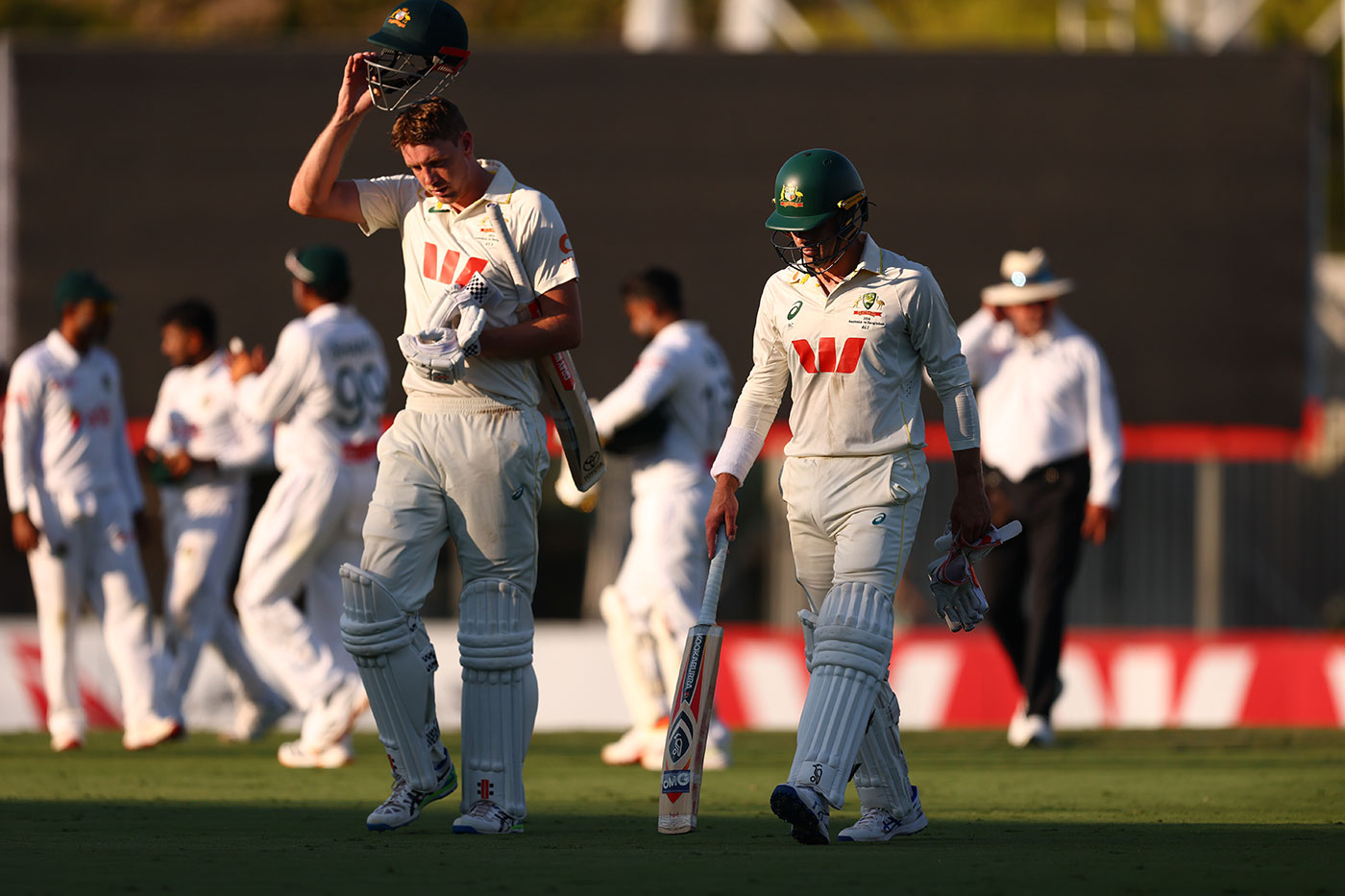

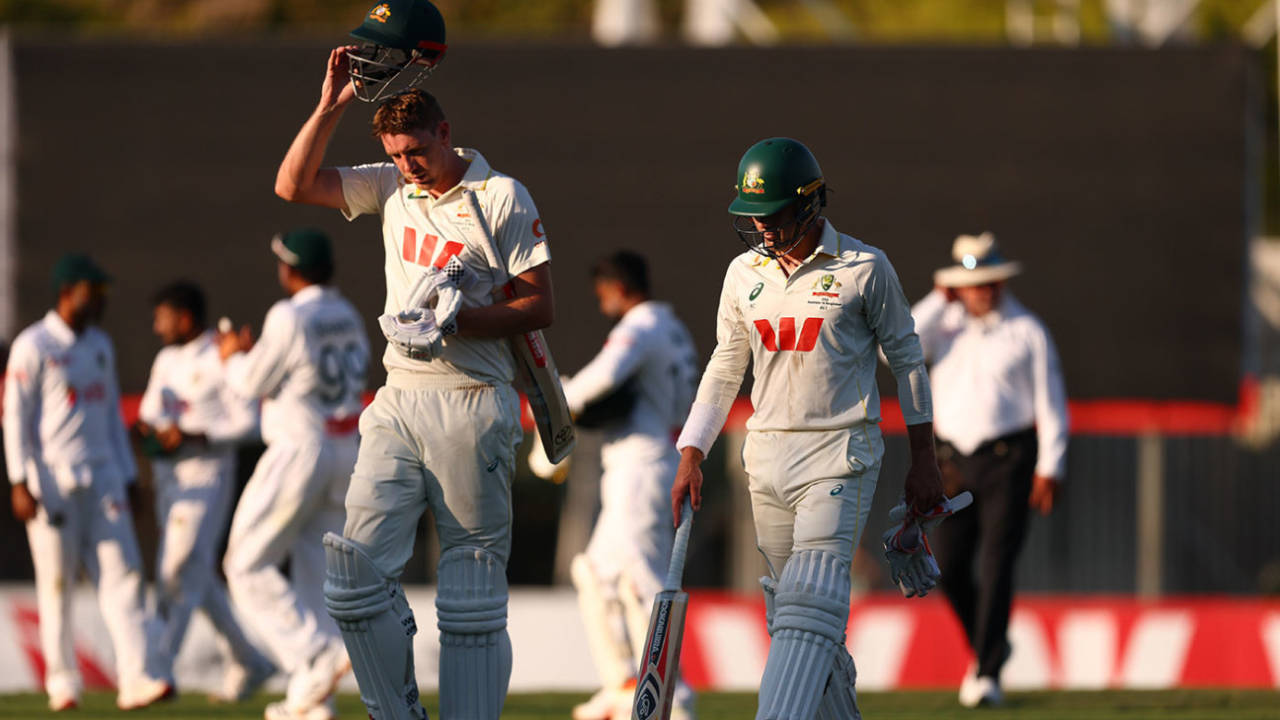
Cameron Green and Alex Carey guided Australia to the close on day three • Getty Images
The home side was four wickets down in the second innings and trailed by 67 at stumps, with Cameron Green and Alex Carey having nursed them to the close with a stand of 39 that will need to swell considerably on Sunday if Australia are to forge a remarkable recovery.
Related

Bangladesh chip away to keep famous victory in sight

Hazlewood becomes ninth Australian to take 300 Test wickets
"Once we tick those [runs] off, hopefully we're still four down and you can start to build the pressure," Josh Hazlewood said, on the day he joined the 300-wicket club. "I'm not sure how the wicket will play. Obviously we haven't played much in Test cricket [here].
"It was showing a little bit of signs of up and down. If we can bat deep into tomorrow and potentially even the whole day maybe, there's always opportunities to take 10 wickets on the final day if the wicket is a little bit up and down.
"So [the] win is still definitely in our mind, and always is pretty much. So we'll look to do whatever we can to move towards that."
To win, they would have to overturn their highest first-innings deficit at home of 228 - the previous was the 206 they trailed by against Pakistan at the SCG in 2010 - while there have only been two larger ones anywhere.
The biggest deficit Australia successfully overcame was when they turned trailing by 291 against Sri Lanka in Colombo in 1992 into a 16-run victory, defending a target of 181 in what is a likely model of how they would have to do it in Darwin. That game was famous for the first match-winning impact Shane Warne had in his Test career.
This current Australia bowling attack, which now features its four frontliners with 300 or more Test wickets, would need some collective or individual brilliance to defend a target but whether that becomes an option will depend on the middle order.
Green has the chance to build on a promising innings and ease some of the talk around his position, which won't be the case for Jake Weatherald and Marnus Labuschagne who remain firmly under scrutiny after loose dismissals. Green, however, was millimeters from being dismissed on 12 when an inside edge against Taskin Ahmed grazed leg stump without the force to dislodge a bail.
"You definitely need luck in cricket, that's for sure," Hazlewood said. "I think his intent has been good. He's looked to score from the outset. I thought even in the first innings, it was probably just summing up the situation more so in that time, just before whatever break it was.
"I think he's shown good intent from ball one in both innings. [He] looked to score, put the pressure back on the bowler. Yeah, a little bit of luck goes a long way sometimes. So you never know.
Bangladesh allrounder Mehidy Hasan Miraz, who followed his half-century with the massive wicket of Steve Smith, was confident the visitors could keep the target small, though he acknowledged the opening session of the four day would be vital.
"We are playing on a good wicket so all we want to do is bowl in the right areas," he said. "We have to work hard for each wicket. We had to do a lot to get those four wickets today. We are trying to give away as few runs as possible. If we can take at least three or four wickets within these [67] runs, then we won't have a difficult target coming up.
"We want to give them as few runs as possible. They have a lot of good batters still remaining so getting at least three more wickets is our first priority. I don't want to predict the future, but we must own the first session on day four."
Andrew McGlashan is a deputy editor at Cricinfo

50
One of the most underappreciated aspects of Test cricket is the quality of pitches in Sri Lanka. Their groundstaff - who at times were prison inmates on penal labour duties teaming up with the regular staff - are famous for covering the whole ground in no time at all when it rains but the curators' expertise in creating excellent Test surfaces often goes undernoticed. Despite all that ever-present threat of rain on the island, there have been only two draws in 46 Tests in Sri Lanka since 2014.
Sri Lanka has managed such an impressive result rate without rolling out any diabolical surfaces: batting averages in both the first and the second innings are fifth-highest in Sri Lanka out of the 12 countries that have hosted Test cricket in this period. While spinners average 4.27 better than the fast bowlers, the dominance of one kind of bowling over the other is not as stark as in Australia, England, South Africa and New Zealand where spinners hardly play a role.
With some of the more picturesque grounds in the world, grass banks to sit on and a general relaxed unhurried tempo to life, Sri Lanka has to be one of the most enjoyable Test-watching experiences in the world.
Related
India and Sri Lanka meet in a vastly different Test landscape
Gill: 'Extra time in preparation definitely helps'
De Silva on Dickwella selection: In Galle, 'player with the best glovework plays'
A series of unknowns as once familiar Sri Lanka and India face off
Rock & Roll It podcast: Kuldeep's big chance and Sri Lanka's spin woes
Spinners won't disagree even though long spells in the humidity can test their physical fitness. The ask of them is slightly different than, say, in India or Bangladesh.
Unlike in India and Bangladesh, it is the slower spinners that tend to succeed in Sri Lanka. In recent times, think Rangana Herath, think Dilruwan Perera, think Prabath Jayasuriya. Even among travelling spinners, for example, R Ashwin enjoys much better numbers in Sri Lanka than Ravindra Jadeja.
In India, nearly one out of every two Ashwin wickets - 175 out of 383 - were bowled or lbw. In Sri Lanka, only 13 of his 38 wickets, one out of three, were bowled or lbw. It points to availability of more bounce in Sri Lanka. When that happens, spinners tend to use overspin more because the little sideways turn is enough in order to get dismissals through catches at slips, gully, short leg and silly point. When you bowl overspin, you automatically end up slowing the ball down in the air.
That explains why, since 2020, the average pace of spinners in Sri Lanka has hovered around 83 kph as against 89 in India. It follows that while 4-5m remains the holy grail of spin bowling in Test cricket, you can afford to err on the fuller side in Sri Lanka as opposed to the shorter side in India. The numbers are better for 3-4m than 5-6m in Sri Lanka, which almost makes 3-5m the good length in Sri Lanka. In India, you go by the traditional 4-6m; anything fuller than 4m is overpitched.
Generally the Sri Lankan spinners have struggled to adjust to the slightly higher pace required in India than India's spinners when travelling to Sri Lanka. It is likely down to the quality of spinners. India have had two of the greatest of all time in recent times while even Muthiah Muralidaran and Herath didn't have a great time of it in India. That likely explains the better average for spinners in India even though Sri Lankan tracks offer more by the way of grip and turn. The spinners' average in India is skewed by the home spinners, who have for long outperformed the visitors by a significant margin. In Sri Lanka over the last 12 years, the difference between the average of home and visiting spinners has been just three.
Therein lies Sri Lanka's opportunity. India don't have Ashwin, Jadeja is not physically the same at the age of 37, despite all the promise Manav Suthar has played only one Test, and we will only believe Kuldeep Yadav is playing once he is on the sheet at the toss. How quickly the India spinners find the right pace and length to bowl will determine if the favourites tag for them is justified. Especially if they lose the first toss and have to likely do a containing job on day one because runs do come quickly when they come in Sri Lanka.
We will also know - especially from how Jadeja chooses to operate and how effective he is - whether bowling slow is a luxury or a necessity in Sri Lanka.
KioskNews shows a cleaned-up reading view extracted from the publisher’s page — the original always lives on their site, not ours.