Helping skin age better: How non-invasive RF treatment can boost collagen and improve sagging
The conversation around ageing skin is usually focused on what we can see – fine lines, sagging skin, a softer jawline or cheeks that are no longer as firm as they once were.
But rather than waiting for these changes to appear before trying to correct them, there is growing interest in a longer-term approach: maintaining the health and quality of the skin as it ages, notes aesthetic doctor Rachel Ho.
It is an approach that she describes as skin longevity.
“Skin longevity to me is the extension of healthy longevity to the skin, in other words, optimising the biological health and functional lifespan of the skin. It is about building cellular resilience so the skin ages slowly and healthily,” says Dr Ho, who is also the founder of The Skin Longevity Clinic.
According to her, ageing affects not just the skin, but also the fat, ligaments, muscles and bones that support the face.
“Collagen and elastin loss can reduce skin firmness and elasticity, while changes to facial fat pads, retaining ligaments and the underlying bones can contribute to jowls, a less defined jawline and deeper folds around the mouth,” she explains.
According to Dr Ho, the foundation of skin longevity includes daily sun protection, evidence-based skincare such as retinoids, vitamin C and lifestyle habits such as balanced nutrition, restorative sleep and smoking cessation.
Aesthetic treatments could form another part of this wider approach by targeting concerns that skincare and lifestyle measures alone may not address.
XERF for skin tightening
For those noticing changes in skin firmness or facial contours, one approach is radiofrequency (RF), which uses electromagnetic energy to heat the dermis. Dr Ho explains that the heat causes collagen fibres to contract and stimulates the production of new collagen over the following months.
One non-invasive RF option offered at The Skin Longevity Clinic is XERF. Dr Ho considers it for patients with mild to moderate sagging skin affecting areas such as the forehead, cheeks, jawline and neck, particularly those who have a low tolerance for discomfort and downtime.
One feature of XERF is that it uses two frequencies – 6.78 MHz and 2 MHz – to deliver energy at different depths.
“The higher frequency targets shallower layers to stimulate superficial tightening, while the lower frequency penetrates deeper to help with lifting and tightening of loose and saggy skin,” says Dr Ho.
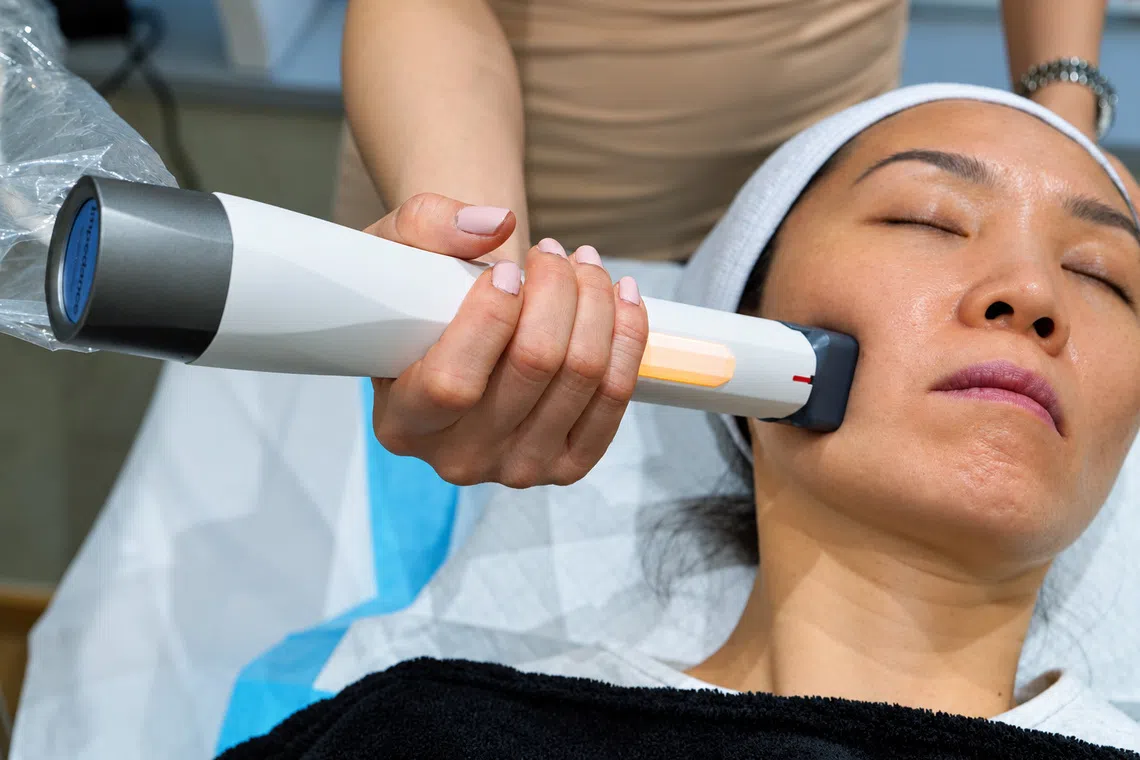
XERF uses two radiofrequency frequencies to target different skin depths, helping to tighten both the surface and deeper layers of the skin.
PHOTO: THE SKIN LONGEVITY CLINIC
The treatment can then be tailored further according to the patient and the area being treated. For instance, she takes into account differences between thicker skin on the cheeks and thinner, more delicate skin around the eyes or neck. The degree of laxity, tissue thickness and patient comfort, including how much heat they feel during treatment, can also influence the settings used.
Temperature is also closely monitored throughout the treatment. XERF uses a cooling system and real-time temperature monitoring, which Dr Ho says helps protect the skin’s surface from burns while allowing heat to reach deeper layers.
“Patients typically experience alternating sensations of warmth and cooling as the energy is delivered,” she adds.
There may be mild, temporary flushing immediately afterwards, but Dr Ho says her patients are able to resume their usual skincare, makeup, work and daily activities immediately after treatment.
“Some firmness and definition may be noticeable at first as collagen fibres contract, with further lifting developing over two to three months as new collagen forms,” she adds.
Is XERF suitable for you: What to consider before treatment
As a non-invasive treatment, there are limits to the degree of change XERF can achieve, notes Dr Ho.
“It cannot replicate the surgical removal of excess skin seen in a facelift,” she says.
For patients with more severe skin laxity, pronounced laugh lines, sagging tissues or concerns primarily related to volume loss, she may instead discuss a combination of treatments or other approaches.
This is why assessing the individual before recommending a treatment is important, says Dr Ho. During a consultation, she considers the patient’s age, skin type and thickness, degree of sagging, facial anatomy, expectations and tolerance for downtime or discomfort.

At the Skin Longevity Clinic, XERF treatments are tailored to each patient’s skin, facial anatomy, concerns and expectations.
PHOTO: THE SKIN LONGEVITY CLINIC
“Ultimately these are medical treatments, and patients need to be evaluated for their suitability, risks and whether the treatment is indicated for their concerns,” she says, adding that proceeding without a medical evaluation can lead to unsatisfactory results and side effects such as burns and post-inflammatory hyperpigmentation.
Just as important is understanding what the patient hopes to achieve. Dr Ho says she commonly sees patients who do not want to look different, but simply want to look less tired or more refreshed. In such cases, treatment can focus on improving firmness and contours while preserving their facial features and natural expressions.
Having realistic expectations is therefore an important part of deciding on a treatment. For those considering skin-tightening treatments, she recommends asking whether a particular technology is suitable for them and what alternatives are available.
“Patients should also understand the realistic outcome and timeline, potential risks and side effects, expected downtime, recommended number of sessions and how long results may last,” she adds.
Ultimately, Dr Ho says taking a longer-term view of the skin may be less about trying to erase every sign of ageing and more about understanding what it needs at different stages – and making informed choices about how to care for it along the way.
For more information on XERF, visit The Skin Longevity Clinic.
KioskNews shows a cleaned-up reading view extracted from the publisher’s page — the original always lives on their site, not ours.