One in six older people experience abuse in NZ, with psychological harm most common
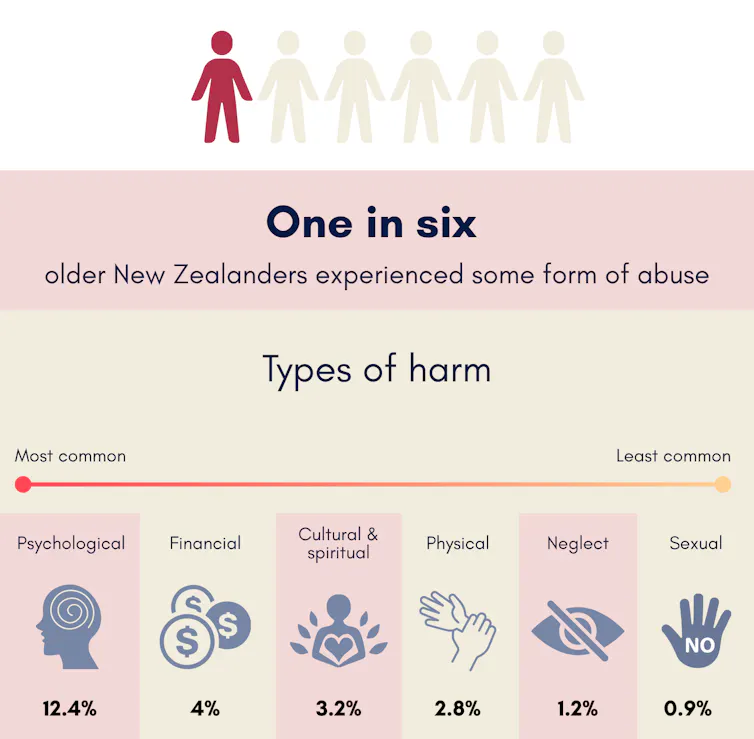
Around one in six older New Zealanders (17%) living in the community experience some form of abuse, equating to more than 250,000 people, according to our newly released study.
We surveyed more than 5,000 people aged 55 or older about 53 potentially harmful behaviours experienced in the previous 12 months. The study provides the most comprehensive picture to date of abuse of older people in New Zealand.
Abuse can take many forms, including threats, harmful actions and neglect in a relationship involving trust, or a power imbalance.
We found psychological harm was most common form of abuse (12.4%), followed by financial (4.0%), cultural and spiritual (3.2%), physical (2.8%), neglect (1.2%) and sexual harm (0.9%).
Apart from the obvious human costs – such as the loss of dignity, independence and social connection – abuse of older people also has substantial economic consequences.
We estimate it costs New Zealand at least NZ$1.8 billion a year, including financial losses, lost earnings, additional residential and hospital care, and spending on justice and support services.
Around two-thirds of these costs fall on older people and their families themselves, with the government bearing about $615 million.
Who experiences harm more?
Abuse affects older people across society, but rates of harm vary.
Māori, Pasifika, people living with disabilities, rainbow communities and people in poorer areas experienced higher rates of abuse. It was also more common among people aged 55 to 64 than those aged 75 years and over.
Social isolation was associated with higher rates of harm, as were complex living arrangements such as older people caring for children or grandchildren with high needs.
Family relationships featured prominently. Around one in five older people who experienced harm identified a partner or ex-partner as responsible. A similar proportion identified one of their children as the person who caused them harm.
Interviews revealed how family ties can become a means of control. Some older people described threats to restrict their contact with grandchildren. Others spoke about being silenced or isolated within families and support networks.
For some, harm reflected trauma, discrimination or family violence that had begun much earlier in life.
Much of the harm remains hidden
A little over half of those experiencing harm sought help or advice. Among those who did not seek help, many said they wanted to handle it themselves, didn’t need help or considered it a private matter.
Even people who sought help often reported their needs were not met, especially for emotional support and advice.
The invisibility of harm and people’s needs extends to official records. Data from police, hospitals and the Accident Compensation Corporation (ACC) mainly capture harm that is serious enough to come to the attention of public services. As a result, these records do not reflect much of the harm identified in our survey.
Even so, these administrative records reveal consequences of detected abuse of older people, including higher use of mental health prescriptions after physical and sexual assault. Physical assault was also followed by short-term increases in potentially avoidable hospitalisations and ACC payments.
We know less about harm among the roughly 30,000 people in aged residential care. They were outside our study’s scope, and existing data cannot reliably establish the scale or nature of harm in these settings.
Systems can protect, but also enable harm
Systems intended to protect older people can sometimes make them more vulnerable.
For example, our research with financial and legal professionals identified inconsistent practices and unclear referral pathways for older people seeking help and advice.
We also found gaps in safeguards around enduring powers of attorney. These arrangements can help people manage their affairs, but limited oversight can allow those appointed to act on their behalf to misuse their powers.
Ageist assumptions can also undermine the safeguards intended to protect older people. Our interviews revealed cases where family members questioned older people’s ability to make decisions as a means of gaining control, sometimes with the unwitting involvement of health and legal professionals.
Prevention is a collective responsibility
There is no single solution to these complex issues. But our findings highlight several areas where action could reduce harm and improve support for older people.
First, support needs to reach those who need it most. Older people need accessible, culturally appropriate services, with particular attention to groups facing higher rates of harm, including disabled and socially isolated older people. They also need clear information about where to seek help.
Second, services need to work together. Banks, lawyers, health professionals, government agencies and community organisations need to be better equipped to recognise and respond to harm. Stronger professional training and clearer referral pathways would help older people get the support they need, rather than leaving them to navigate fragmented services alone.
Third, we need stronger legal safeguards and better information. Our research highlights the need to strengthen oversight of enduring powers of attorney and reform the Protection of Personal Property Rights Act 1988, particularly to clarify when others can make decisions on an older person’s behalf and how their autonomy is protected.
We also need better data to understand and monitor harm, particularly in aged residential care.
As New Zealand’s population ages, addressing abuse of older people is essential. Recognising harm is only part of the response. We also need to address the gaps in our systems that allow it to continue.
KioskNews shows a cleaned-up reading view extracted from the publisher’s page — the original always lives on their site, not ours.