[News analysis] Is Korea’s roundabout response to US pressure over Iran a lose-lose?
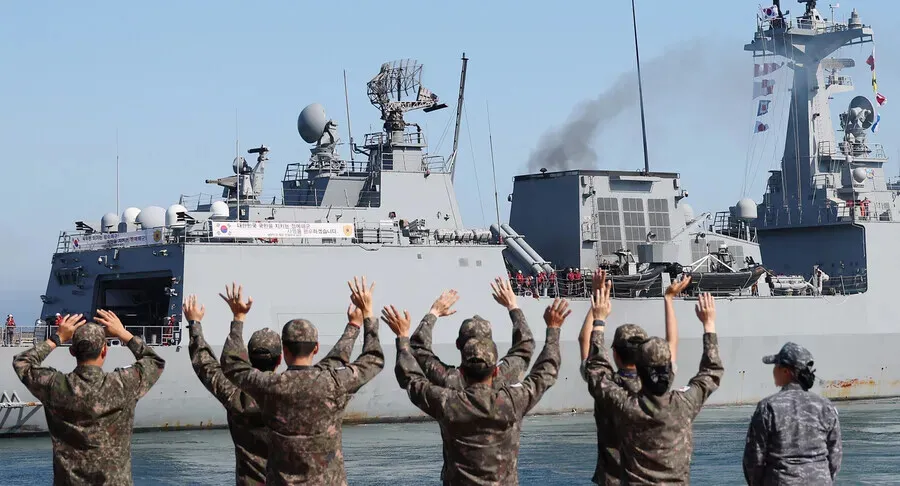
Members of the Cheonghae Unit’s 48th contingent attend a send-off ceremony before the ROKS Wang Geon departs Busan Naval Base in May 2026. (Yonhap)
The proposal to expand the operational area of the Cheonghae Unit to the vicinity of the Strait of Hormuz and deploy additional forces is considered a workaround that considers both US pressure on Korea to send troops to the region and domestic opposition to the measure.
The move could also carry significant diplomatic repercussions, depending on how Washington and Tehran respond, with fears rising over the potential for Washington to demand more troops as well as mounting concerns about the safety of service members.
The Ministry of National Defense on Thursday submitted a revised consent motion to the National Assembly on extending Cheonghae Unit’s deployment, including provisions to expand the unit’s area of operations from its base in the Gulf of Aden to offshore waters south of Oman, or just about 650 km in a straight line from Hormuz.
The motion also sought additional deployment of mine-detection assets like naval maritime patrol aircraft and unmanned underwater vehicles, with an explosive ordnance disposal team to operate them.
While the ministry cited a surge in Somali piracy and the expansion of their operational areas as its rationale, its request is considered a de facto, limited response to persistent American demands for Korea to expand its military contribution in the strait.
Since March, Washington has urged Seoul to deploy military assets such as warships or mine-detection and clearance equipment, as well as join surveillance and reconnaissance activities under American supervision, to ensure safe passage through the Strait of Hormuz.
The ministry, however, left the door open for its participation in military operations like mine sweeping in Hormuz down the road.
“We do not necessarily rule out the potential for conducting exercises with a multinational coalition to build operational capabilities for the future, as this would enable our response to requests from the international community after a safe environment is established,” it said.
But to what extent will this expansion of the mission and capabilities of the Cheonghae Unit help improve bilateral relations with the US, which are strained by conflicts over trade and security?
“Korea can’t simply ignore the US’ repeated demands given their turbulent ties, but domestic opinion prevents Seoul from meeting them to Washington’s satisfaction,” said Lee Byung-chol, a professor at Kyungnam University’s Institute for Far Eastern Studies.
“Korea has said that this is the best it can offer,” he said. “It’s passed the ball to the US, but whether Washington will play is uncertain.”
Yang Uk, a research fellow and director of the Center for Foreign Policy and National Security at the Asan Institute for Policy Studies in Seoul, suggested that diplomatic gains with the US are “likely to be minimal.”
“Had Seoul announced its decision on the deployment before the US midterm elections, President Donald Trump might’ve recognized the value of Korea’s contribution, but that’s off the table now,” he said.
How Iran will react to the expanded deployment is also unclear.
In September, the Iranian Foreign Ministry wrote in a post in Korean, “Dangerous choices will incur consequences,” warning, “If any other party either participates in operations or has an active military presence in the Persian Gulf and the Strait of Hormuz, we have no choice but to interpret that as direct support for the aggressor, which will lead to serious consequences.”
Yu Dal-seung, the chair of the Department of Persian and Iranian Studies at Hankuk University of Foreign Studies in Seoul, said, “The US and Iran are likely to hold intense negotiations, and if their talks get difficult, Korea could turn into a target and place its merchant vessels and oil tankers at risk.”
In Seoul, the foreign affairs and defense ministries pledged to maintain “thorough communication” with Iran to prevent misunderstanding.
Fears are also rising over the potential for the US to demand more troops from Korea, as well as the safety of the Korean service members deployed.
“If the intelligence gathered by our maritime patrol aircraft is used in military operations, we cannot rule out the other side viewing it as a hostile military act,” said Rep. Kim Joon-hyung, the floor leader of the minor Rebuilding Korea Party. “There is no guarantee that expansion of our operational scope will prevent further requests for troop deployment [from the US].”
“The decision to widen the operational area of the Cheonghae Unit considers both US requests for security cooperation and Korea’s national interest in securing energy supply routes in the Middle East,” Yu Ji-hoon, a research fellow at the Korea Institute for Defense Analyses, told the Hankyoreh.
“But with military threats continuing in the Middle East, we have to manage the situation by gauging the risk of accidental clashes and the diplomatic burden arising from expanded deployment,” he said.
By Park Min-hee, senior staff writer; Kim Chae-woon, staff reporter; Jang Ye-ji, staff reporter
KioskNews shows a cleaned-up reading view extracted from the publisher’s page — the original always lives on their site, not ours.