Far-right AfD wins big in German regional election, falls short of majority
The far-right Alternative for Germany party surged to a resounding victory in a regional election Sunday, but fell a little short of winning a majority in its quest to form the country's first far-right state government since World War II.
The party of Germany's unpopular leader, Chancellor Friedrich Merz, slumped to a disastrous result in the eastern state of Saxony-Anhalt. The anti-migration and Russia-friendly Alternative for Germany's candidate for governor said that "we have written history" and the party had a clear mandate to govern.
Ulrich Siegmund, 35, told public broadcaster ARD that voters had sent a signal that "things cannot carry on like this." He said that "a very good campaigner for us in this election campaign was Friedrich Merz."
Alternative for Germany, or AfD, was seeking an absolute majority in the state legislature to govern alone and overcome the so-called firewall of mainstream parties' refusal to work with AfD.
Final results showed AfD falling three seats short, with 39 lawmakers in an 83-member parliament. Siegmund said it wouldn't engage in "games" such as a minority government. But it wasn't evident how its divided opponents could assemble any stable government without it.

A first state government would be the biggest prize in the anti-migration party's 13-year history, at a time of widespread discontent with a national government that has yet to persuade voters that it can get the country's sluggish economy moving.
Whether or not AfD ends up governing, the result is a blow to Merz, whose center-right party has led Saxony-Anhalt for 24 years.
Unlike other countries in Europe, modern Germany hasn't yet had a far-right or right-wing populist party leading a national, state or major-city government.
AfD is the biggest opposition party in Germany's national parliament and is strongest in the formerly communist and less prosperous east, where Saxony-Anhalt is located.
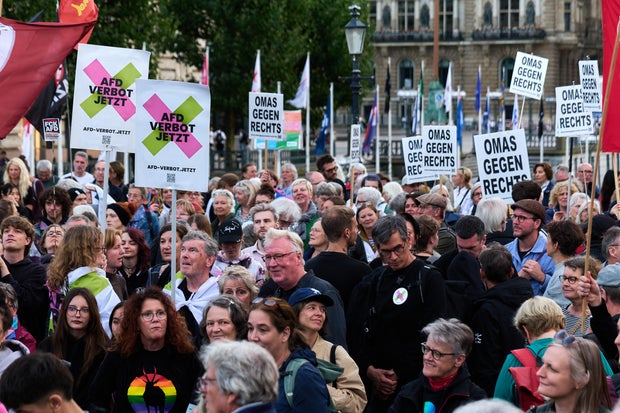
Its regional branch in Saxony-Anhalt is one of several classified as a proven right-wing extremist group by the domestic intelligence agency, which points to members' denigration of migrants from Muslim countries, among other things.
The party talks of "remigration," a politically charged term for the deportation of immigrants. Its leader in a neighboring state appealed two convictions for knowingly using a Nazi slogan.
AfD vehemently rejects accusations of extremism and says they're politically motivated.
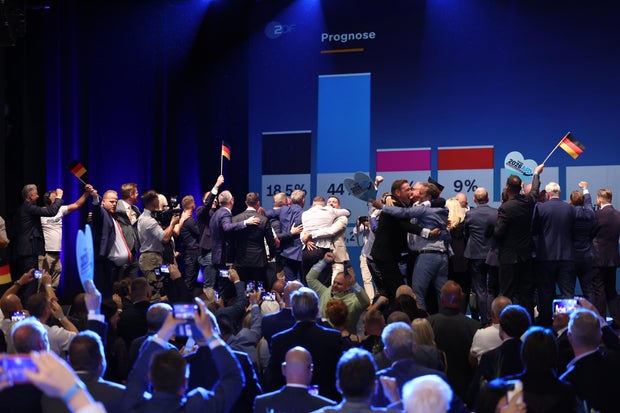
AfD won 43.8% of the vote, more than double its showing five years ago in the region of 2.1 million people west of Berlin.
That was far ahead of Merz's Christian Democratic Union, which polled 17.2% — losing about half its support — and won 15 seats. The center-left Social Democrats polled 9.3%, the Greens 8.9% and the Left Party 8.6%, winning eight seats apiece.
The BSW party, which has said it wouldn't elect either Siegmund or incumbent Sven Schulze as governor but criticizes the "firewall" against AfD, took 5.3% and five seats.
Turnout was very high at 77.8%. AfD appeared to have won over many people who didn't vote at all five years ago.
AfD's national co-leader, Alice Weidel, described the result as "sensational." She said the party's "hand is outstretched to all who want to make Saxony-Anhalt better and move Germany forward." It may hope to attract defectors from other parties.
Schulze congratulated AfD on becoming the state's strongest political force and said that "we as the CDU will also have to deal with this result," without specifying how.
Franziska Hoppermann, the national general secretary of Merz's party, rejected backing off its refusal to deal with AfD.
"AfD is a right-wing extremist party. It wants to leave the euro; that would be economic downfall ... it works closely together with Russia, it wants a completely different social model," she said. "We will not work with them."
Once previously AfD won a state election but didn't end up governing. That was two years ago in neighboring Thuringia, where a CDU governor took power with a minority government, but AfD was much further short of a majority there.
Any attempt by Schulze to put together an alliance against AfD would be delicate because it would require at least some tacit support from the Left Party, a hard-left party with which the CDU refuses to form coalitions.
Germany's 16 states have extensive powers, for example in overseeing security matters and running the education system.
Siegmund has listed among his top priorities "a deportation offensive" and dropping incentives for people to come to Germany and "exploit our social system." He wants to initiate a long process to withdraw Saxony-Anhalt from the regional public broadcaster, citing concerns about "disinformation."
AfD in Saxony-Anhalt wants to allow home schooling, which so far isn't permitted in Germany. It pledges to ban schools from officially raising the rainbow flag, which it says "stands for the devaluation of the family," and ensure they fly the national flag.
It opposes taxpayers' money being "given away" to Ukraine and says it would push to lift sanctions against Russia, but that isn't a matter state governments can decide.
The 16 states' governments also sit in Germany's upper house of parliament, which has to approve some government legislation. The influence there of Saxony-Anhalt, one of the smaller states in a nation of 83.5 people, is limited — it controls four of the 69 votes.
KioskNews shows a cleaned-up reading view extracted from the publisher’s page — the original always lives on their site, not ours.