5G services on high-speed rail inconsistent: test
LACKING: Tests by the three major operators showed that high-speed rail passengers experience unstable 5G signal and sometimes even have to rely solely on 4G
By Shelley Shan / Staff reporter


Although high-speed rail passengers can access 5G services during transit, mobile reception and Internet connectivity remain unreliable along certain sections of the route due to gaps in coverage, a test by the Consumers’ Foundation and the Telecom Technology Center found.
The test, conducted on March 18, covered the entire high-speed rail route for express and all-stop trains during peak and off-peak hours.
Representatives of the three major telecoms — Taiwan Mobile, Far EasTone Telecommunications and Chunghwa Telecom — assessed mobile Internet connectivity by using new Samsung phones to download and upload files of identical sizes to their respective HTTP servers.
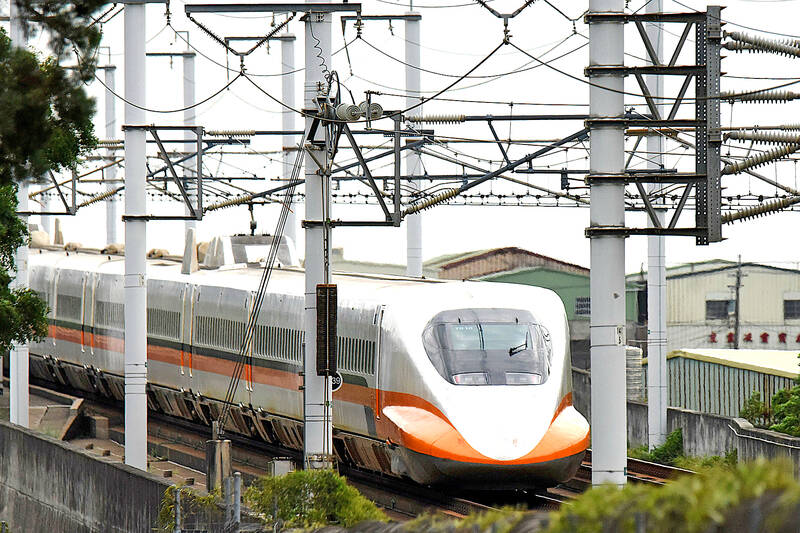
A high-speed rail train is pictured in an undated photograph.
Photo: Wu Liang-yi, Taipei Times
The download and upload speeds were measured and transmitted to the center’s data server.
Operators also used mobile phones to call a fixed audio source on their respective networks, with consistent call durations and intervals.
Chunghwa Telecom recorded the highest average download and upload speeds, at 159Mbps and 39.21Mbps respectively, the results showed.
Taiwan Mobile recorded an average download speed of 144.65Mbps and an upload speed of 31.19Mbps, while Far EasTone averaged 122.27Mbps for downloads and 36.01Mbps for uploads.
All three operators delivered better download and upload speeds at underground stations in northern Taiwan, including Taipei, Banciao (板橋) and Nangang (南港) railway stations, where relatively comprehensive infrastructure was in place, the foundation said.
Download speeds were generally faster in Chiayi County, while upload speeds were higher in Kaohsiung, it added.
Download and upload speeds were unstable in tunnels in Hsinchu and Miaoli counties, it said.
Chunghwa Telecom had access to 5G services for 92.86 percent of the test time, followed by Taiwan Mobile at 90.22 percent and Far EasTone at 85.3 percent, it added.
In some sections, including Tainan’s Yongkang District (永康) and Miaoli County’s Zaociao Township (造橋), 5G was unavailable, leaving passengers with access to 4G services only, it said.
All three operators also experienced voice-call disruptions during the test, particularly when trains passed through tunnels, the foundation said.
The results indicate that 5G coverage along the high-speed rail route needs improvement, it said, adding that passengers could experience poor Internet connectivity and interrupted calls when trains pass through tunnels or challenging terrain without additional equipment to strengthen signals.
“Given that consumers pay higher monthly fees for 5G services, they should reasonably expect stable, continuous, high-speed Internet access,” the foundation said. “However, the test showed that high-speed rail passengers frequently had to switch between 5G and 4G on their mobile devices, put up with unstable signals or rely solely on 4G in certain sections of the journey.”
“There is an obvious gap between consumer expectations and actual experience,” it added.
Taiwan High Speed Rail Corp said it signed a memorandum of understanding with the three telecoms in March to improve telecommunications quality along the line.
The operators would replace 369 base-frequency repeaters along the route with remote radio heads, increasing the number of units deployed to more than 2,200, it said, adding that the upgrade is scheduled for completion by the end of next year.
Once completed, it is expected to enable passengers to make uninterrupted voice calls, browse Web sites and stream videos without losing connection, the company said.
KioskNews shows a cleaned-up reading view extracted from the publisher’s page — the original always lives on their site, not ours.