How to make the perfect zuppa di cozze – recipe | Felicity Cloake's How to make the perfect …
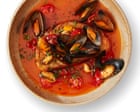
Abundant, good value and ready in minutes, mussels are one of my favourite seafoods, but when it comes to preparing them, I rarely look farther than northern France. Italians, of course, also eat mussels, and this tomato-rich recipe is a particular favourite in the south – Neapolitans traditionally tuck into zuppa di cozze on Maundy Thursday but it’s found on menus all year round. With its bold flavours and oily, garlicky sauce, it’s a great alternative to creamy moules marinières, and similarly needs no accompaniment but a hunk of bread to make a meal, though chips, of course, are rarely unwelcome.
The mussels
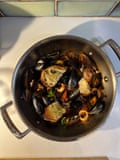
There’s not much to say about the main ingredient, except to bemoan the increasing difficulty in getting hold of live mussels due to the disappearance of so many fresh fish vendors, and the subsequent closure of supermarket fish counters (another rant for another day). Any remaining fishmongers should have British mussels, or they can easily be bought online. Don’t wash them until you’re ready to cook, when you should dump them in the sink and sort through them, discarding any with broken shells or that don’t close when you give them a sharp tap. Rinse with cold water; most mussels on the market are farmed, and rope-grown, so should be pretty clean, and I’ve never seen the point of scrubbing away at barnacles for hours when you’re not going to be eating the shells anyway (though please do enlighten me as to why I should bother). Remove any remaining trailing beards, though – I do have some standards!
The Silver Spoon dry-fries the mussels, then shells them to add to the soup later, while the Giallo Zafferano website steams them in garlicky oil and a little white wine, then removes them from the pot to be returned to the finished soup. It makes more sense to me to eat them as freshly cooked as possible – as Elizabeth David cautions in Italian Food, these “final operations must be carried out only immediately before serving”. Not only does this leave less chance of the shellfish overcooking, but necessarily ensures that every last drop of that delicious mussel liquor makes it into the sauce; tipping it back and forth, as in the Zafferano recipe, risks sacrificing a little, and when there’s not a lot to start with, that’s a gamble I’m not prepared to take.
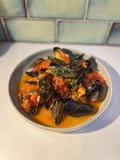
Zafferano, whose recipe is specifically Neapolitan, includes octopus, squid and prawns alongside the mussels. Delicious as all those things are, we find the squid and prawns are overcooked and rubbery once they’ve been fried and then simmered in tomato sauce for 15 minutes. If you’d like to include them, I’d fry them briefly first, then return them to the pan right at the end (and buy the octopus ready-cooked, if you can).
The base
David and the Silver Spoon are the only ones to use onions as the base of their dishes, with the former also including celery. More common is garlic in more or less generous amounts – Zafferano simply uses it to flavour the oil, while Marcella Hazan, perhaps reflecting the more Italian-American milieu in which she was writing The Essentials of Classic Italian Cuisine, sticks in a whole teaspoon and a half of the stuff, finely minced. I like the fiery flavour, especially alongside the chilli she also includes, plus this feels like a dish that should pack a punch.
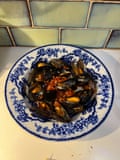
And that also applies when it comes to the tomatoes. Hazan uses tinned, and reduces them to a jammy, oily sauce before adding the bivalves, a similar approach to David, but the latter’s more watery fresh fruit (and seeded summer san marzano plum tomatoes are about as far from watery as you’re likely to get) yields a lighter, fresher flavour. My favourites, however, are the cherry tomatoes suggested by Benedetta Rossi of the Fatto di Casa da Benedetta website, because they strike a good balance between the intensity of the tinned variety and the zingy acidity of plum tomatoes. My recipe uses a few more than Rossi’s, though, because we find her version a bit light on sauce, and cooks them for a little longer, in homage to Hazan.
The Silver Spoon flavours the base with saffron, Hazan chilli and parsley (Rossi adds the stalks, reserving the leaves as a garnish), and David suggests fresh marjoram, thyme or basil. I really like the echoes of Mediterranean French fish soups that the saffron brings with it, but my testers are ambivalent as to its merits, so I’ll leave that one up to you. Herbs, I think, are better used on top; not only do they look pretty against the glossy black shells and vivid sauce, but the peppery flavour of the parsley gets lost in the heat.
The liquid
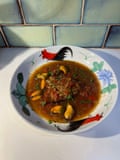
Not all recipes add extra liquid – the mussels give off enough to make a sauce, but it’s fairly scanty, so it makes sense to dilute it a little so everyone gets a decent spoonful alongside the shells. Wine is popular, used by David (who also adds a little water), Zafferano and Edinburgh’s Contini, while the Silver Spoon, whose recipe is more of a mussel soup garnished with a few actual bivalves than a pot of mussels, goes for fish stock. If you don’t drink, then this, with a spritz of lemon juice, is a decent substitute, but the zesty acidity of a crisp white is the ideal, not least because you can then drink it as an accompaniment.
Serving suggestion
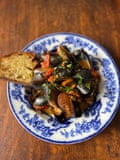
Peppery parsley looks good, and tastes great, according to those who like it better than I do (if you share my aversion, you might like to experiment with mint, thyme or basil), and the garlicky toasts that pop up in the Silver Spoon, Hazan and Zafferano’s recipes are the perfect accompaniment, whether you want to spoon the mussels on top, so the bread soaks up their liquid, or serve it on the side to mop up the end of the sauce.
Perfect zuppa di cozze
Prep 10 min
Cook 15 min
Serves 2
2 garlic cloves
500g cherry tomatoes
3 tbsp extra-virgin olive oil, plus extra to serve
1 pinch dried chilli flakes (optional)
1 pinch saffron (optional)
Salt
800g live mussels
2 tbsp white wine, or dry vermouth or fish stock
2 thick slices crusty bread
1 small bunch flat-leaf parsley, to serve
Finely chop one and a half cloves of garlic. Cut the tomatoes in half. Heat the oil on a medium flame in a saucepan large enough eventually to hold all the mussels, then fry the garlic and chilli, if using, until pale golden.
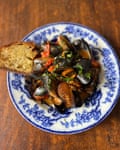
Stir in the tomatoes, saffron, if using, and a pinch of salt, then turn down the heat a little and cook until soft and pulpy. You can prepare the dish ahead up to this point if needed.
For this recipe, I’m assuming you’ve bought your mussels; should you have gathered them yourself, however, you’ll need to purge them in salt water overnight first, to get rid of any grit (have a look online for specific instructions).
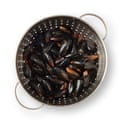
Either way, just before cooking, tip the mussels into a large colander and give them a good rinse with cold water. Sort through them, discarding any with broken shells or that don’t close when given a sharp tap (unless you can see the creature moving within). Scrub off any dirty patches (and barnacles, if you wish), and give any trailing beards (the weedy bits hanging out of the side of the shell) a sharp tug to pull them off.
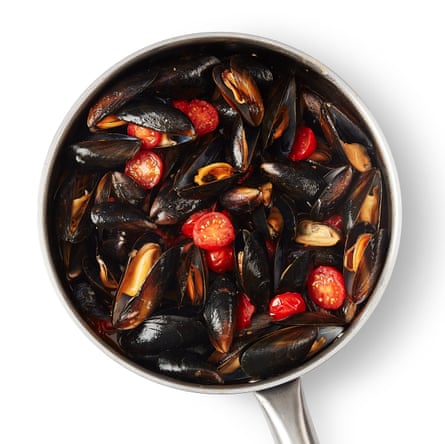
Add the wine to the pan, turn up the heat, then tip in the mussels. Cover and leave to cook, shaking the pan occasionally, for five to eight minutes, until most of them have opened (discard any that do not).
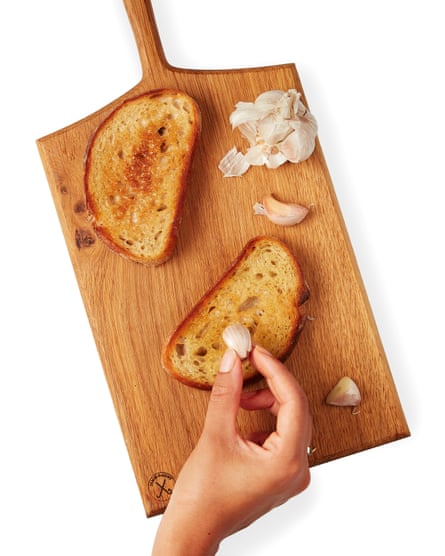
Meanwhile, grill or toast the bread, then rub it with the remaining half-clove of raw garlic and drizzle with oil. Finely chop the parsley.
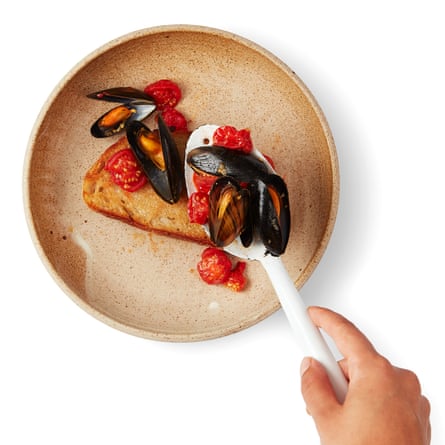
Divide the bread between serving bowls, then use a slotted spoon to scoop out the mussels and arrange on top (or serve the bread on the side). Bring the liquid back to a simmer, reduce slightly, taste for seasoning and ladle on top of the mussels. Sprinkle with parsley and devour immediately.
-
Zuppa di cozze – how do you like yours, and can anyone explain the many regional variations that surely exist on Italy’s extensive coastline? And which other mussel recipes would you recommend to anyone wanting an alternative to marinières?
-
The Guardian aims to publish recipes for sustainable seafood. Check ratings in your region: UK; Australia; US.
KioskNews shows a cleaned-up reading view extracted from the publisher’s page — the original always lives on their site, not ours.