Making Iraq ‘normal’ again: do mass arrests and cash seizures signal end to corruption?
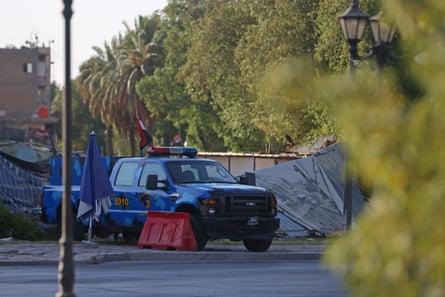
The gates of the Green Zone in Baghdad are made of five-metre-high armoured steel, reinforced with horizontal girders, and strung between concrete pillars and anti-blast walls. Police water cannon trucks are stationed nearby, along with armoured personnel carriers and squads of heavily armed soldiers.
At the first sign of street protests – over failing electricity, unemployment or, more recently, the US-Israeli attacks on Iran – the gates are shut. X-shaped vehicle barriers, made from welded iron beams and mounted on wheels, sit ready at the roadside alongside coils of razor wire; both are slid across the street, sealing off the sprawling neighbourhood, home to the presidential palace, parliament, the prime minister’s office, the massive fortress-like US embassy, and other institutions, including the homes of scores of politicians and members of parliament.
When the gates are closed, traffic is diverted, creating monumental jams lasting for hours for most Baghdadis who lack the coveted Green Zone badges.
In the early hours of 28 June, the gates were shut, US-made Abrams tanks prowled through the streets, and black-clad counter-terrorism units fanned out across the area. Only this time, the measures were meant to prevent those inside from leaving, rather than to keep those outside from getting in.
By dawn, Iraqis woke to the news that nearly 50 people, including a dozen MPs and senior officials, had been detained, along with the seizure of hundreds of millions of dollars in cash and gold. Pictures and videos, purporting to show masked officers hauling out safes full of money, piles of jewellery and suitcases filled with dollars, circulated widely.
The arrests were met with the greatest Iraqi schadenfreude since the beginning of time. For if Iraqis – of all persuasions, sects, ethnicities and social backgrounds – agree on one thing, it is the rottenness and corruption of the political parties that have held power since 2003, and the greed of a clique of party bosses, businessmen and militia leaders.
‘Not just something every PM does’
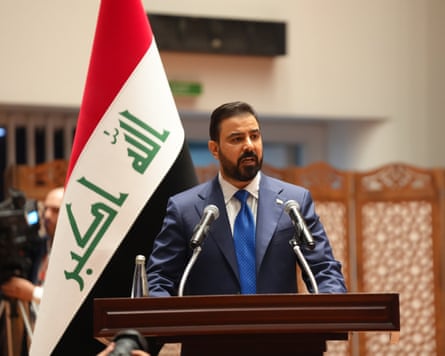
On the day of his inauguration as Iraq’s new prime minister in early May, Ali al-Zaidi, a 41-year-old with a round face, thin beard and sharp eyes, delivered, in stilted language riddled with grammatical mistakes, the standard repertoire of promises made by every prime minister before him, Iraq’s own version of making the country great again: supporting local industry, agriculture and youth; fixing the electricity supply and solving the housing crisis. But the two issues the wealthy businessman with little political experience emphasised as most urgent were disarming the pro-Iranian factions and fighting corruption “with no red lines”.
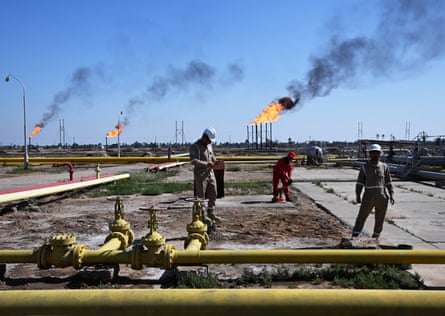
With Iraq’s coffers nearly empty after the near-total halt of its oil exports since the start of the US-Israeli war on Iran, these two issues – militias and corruption – are interlinked and, in the shadow of war, are threatening the state itself.
But the prime minister before him, and the one before that, had both begun their tenures with similar gestures – declaring the exposure of vast corruption networks – and both had ended their time in office mired in corruption charges of their own, while the country’s public services remained in ruins. So why should this time be different?
“No, this isn’t just something every prime minister does,” a government insider told the Guardian. “No, this is unprecedented – a real earthquake inside political circles, because it’s a signal to all the politicians about what could happen to them. To everyone, without exception.”
What we are seeing, he said, is a prime minister trying to dismantle the financial empires of the political parties – empires built on corruption that is naked and clear for all to see, and that implicates every single politician without exception. “So when you pick four or five of them and strike,” he said, “you are sending a message to everyone: what happened to those people can happen to all of you, if you don’t do such and such.”
Division of the spoils
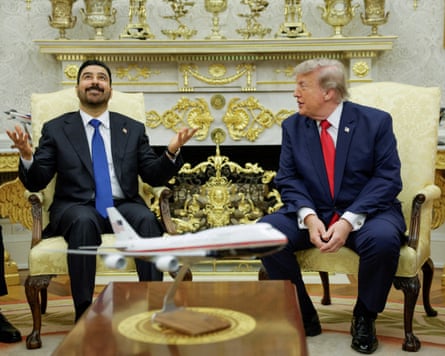
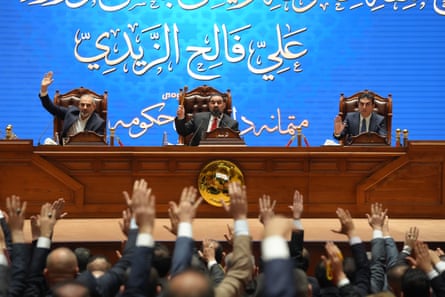
Al-Zaidi came to power as a compromise candidate after months of negotiations among the Coordination Framework, the bloc of major Shia parties and figures in parliament, and after the Trump administration vetoed the leading candidates.
The negotiations – really a haggling over the division of spoils – are a well-rehearsed exercise, repeated after every election for the past two decades, under a system known as muhasasa, which has become the cornerstone of Iraqi politics, devised by Iraqi opposition parties in exile in the 1990s as a power-sharing arrangement that would prevent Iraq from again sliding into a dictatorship. The arrangement was imported wholesale after the 2003 US invasion by those same parties and the Americans; under muhasasa, the prime minister is a Shia, the president a Kurd. But muhasasa also came to mean the division of government posts among all the political factions: Sunni, Shia, Kurdish and others.
Party bosses and militia commanders feud, threaten and cajole, some claiming to represent the historical rights of their community, others decrying the historical injustices imposed on theirs, all in an attempt to increase their share of the lucrative ministries and state institutions, turning them into party fiefdoms, running every possible scheme to defraud the treasury.
“The parties have built states within the state,” an international banker, who was hired by a previous government to help clean up the system, said. “We probably have seven or eight of these mini-states, siphoning between 5% and 10% of every government contract.”
The stooge?
In the muhasasa power-sharing system, if the minister of oil is Shia, at least one of his deputies – and it is always “his” – will be Sunni.
Here a second round of haggling and horse-trading begins within the Sunni blocs and parties over the lucrative post. It usually comes down to a kind of exchange rate – how many directors of education, health and culture is one deputy oil minister worth?
Once a party has won the post, the contest shifts to finding the right candidate. Sometimes the parties bring in someone from within their own ranks, ideologically committed to them, or a relative of the party boss. But in most cases, they choose someone from the bureaucracy instead – someone familiar with the running of the state, versed in the rules and regulations of an archaic and dysfunctional system: mandarins who have succeeded in weaponising these often-conflicting regulations accumulated over more than a century, from the Ottomans, to the British who imported a system for the Indian Raj, to the military dictators who added a socialist flavour, and finally the young American zealots who arrived in Baghdad after the 2003 war that toppled Saddam Hussein and wanted to create a neoliberal free market state, without any knowledge of Iraq or its history.
The regulations are deployed at every level to obstruct every state function – from the issuing of an ID card to the signing of a multibillion-dollar contract – until a bribe is paid to ensure the task’s smooth completion.
In January 2025, Adnan al-Jumaili – a young engineer with a pleasant, smiling, square face, lean, with a trim moustache and thick, prematurely greying hair – was appointed deputy oil minister responsible for refineries.
His fast rise through the ranks, first as director of a single refinery, then as director of the state institution overseeing the northern refineries, responsible for several plants, was celebrated in some pro-government local press as the placement of a young, honourable and efficient talent at the helm, one who would end years of mismanagement and setbacks.
He appears in several videos alongside the then prime minister, Mohammed Shia al-Sudani, who had been chosen by the same Shia parties to lead a government focused on delivering essential services.In video after video, al-Sudani is shown with his chest puffed out, wearing black sunglasses, cutting ribbons to inaugurate projects and showcase his government’s achievements, while beside him, a smiling al-Jumaili, in a hi-vis vest and helmet, briefs him on the details. In one clip, he even receives an “honourable employee” award from al-Sudani.
But soon after al-Sudani lost his bid for a second term and al-Zaidi became prime minister, it all came crashing down.
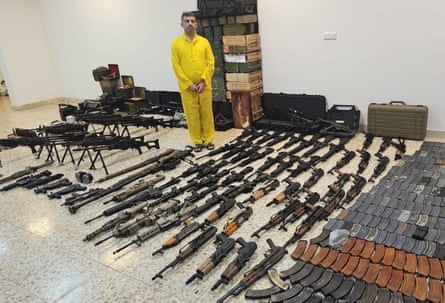
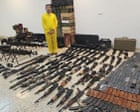
Al-Jumaili was the first to be arrested, on 30 May, and arraigned on television in a yellow jumpsuit, surrounded by dozens of machine guns and boxes of ammunition found at his home. Investigators said they had also recovered $10m (£7.4m) in cash, 3bn dinars (about $2m) and 1.5kg of gold, along with around 40 properties across Baghdad and other provinces. In the weeks that followed, more wealth surfaced: cash stuffed into plastic water bottles, hidden down a rainwater drain, concealed in walls – and, allegedly, 7bn Iraqi dinars that his wife was caught trying to burn in an outdoor oven. By mid-July, the total seized in the case had reached 127bn dinars ($96m) and $24m in cash, plus properties, vehicles and 375kg of gold, and 70 properties as well as a number of cars.
What shocked many Iraqis was the sheer vulgarity of it all – the way the money, the product of elaborate schemes devised to siphon millions, only for it to end up buried underground or stashed in boxes and large, family-size plastic pickle jars.
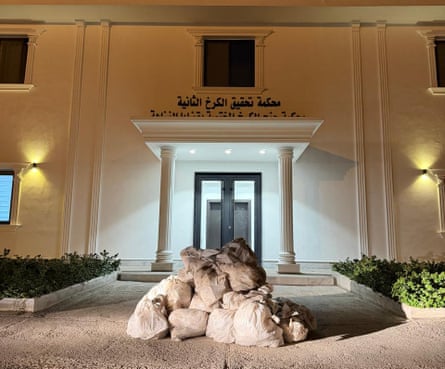
According to the judicial investigation, al-Jumaili ran a scheme that had yielded hundreds of millions of dollars.
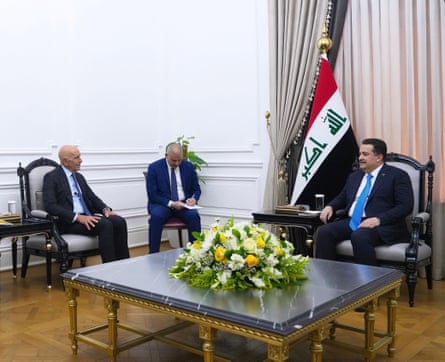
In a meeting with Iraqi journalists the next day, al-Zaidi said that al-Jumaili had tried to bribe him before his arrest with $200m to keep his post – in some reports, the total offer was said to reach $600m.
Whether al-Jumaili was the mastermind of all the corruption, or whether it had been laid out for him in advance, is unknown. But from the moment he arrived at the ministry of oil, he began amassing huge commissions from contracts and awards handed to companies and contractors and from diverted shipments of fuel.
As last year’s elections neared, he became a conduit for delivering millions of dollars to candidates, many on the prime minister’s list, though not all.
One politician told the Guardian: “Many parties came in and benefited from working with al-Jumaili, and he regarded all of this as protection for himself.” As his connections to political parties expanded – not only to the Sunni bloc that had nominated him, but allegedly to his bosses at the ministry of oil and in the prime minister’s office – he came to believe he was untouchable. And as his political cover grew, he began to commit catastrophic mistakes, the politician said. “Because, you see, he was telling himself he was now beyond reach – that it was impossible for anyone to touch him.
“So he began making mistakes, overreaching – faking warehouse deliveries, for example, and diverting fuel to create phantom storage stock that didn’t exist. We started hearing about thousands of phantom day-labourers, whose wages were being paid out even though they didn’t exist in the first place. We heard about transport contracts inside the refineries worth millions of dollars – contracts at astronomical figures.”
“The Adnan al-Jumaili affair is, I think, a model of the way things are run, the way the process of placing people in particular positions works,” the government insider said. “These positions are responsible for generating large revenues, illegally, for a party or for several parties. It’s like bitcoin mining, you see, they generate money.”
Investigations into al-Jumaili’s financial dealings had begun the previous October, when the judiciary began looking into spending irregularities in the elections and discovered that he had funnelled money to numerous candidates. This eventually led to his arrest and, after his confessions, to the mass arrests on 28 June.
‘That chapter must close’
The investigations and arrests coincided with two things: severe pressure on Iraqi finances brought on by the war, and a more active role by the US in shaping Iraqi politics.
According to government insiders, members of parliament and a source close to the judiciary, the Americans – weary of dealing with Iraqi politicians continuously failing to achieve any reforms – had built a rapport instead with the Iraqi judiciary. The new American envoy, Tom Barrack, played an active role, encouraged by the judiciary’s increasingly assertive statements on the state’s monopoly of weapons.
For many months, investigators searched for a corruption case that could be exposed publicly. The challenge was finding one that, when exposed, would make headlines domestically and internationally, while guaranteeing that the fallout would not bring down the entire post-2003 political system. Al-Jumaili’s case was perfect: it implicated a number of prominent politicians, but stopped short of naming the big party bosses.
As one official put it: “You don’t know, in the end, if you keep pressing on these parties – what might the armed factions do? What might Iran do?” The case also touched a nerve sensitive to the Americans specifically: the smuggling of Iraqi oil.
“The government and judiciary are aiming to achieve two goals,” the government insider said. “The first is to recover as much as possible of the money that the parties and political leaders have siphoned over the years.” (In several statements, the prime minister has hinted that if the money is returned, there will be no further legal repercussions.) “The second is to sever, in all its forms and details, the relationship between the parties and the state – meaning the relationship between the economic offices of these parties and every corner of the state apparatus. In other words: the parties will no longer be able to extract anything from the state.
“The idea that the parties live off quotas they receive from the state – through projects, commissions and so forth – must come to an end. That chapter must close. And I believe this is the most important thing that could happen in Iraq’s modern history.”
It seems that bringing in al-Zaidi, or at least the support he is getting from the US and the judiciary, was calculated precisely for this moment, he and other officials said. Someone with sufficient experience and knowledge of the mechanisms involved in routing money out of the state, who knows how money is smuggled, channelled and extracted through contracts, projects, commissions and so forth.
Will this latest drive to fight corruption deliver any serious results? Or will it turn out to be, at best, another cosmetic operation – if not a case of political score-settling? And how can Iraq become a normal state, capable of reform, while it sits on a regional faultline, caught amid a multi-pronged war fought across its land and skies – and can that reform ever be achieved without accountability for the party bosses and the mini-states they’ve built?
“There are no guarantees that corruption will end, and that parties will stop looting the state,” the government insiders said. “But what we’re hearing is that there really is a governmental and judicial desire to end a certain phase and begin a new one – a situation where things are normal, where basic services are available, where this constant crisis over fuel, electricity, water and every other detail comes to an end. Where the situation becomes normal, meaning: our state becomes like any other state in the world, with its successes and its failures.”
KioskNews shows a cleaned-up reading view extracted from the publisher’s page — the original always lives on their site, not ours.