'The Simpsons' Broke a 27-Year Rule With One Controversial Episode

Lloyd 'Happy Trails' Farley: the man, the myth, the legend. What can be said about this amazing - and humble - man that hasn't been said before? Or, more accurately, what can be said in public? Born in Calgary, Alberta, Canada, Lloyd is a master of puns and a humorist, who has authored one pun book to date - Pun and Grimeish Mint - and is working on a second. His time with Collider has allowed Lloyd's passion for writing to explode, with nearly 1,000 articles to his name that have been published on the site, with his favorite articles being the ones that allow for his sense of humor to shine. Lloyd also holds fast to the belief that all of life's problems can be answered by The Simpsons, Star Wars, and/or The Lion King. You can read more about Lloyd on his website, or follow his Facebook page and join the Llama Llegion. Happy trails!
Sign in to your Collider account
As far as the citizens of Springfield are concerned, what you see is what you get on The Simpsons, now entering its 38th season. Homer (Dan Castellaneta) is an idiot, Moe (Hank Azaria) is surly and depressed, Comic Book Guy (Azaria) is perpetually sarcastic, and so on. Likewise, despite being a series that famously eschews continuity, there are instances where an element of a character's life story is canon: Ned Flanders (Harry Shearer) was raised by beatnik parents, introduced in Season 8's "Hurricane Neddy"; Marge (Julie Kavner) had parents Clancy and Jacqueline and, of course, her twin sisters Patty and Selma (Kavner) growing up; while Homer was raised by Abe Simpson (Castellaneta) alone, after his mother, Mona (Glenn Close) left them and went into hiding.
These are longstanding truths about the characters, and while the series thrives on life events that are largely one-and-done — the rise and fall of the Be-Sharps in "Homer's Barbershop Quartet," for example — there is an implied rule that those canonical truths be adhered to. Only 27 years ago, The Simpsons broke that rule with one character, a mama's boy that's as rigid and strait-laced as they come, with an established history built up over 8 full seasons tossed aside in one controversial episode. That character is Principal Seymour Skinner (Shearer), and the episode is Season 9's "The Principal and the Pauper."
Will the Real Seymour Skinner Stand Up in ‘The Simpsons’ Season 9 Episode "The Principal and the Pauper"?
It's the 20th anniversary of Seymour Skinner's appointment as the principal of Springfield Elementary, and he's given a big surprise party to celebrate the occasion. Only there's a bigger surprise to come, the arrival of a man (Martin Sheen) claiming to be the real Seymour Skinner. Alas, the claim is true, as Principal Skinner admits that he is really Armin Tamzarian, a one-time troublemaker from Capital City before enlisting in the Army (versus jail time, that is).
Collider Exclusive · 8 Questions · 2 Minutes Which Iconic Fandom Should You Join? Harry Potter · Lord of the Rings · Star Wars · Star Trek
Eight honest questions about how you actually are: what you put on when you need cheering up, how deep you go into the things you love, what you argue about, what you keep on your shelf. Answer them and we will tell you where you belong. Four of the biggest fandoms on earth are taking new members, and they could not be more different from one another.
⚡Harry Potter(Wizarding World)
💍Lord of the Rings(Middle-earth)
⚔️Star Wars(A Galaxy Far Away)
🖖Star Trek(The Final Frontier)
01
What do you put on when you need cheering up? Nobody is brave about this one.
02
How deep do you go into something you love? There is no shallow end here, only different deep ends.
03
What do you and your friends actually argue about? Every fandom has one argument it has been having for years.
04
How do you feel about a room full of strangers? Every one of these comes with a very big room.
05
Where would you rather spend a week? Pick on instinct rather than on budget.
06
What do you believe about people, mostly? All four of these stories have an answer, and they disagree.
07
What is actually on your shelf? Look over at it before you answer.
08
What do you actually want from a story? Eight questions in, this is the one that picks your fandom.
Membership Confirmed Your Fandom Is…
Four of the largest communities on the planet, and four completely different reasons to belong to one. Here is yours, what it would give you, and the argument you would be having within a week.
Harry Potter
You belong to the fandom that is really about comfort. Hogwarts works on people because it is a place rather than a plot, and the pull is not the wizard war so much as the corridors, the food, the weather and the sense that somebody is expecting you.
- You are drawn to belonging, which is why this fandom sorted itself into houses within about five minutes and has never stopped.
- This is the most social of the four, and the one most likely to know which type every single person in your life would be.
- The books are built to be reread rather than analysed, and rereading is exactly what you do with things you love.
- The new HBO series is bringing the whole thing back one book at a time, which means the arguments are about to start all over again.
Lord of the Rings
You belong to the deepest fandom on this list, the one where somebody has always read further than you and is quietly delighted to say so. Middle-earth rewards patience more than any other world in popular culture.
- You like the sense that the story you are reading is only the visible part of something enormous, which is precisely how Tolkien built it.
- This fandom takes adaptation seriously to a degree that other fandoms find slightly alarming, and it has good reasons for that.
- Your favourite thing about the books is probably the bit that is not action at all, which is the walking, the songs and the long goodbyes.
- Nobody here thinks heroism belongs to the powerful, and the whole story exists to make that argument.
Star Wars
You belong to the loudest and largest tent of the four, the one where three generations are all watching the same thing and none of them agree about any of it. That disagreement is not a flaw in this fandom, it is the main activity.
- You want something you can share with absolutely everybody, from a six year old to a grandparent, and this is the only one on the list that really does that.
- Nobody argues like Star Wars fans argue, and the argument has been running since roughly 1980 with no sign of resolution.
- The pull here is sensory before it is narrative, since it is the sound design, the score and the look of a used and dented galaxy.
- You would be first in the queue, in costume, with strong opinions and a genuinely good time.
Star Trek
You belong to the thinking fandom, the one that turns up for the argument rather than the explosion. Trek has always been a series of ethical problems in space, and the people who love it love being asked what they would have done.
- You are an optimist in a way that is currently unfashionable, and this is the only major franchise still willing to say the future might be better.
- The best episodes are the ones where nobody fires anything, which is a sentence that makes perfect sense to this fandom and to nobody else.
- Starfleet Academy brought the franchise back to a classroom in 2026, which is appropriate, because Trek has always been a bit of a seminar.
- You would want the conversation afterwards more than the episode itself, and here you will always find somebody willing to have it.
It was in Vietnam where he met Sergeant Skinner, who helped Armin to put aside his troublemaking ways. Sadly, Seymour was declared missing and presumed dead, and Armin took it up on himself to deliver the news to his mother, Agnes (Tress MacNeille). Only Agnes mistook Armin for Seymour, and so, now unable to break the news, Armin went along, taking over Seymour's life and becoming a principal, a long-time dream for Seymour. The real Seymour, meanwhile, spent five years in a POW camp, then worked in a Chinese sweatshop for decades until the UN shut it down.
The townspeople start treating Armin with disdain, and so Armin leaves for Capital City. Meanwhile, the real Skinner takes over as school principal, but as time goes on, the townspeople, including Agnes, realize that they prefer fake Skinner. With that, Agnes, accompanied by the Simpsons and Edna Krabappel (Marcia Wallace), finds Armin, telling him he's more of a son to her than the real Seymour... before commanding him to return home. Homer persuades everyone to allow Armin to resume being Principal Skinner, an act that incenses the real Skinner. Showdown? Nope — real Seymour is tied up to a chair, placed on a freight train and sent out of town. With Seymour gone, Judge Snyder (Shearer) declares Armin to again be Seymour Skinner, school principal, and if the matter is ever brought up again, there will be harsh consequences.
'The Simpsons' "The Principal and the Pauper" Disrespects the Series' Fans
The out-of-the-blue reveal did not, and has not, gone over well, to say the least. Matt Groening cites it as one of his least favorite episodes, calling it a "mistake." Ian Jones of The Guardian cites it as when the show "became stupid," while The Star-Ledger, in an article from February 14, 2006, was a little more polite, saying that the quality of The Simpsons as a whole "gets much spottier" from that point on. Jon Hein, the father of the term "jumping the shark," declared the reveal of Skinner as Armin Tamzarian was "when we finally spotted a fin," and he's not alone in declaring "The Principal and the Pauper" as The Simpsons' "jump the shark" moment.
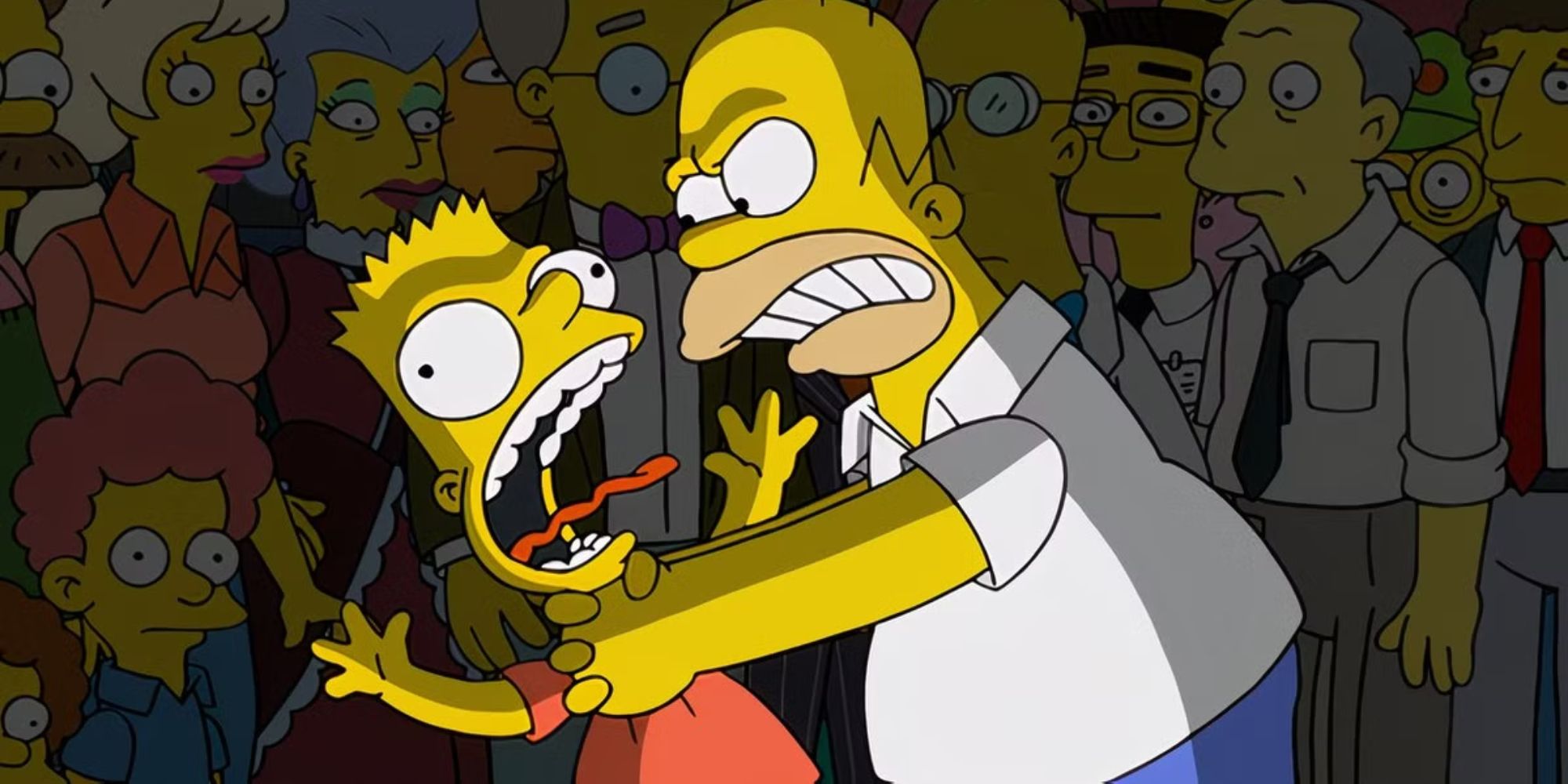
The question, though, is why the episode gets so much vitriol. For one, the series to that point was edgy, even controversial, but it was never mean-spirited. That changed, as noted in Fatherly, which claims that the episode was "just mean" and heartless, with Armin going unpunished for stealing an entire life as going too far. It rendered everything we thought we knew about the character — his military past, his co-dependent relationship with his mother, and so on — void, even nonsensical given an impostor couldn't possibly know all the details of Skinner's life. Even at the end, where the townspeople (and us, by extension) are told to forget it happened, the episode changed the perception of Skinner going forward, with viewers left to wonder if it was now canon or not.
However, it's Harry Shearer who sums up the problem with "The Principal and the Pauper" best, recollecting how he told the writers, "That's so wrong. You're taking something that an audience has built eight years or nine years of investment in and just tossed it in the trash can for no good reason, for a story we've done before with other characters. It's so arbitrary and gratuitous, and it's disrespectful to the audience." There are those that defend the episode, as few and far between as they are, leaving "The Principal and the Pauper" not only one of The Simpsons' most controversial, but also arguably its most divisive episode as well.
KioskNews shows a cleaned-up reading view extracted from the publisher’s page — the original always lives on their site, not ours.