Five baby orangutans dumped in Odisha forest lay bare India’s booming exotic pet obsession
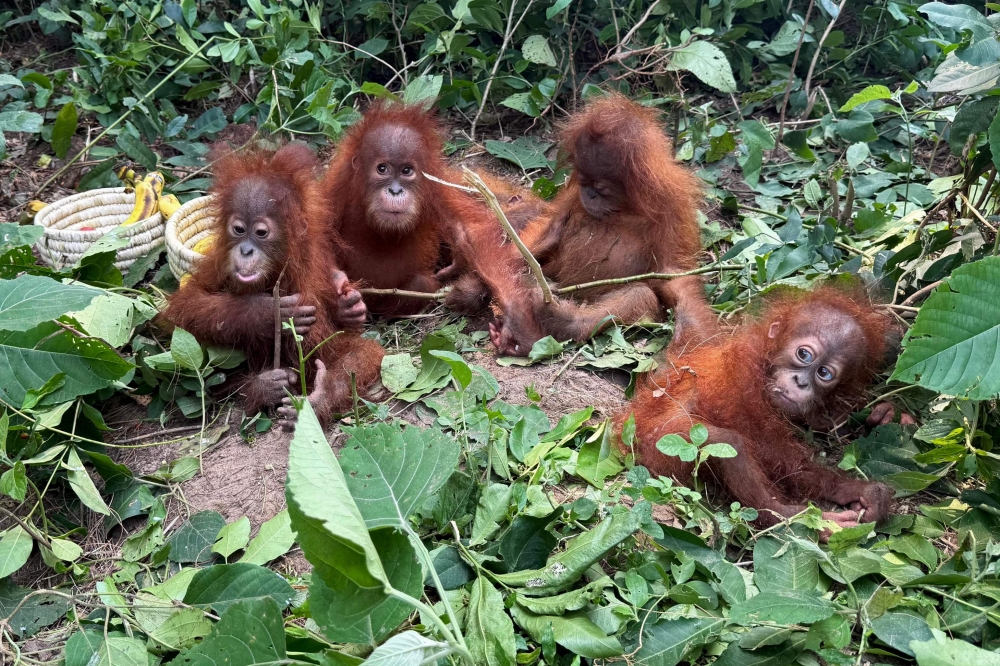

This handout photo shows rescued orangutans at the Ranakatha Protected Reserved Forest in Balasore district, Odisha state, India. — AFP pic/Odisha Forest Department handout
First Published: Saturday, 19 Sep 2026 7:00 AM MYT
NEW DELHI, Sept 19 — Five baby orangutans abandoned in an Indian forest have exposed a “massive” exotic wildlife trade, with traffickers smuggling increasingly rare species into the country, experts say.
They warn of a growing multi-million-dollar trade in endangered animals, including apes smuggled through war-torn Myanmar to feed demand among wealthy Indians seeking exotic status symbols to flaunt on social media.
“There have been several instances of exotic wild animals being found or seized across the country, said Sumanth Bindumadhav of Humane World for Animals India. “The scale is massive.”
Critically endangered orangutans are native only to Indonesia’s Sumatra island and Borneo, which it shares with Malaysia and Brunei.
Yet the five tiny orangutans were found by rangers in Balasore, in India’s eastern Odisha state.
Aged around one-and-a-half years old, they are being cared for at a zoo. Indonesia has requested their return.
Bindumadhav’s group, in a June 2026 report, detailed what it called a “rising trade in exotic wildlife”, demonstrated by a “steep increase in seizures” that reflected a “surge in illegal trade”.
The report estimated India’s exotic-pet market at US$42.6 million in 2024.
Orangutans and gibbons, small apes, were being “increasingly trafficked into India” from South-east Asia’s rainforests, it added.
‘Alarming scale’
A senior official at India’s Wildlife Crime Control Bureau said “thousands of social media influencers” were promoting exotic species as pets online, fuelling demand among followers.
“It is a huge market,” said the official, who requested anonymity because they were not authorised to speak to the media. “Rich people keep them in their homes.”
Under a government voluntary disclosure scheme, more than 40,000 people had registered exotic animals by February 2021, government data shows.
The figure is likely only a fraction of those in private hands, analysts say.
“This is a figure from only those who registered themselves, so the true volume of it is potentially much larger and remains unknown,” said Bindumadhav.
“The true scale of it is actually quite frightening.”
Former India head of global anti-wildlife-trade group TRAFFIC Shekhar Kumar Niraj said the surge in trafficking was also linked to a “rising number” of animals held in private hands.
“Private zoos have violated laws at a very alarming scale across the country,” said Niraj.
“Primates are very popular in zoos because they are very intelligent, like to interact with humans, the kind of thing zoos want.”
Indian federal authorities did not respond to AFP’s requests for comment.
The World Wide Fund for Nature-India (WWF-India) documented 56 seizures involving about 4,000 exotic animals in 2022 alone.
In October 2025, Mumbai customs officers arrested a passenger carrying two endangered gibbons stuffed inside a checked bag.
Other seizures in Mumbai last year included lizards, tree-climbing possums and dozens of venomous vipers.
In 2024, forest officials recovered a trafficked orangutan from a flat in Maharashtra state.
But such seizures represent only a fraction of the trade, experts warn.
‘Porous border’
“The scale of it is much, much bigger than what we see actually based on the seizure data,” said Jimmy Borah of the environmental advocacy group Aaranyak.
Experts have previously raised concerns over Vantara, a vast wildlife rescue and conservation centre in Gujarat founded by Anant Ambani, son of billionaire Mukesh Ambani, over its intake of endangered species.
Vantara has consistently denied any wrongdoing.
In August, it said it was taking “bold steps to reset its operations”, had withdrawn all applications to import live animals, and named former head of the global wildlife watchdog CITES, John Scanlon, to chair its governing council.
Exactly how the orangutans were brought to Odisha — more than 2,000 kilometres (1,200 miles) by sea, and 7,000 kilometres by land (4,500 miles) — is not clear. Police have launched a criminal investigation.
Experts say that in addition to airports and formal cargo routes, the land border between Myanmar and India’s northeast is a key trafficking route.
“The northeast is important for seizures of live exotic animals, linked to cross-border movement from Southeast Asia,” said Dipankar Ghose of WWF-India.
Authorities have seized other exotic primates in the region in recent years, smuggled on jungle routes across the frontier.
“We are talking about miles and miles of a very porous border,” said Borah of Aaranyak. — AFP
KioskNews shows a cleaned-up reading view extracted from the publisher’s page — the original always lives on their site, not ours.