Russian AI model fills void in Nikolai Gogol’s unfinished novel ‘Dead Souls’
Unable to complete his novel Dead Souls, the writer Nikolai Gogol suffered a breakdown and threw part of his manuscript into the fire only days before he died in 1852.
The book — though still regarded as a masterpiece of Russian literature — remained unfinished, with only one of three intended volumes surviving intact.
Now a Russian artificial intelligence (AI) model has created its own version of the second volume that Gogol burnt, in a bold experiment to test whether AI can capture the spirit and style of a great author.
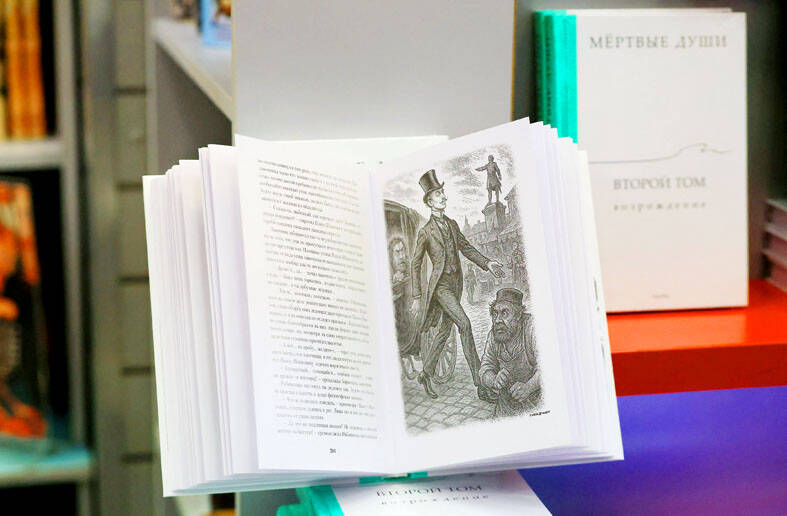
Copies of Dead Souls: Revival are displayed during a presentation and book launch at a bookstore in Moscow on Oct. 28.
The new book, Dead Souls: Revival, has caught the imagination of some readers while leaving critics cold.
Linguists, engineers and historians were all involved in the project by GigaChat, an AI model developed by banking and tech conglomerate Sber. The person in charge, Vladislav Otroshenko, said it had taken about four months for the machine to develop a plausible literary style.
“It handled the artistic side of the task, and the plot element in particular, very well,” he said.
“It is a bestseller... Readers are genuinely interested in it. Does it have artistic value? Of course it does, because it is the first unique, unprecedented experiment of its kind. And we were working with the most challenging style in Russian literature, Gogol’s style and poetics,” he said.
Born in what is now Ukraine, then part of the Russian empire, Gogol wrote his major works in Russian. He is claimed by both countries as a huge literary figure, known especially for his satire and dark comedy.
In the first, surviving, part of Dead Souls, he created a rogue’s gallery of characters led by the swindler Chichikov, who concocts a financial scam based on “acquiring” dead serf peasants still registered as belonging to their landlords.
However, Gogol, tortured by creative and spiritual doubts, was unable to complete the second and third parts of the book in which he had intended to portray the moral regeneration of the protagonist.
Igor, a Muscovite who attended the GigaChat book launch, said it really felt true to the spirit of the original.
“The book is truly unique, and I believe that admirers of Gogol now have an opportunity to assess it, compare it and see how Chichikov’s adventures ended,” he said.
However, Larisa, a visitor to the Gogol Museum in Moscow, said there was no way for AI to successfully capture what was lost.
“It will not move me and I don’t even want to read it,” she said.
Gogol expert Artyom Nikitin said that by the same logic, AI could write sequels to any number of works.
“But I believe that a literary work does not automatically flow from everything that an author created before,” he said. “Even if we know the author’s language, style and plot lines, that does not point us to what they will write next,” he said.
KioskNews shows a cleaned-up reading view extracted from the publisher’s page — the original always lives on their site, not ours.