A sleeping giant awakens, but the politics of suspicion still weighs heavy — Ahmad Ibrahim
NOVEMBER 2 — The four states that make up the SG4—Kelantan, Terengganu, Kedah, and Perlis—have long been described as Malaysia’s economic laggards. Collectively home to 5.7 million people and spanning over 38,000 square kilometres, they contribute a disproportionately small share of national GDP, well under ten per cent, despite holding roughly a fifth of the country’s population. This week, at the Kuala Lumpur Convention Centre, the coalition’s leadership gathered for the SG4 Business and Economic Forum 2026 under the theme “Four States. One Economic Vision,” intent on proving that this narrative can be inverted.
The headline message, delivered via a speech read on behalf of adviser Tun Dr Mahathir Mohamad, was one of latent greatness: SG4 is a “sleeping giant” with the land, resources, and strategic geography to become a productive economic zone if its four component parts finally pool their strengths rather than compete. The forum’s substantive findings, however, reveal a grouping still grappling with the fundamental tension between its economic logic and its political genesis.
The most concrete finding from the forum was a clear consensus that SG4 must resist the temptation of raw commodity extraction, particularly regarding rare earth elements (REE). Dr Mahathir’s prepared remarks explicitly cautioned against merely “retrieving and selling” REE, arguing that the real returns lie in downstream processing and value-added activities that could multiply state revenues several-fold. This is a welcome departure from the resource-cursed model that has plagued resource-rich but economically underdeveloped regions globally.
The forum also articulated a cluster-based approach to regional integration. Rather than treating the four states as separate investment destinations, SG4 Group Sdn Bhd—the equal-share vehicle owned 25 per cent by each state—presented itself as a single gateway. The economic clusters span infrastructure and logistics, agriculture and food security, education and human capital, and new resources including REE. Each state’s distinct ambition was highlighted: Kedah’s manufacturing hub aspirations, Kelantan’s commercial agriculture push, Terengganu’s downstream petroleum exploration, and Perlis’s focus on cross-border trade with southern Thailand.
Dr Mahathir’s speech veered into cultural commentary, warning that “shortcuts, quick profits, corruption” and a departure from Islamic tenets of honesty had hindered Malay progress, and that SG4 states were particularly under scrutiny because their populations are majority Malay Muslim.
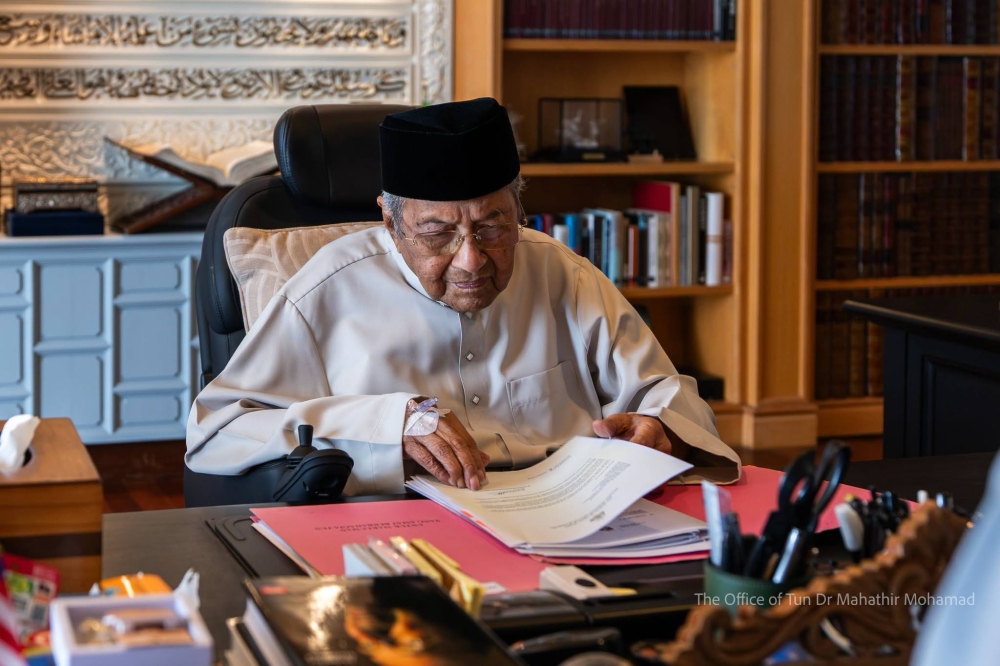
Former prime minister Tun Dr Mahathir Mohamad's speech was delivered on his behalf at the SG4 Business and Economic Forum 2026 at the Kuala Lumpur Convention Centre. — Picture via Facebook/Dr. Mahathir bin Mohamad
More tellingly, the political cohesion of SG4 is already showing strain. Recent political shifts in Perlis have raised questions about whether the coalition is truly four states or “SG3+1,” with PAS stepping back from direct participation in the state’s administration. A regional economic bloc whose membership is contingent on electoral outcomes is a difficult sell to investors seeking regulatory certainty over a ten-year horizon.
The forum’s organisers emphasised that SG4 works alongside federal agencies like MIDA and the Northern Corridor Implementation Authority rather than against them. But the political reality is that a coalition of opposition-governed states seeking greater autonomy over resource revenues will inevitably be viewed in Putrajaya through a lens of suspicion. The federal government’s cooperation, however politely framed, will be calibrated accordingly.
The forum’s stated commitment to people-centred development—creating quality jobs, empowering local entrepreneurs, and ensuring that growth benefits the rakyat—is admirable on paper. The emphasis on consolidating smallholders under professional management for large-scale commercial farming is a genuinely sensible structural reform. The recognition that SG4’s greatest asset is its people, not its minerals, is economically sound.
But the gap between rhetoric and implementation remains vast. The forum produced no detailed human capital plan, no specific skills-training commitments aligned with the semiconductor and downstream mineral industries it hopes to attract, and no timeline for the regulatory streamlining that investors consistently cite as the primary obstacle to doing business in these states. The absence of Dr Mahathir, who has been the intellectual anchor of the project, due to ill health, underscored the initiative’s dependence on a 101-year-old figurehead rather than institutionalised governance.
The SG4 Business and Economic Forum 2026 succeeded in one respect: it demonstrated that the four states have a coherent economic narrative and a leadership willing to articulate it in the language of investors rather than solely that of political grievance. The emphasis on value-added REE processing, cluster-based industrial policy, and cross-border trade with Thailand is strategically sound.
What the forum did not demonstrate is that SG4 can transcend its political origins. Until the grouping can convince domestic and foreign investors that its economic institutions are insulated from electoral cycles, that its commitment to good governance extends beyond exhortation, and that its federal relations are cooperative rather than adversarial, the “sleeping giant” will remain just that—sleeping. The giant has stirred. Whether it rises depends on decisions that no forum, however well-intentioned, can make on its behalf.
* Professor Datuk Dr. Ahmad Ibrahim is affiliated with the Tan Sri Omar Centre for STI Policy Studies at UCSI University and is an Adjunct Professor at the Ungku Aziz Centre for Development Studies, Universiti Malaya. He can be reached at [email protected].
** This is the personal opinion of the writers or publication and does not necessarily represent the views of Malay Mail.
KioskNews shows a cleaned-up reading view extracted from the publisher’s page — the original always lives on their site, not ours.