Ignoring the noise: What it’s like competing at the ‘vocational skills Olympics’ in Shanghai
SHANGHAI – There are hasty glances over at their opponents beside them. Frantic flipping of test papers, youth bent almost double over work stations. Drills clattering to the floor. Futile attempts to lift machine parts.
A hundred curious eyes and phone cameras trained on them, some no more than an arm’s length away. And all the while, a big digital clock counting down on the wall as they race to complete a series of tasks. No pressure.
I am at the biggest skills competition in the world, called WorldSkills. This 48th run of the event, held every two years, is taking place in Shanghai.
Some 1,400 youth representing more than 70 countries and regions are competing across 64 different skills, in sectors ranging from transport and logistics to personal services.
They qualify by beating the competition in their state, nation and regional WorldSkills competitions.
Over four days in a still-warm September, these young men and women are welding and baking, cutting hair and repairing machinery, making clothes and testing software.
I have never seen anything like it.
There are realistic sets of restaurants, hotel receptions and clinic rooms. Nails are painted, food consumed and competitors assessed on their skills and service.
Cars, helicopters and huge machines sat in the space for people to paint, repair and operate.
Some halls smell of baking bread and flowers, while others ring with drilling and whizzing drones.
Work in construction sites, offices, factories and workshops is suddenly brought to the world stage, and everyone wants a glimpse.
Walking into the National Exhibition and Convention Center in Shanghai, I was first struck by its sheer scale – with eight halls forming the shape of a four-leaf clover, it is about the size of 15 football fields.
The sprawling venue is normally used to hold massive trade fairs.
Somewhere, a horn sounds to signal time’s up for an event. The audience claps.
Competing seven hours a day
At the end of the first day, cybersecurity competitor Shum Hoe Yeong, 19, rose dejected from his chair. Later, he told me the questions were difficult.
It is as much a test as a competition. Contestants are expected to compete for as long as seven hours a day.
“I feel like I’m taking O levels again,” said Hoe Yeong.
He and his teammate Eugene Yang, 20, also have to tune out countless comments from tens of thousands of visitors passing through each day.
“I heard a lot of people say, ‘This is Singapore’,” laughed Hoe Yeong. “We cannot listen.”
Headphones are not allowed for cybersecurity.
“Yesterday’s seat was better – it was in the corner, there was not a lot of people,” said Eugene. Cybersecurity competitors draw lots every day to decide the seating arrangement.
The paper was tough, with concepts they had not trained as hard on – cryptography, configuring systems.
But they achieved a mini breakthrough.
Hoe Yeong, stronger in defence, was trying his best to crack a hard question, while Eugene, better at attacks, tackled the subsequent questions.
It was a triumph when Hoe Yeong solved the defence question, and the duo were able to submit their answers in one shot, with all of them marked correct.
Yi Jiaxin, 21, from software testing – a form of quality inspection in the digital world – said he felt pressure from the Chinese competitor sitting behind him.
This is a new category, which means “more chance to win”, Jiaxin said, as competitors are less experienced. He is facing off with 10 competitors.
New skills reflect changing industries
Senior Parliamentary Secretary for Education Syed Harun Alhabsyi, who visited Team Singapore at the event, said the new skills Singapore is participating in reflect the changing industries and how our institutions are adapting.
Among the new areas Singapore joined are rail vehicle technology and unmanned aerial systems.
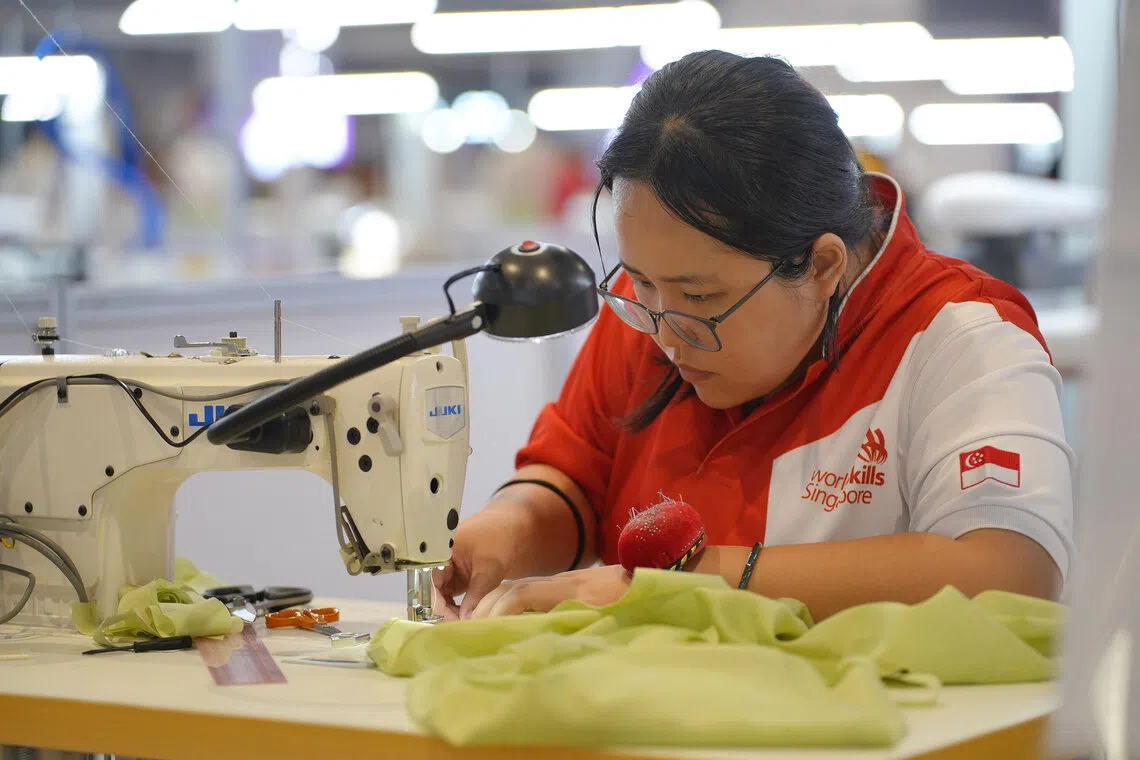
Fashion technology competitor Lim Jia Zhen, 21, was nervous about only finding out what tasks she had to do only on the day itself.
PHOTO: WORLDSKILLS SINGAPORE
Fashion technology competitor Lim Jia Zhen, 21, sweat beading above a furrowed brow on day three, moved from the steamer to the sewing machine. Hair up in a claw clip, pin cushion around her wrist, she stitched away, a slight tremor in her hands.
Watching from the side, her coach Eve Tan said surprise elements in the test threw off competitors.
Jia Zhen had the challenge of creating a rare design of three “darts” on her top – folded and stitched folds of fabric used to shape the material – a process that required high precision.
Eve said Jia Zhen was about 20 minutes behind time, based on usual checkpoints during her training.
But the girl adapted to the changes. And she can go fast and precisely, said Eve. “I’m hopeful.”
Jia Zhen said after the day’s close: “I was really nervous as I would find out what tasks I’m doing only on the day itself. But after the first two days, I’ve decided that I shouldn’t fear the unknown and embrace it like I’m opening a blind box.”
Hungry, but hyper-focused
For aircraft maintenance competitor Aidan Wong, there is no time for toilet or water breaks. The seven hours he is given is barely enough to finish his tasks, he said.
To stay alert, Aidan eats smaller meals, opting for protein over carbohydrates.
“I was basically starving the whole morning,” he said at the end of day two.
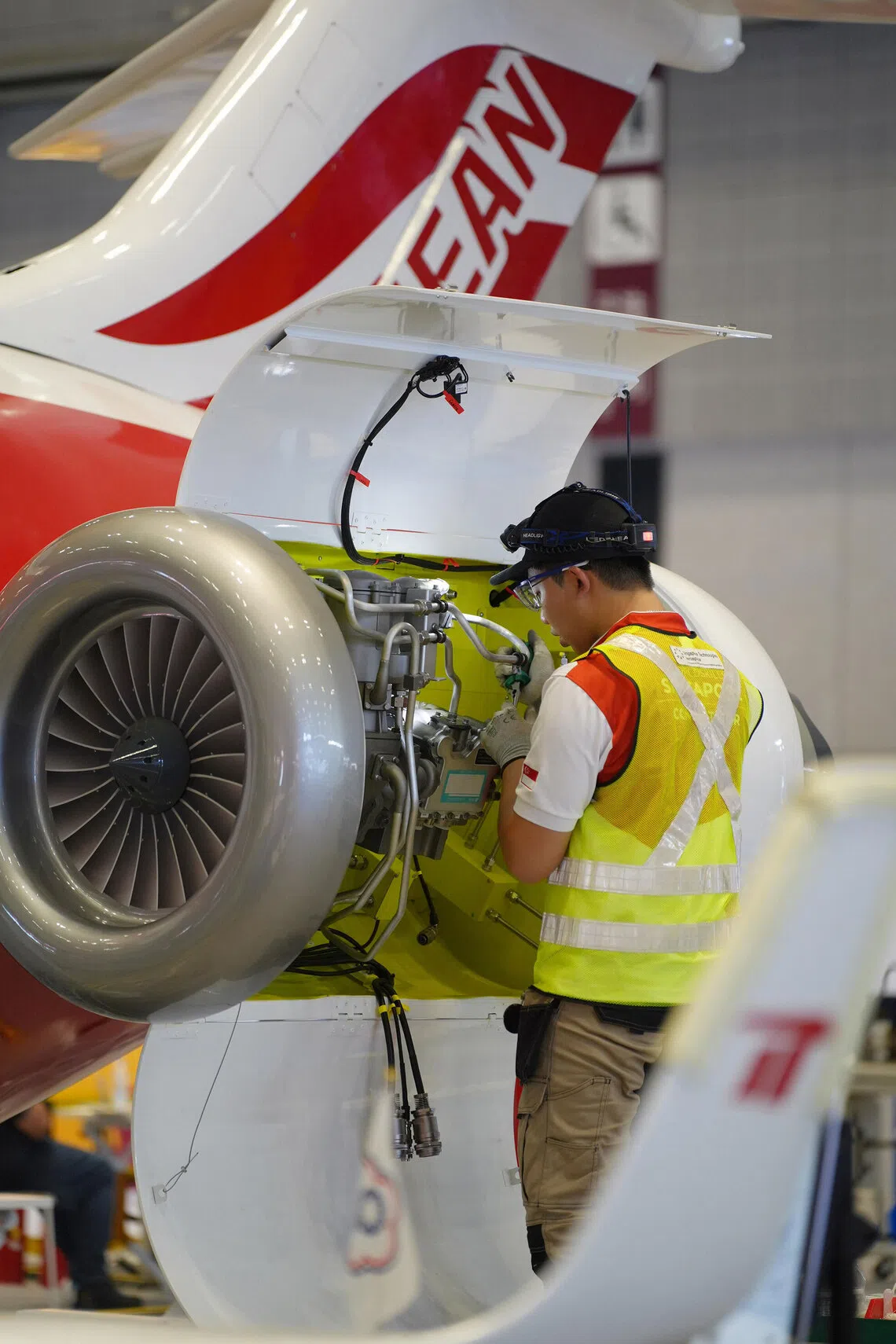
To stay alert, Aidan eats smaller meals, opting for protein over carbohydrates.
PHOTO: WORLDSKILLS SINGAPORE
But he said the hunger helps him concentrate.
He needed it. Self-doubt crept in when Aidan saw how quickly his opponents finished tasks he was struggling with.
The trickiest questions tested him on repairs, where he had to precisely mend a dent in the plane, rather than create a part from scratch.
“I thought I was an all-rounder. It was humbling,” Aidan said.
More than anything, having got up at 5am each day to get ready, he was “super shag” by the end of day two.
So were Eugene and Hoe Yeong – “exhausted”. Some of the Singapore contingent fell sick two days in.
Aidan, who is bound for national service after WorldSkills, knows medals are not everything. “The point of this is to learn from the best of each nation,” he said.
Fashion tech competitor Jia Zhen also said it has been fulfilling. “Looking back at my training, I think I’ve done a really great job, regardless of the result.”
Harun said Singapore’s competitors, through participating over many hours each day under high pressure, “will develop a sense of confidence in their own skills (and) a sense of resilience against any adversity”.
Those who do not perform as well as they hoped also learn to bounce back, he said.
I left the venue spent but deeply impressed by the contestants, who are usually no older than 23. I have much to learn from their discipline in training, their willingness to solve difficult problems under immense pressure. And no less from their daring to put themselves up against the best in the world, to dream of the gold and go for it.
The next time I am fighting my own battles in work and life that seem insurmountable, I will think of these WorldSkills youth and draw strength from them.
KioskNews shows a cleaned-up reading view extracted from the publisher’s page — the original always lives on their site, not ours.