Cabinet approves NT$3.6 billion for school security
By Jonathan Chin / Staff writer, with CNA


The Executive Yuan yesterday approved a three-year, NT$3.6 billion (US$113.28 million) plan to increase the number of safety personnel at junior-high schools to 2,000 from 620.
Local governments would provide annual subsidies of NT$120 million to 966 eligible schools from Thursday next week to July 31, 2029, K-12 Education Administration Director-General Peng Fu-yuan (彭富源) told a post-Cabinet meeting news conference in Taipei.
Premier Cho Jung-tai (卓榮泰) authorized the plan to help teachers handle safety-related tasks, emotional outbursts and behavioral issues, including the use of narcotics, he said.
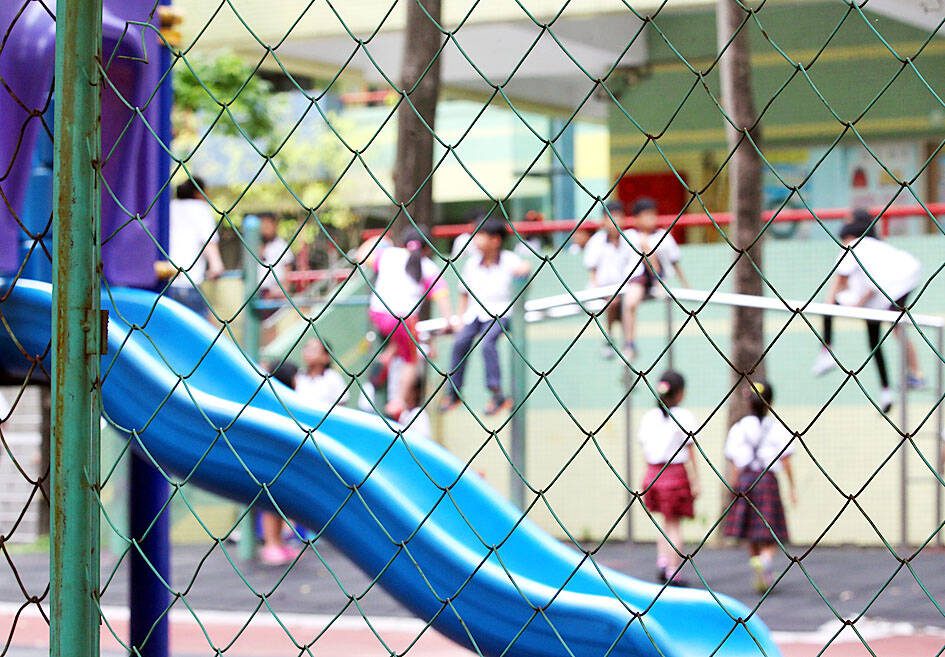
Students play on a school playground in Taipei’s Beitou District on June 1, 2015.
Photo: CNA
Under the plan, one campus security person would be assigned to schools with six classes or less, two to schools with seven to 36 classes and three for schools with 37 classes or more, Peng said.
A dedicated force of personnel would be valuable in dealing with campus safety issues, student-on-student or student-teacher altercations, and post-incident liaisons with parents, allowing educators to focus on teaching, he said.
Local governments would be in charge of selecting and managing the personnel, with the Ministry of Education covering 86 percent to 90 percent of the costs, according to need, he said.
The ministry would also subsidize training costs, such as specialized courses on emergency response, drug abuse prevention, anti-bullying policy and laws governing schools, Peng said.
Taiwan holds training courses for campus safety officers each year and more than 7,000 people are licensed to work as school safety officers, Deputy Minister of Education Chang Liao Wan-chien (張廖萬堅) said.
Elementary schools are already expanding their counseling staff under a separate program, and senior-high schools are protected by more than 2,000 campus safety officers, he said.
A rise in safety incidents in junior-high schools, which have fewer resources than other levels of education, prompted an official policy response, Chang Liao said.
School administrators expressed support for the policy during meetings with educational officials as a measure that would help relieve the burden on teachers, he added.
KioskNews shows a cleaned-up reading view extracted from the publisher’s page — the original always lives on their site, not ours.