COA sounds alarm as pests feast on stash of disaster supplies in warehouses
Already have Rappler+?
to listen to groundbreaking journalism.
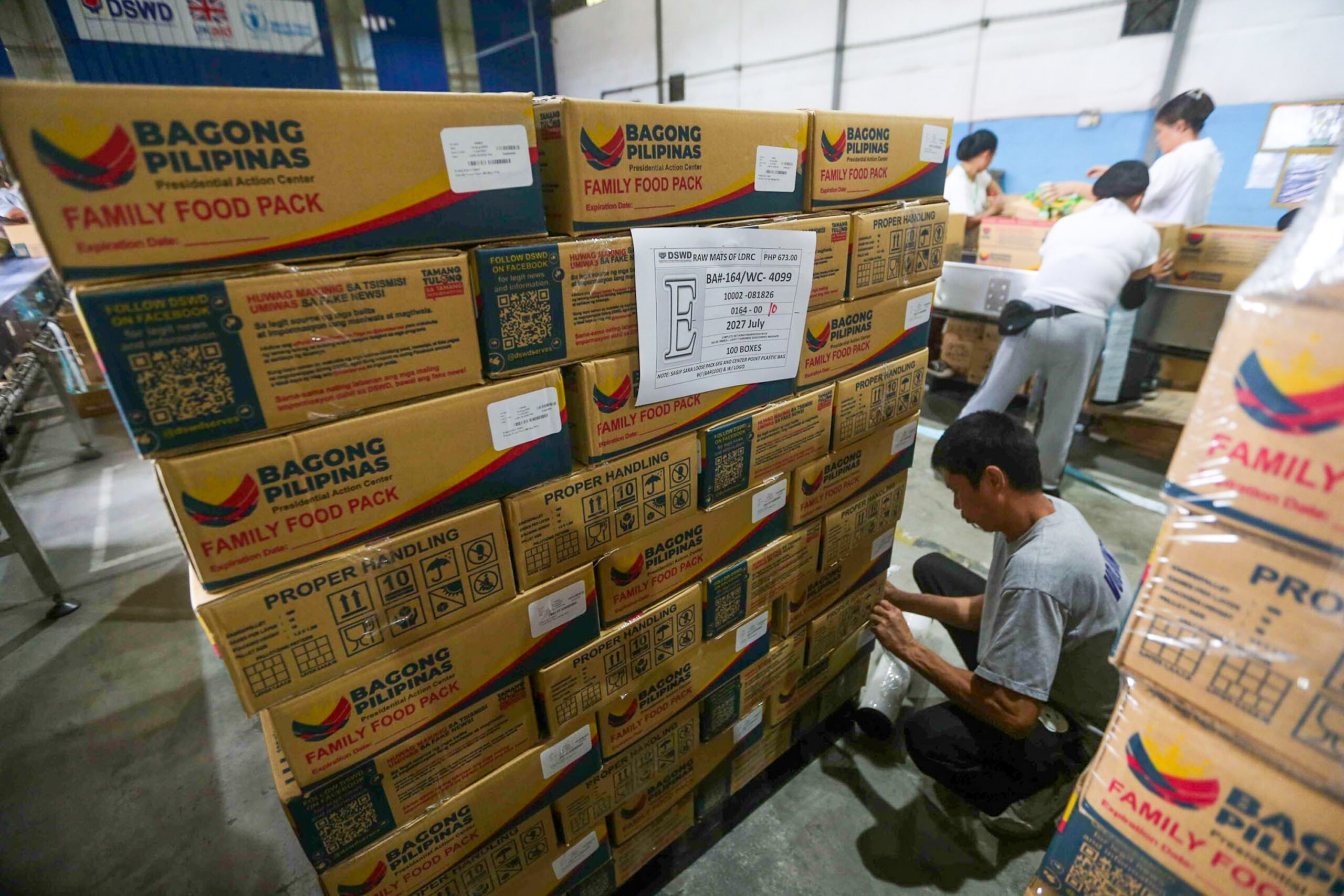
Volunteers and personnel from the Department of Social Welfare and Development (DSWD) repack relief goods at the DSWD-National Resource Operations Center in Pasay City on August 18, 2026, as the agency continues its disaster response operations following recent calamities across the Philippines. The relief packs are set to be distributed to families affected by flooding and other weather-related incidents linked to the southwest monsoon and recent tropical weather disturbances.
Rappler
Inadequate management and monitoring result in welfare goods being disposed of or left unused, with some items nearing expiration and unfit for distribution
AT A GLANCE
- The Commission on Audit reported significant pest control and storage issues in warehouses used by the Department of Social Welfare and Development, leading to the contamination and deterioration of disaster response supplies worth over P106 million.
- The auditors emphasized the need for the DSWD to improve monitoring and compliance with storage standards to prevent further loss and ensure timely distribution of emergency supplies.
This is AI-generated. Read the article for full context. Report any errors.
MANILA, Philippines – The rats and other pests got there first. And they were not confined to one warehouse.
Much of the supplies, meant for disaster response, became part of the waste, showed the findings detailed in the Commission on Audit’s 2025 report on the Disaster Risk Reduction and Management Fund, released on September 16.
The COA found pest-control and storage problems in warehouses and other facilities used by the Department of Social Welfare and Development (DSWD) and local governments in Northern Mindanao, Ilocos Region, Calabarzon and Davao Region, where government-held food and welfare supplies were exposed to rodents and other pests.
In Northern Mindanao, the problem involved close to P107 million worth of welfare goods stored for disaster response at the end of 2025.
State auditors said the supplies were not adequately protected by a food-safe and systematic pest control program. Rodents and other pests got into the warehouses, exposing the goods to contamination, physical damage and deterioration.
Some of the supplies became damaged, infested or stale and had to be disposed of as unfit for distribution.
State auditors said, “DSWD warehouses holding welfare goods worth P106,934,388.07 at year-end were not adequately protected by a food-safe and systematic pest control program.
“The goods were exposed to contamination, physical damage, and deterioration from rodents and other pests, leading to damaged, infested, and stale items that had to be disposed of as unfit for distribution.”
The problems went beyond rats and mice.
In the Ilocos Region, auditors found welfare goods that were either thrown away before they could reach beneficiaries or left sitting in storage for extended periods, victims of poor stock management and delayed distribution.
“Welfare goods amounting to P6,363,788.31 earmarked for distribution beneficiaries were either disposed of due to impairment prior to their distribution or remained dormant for prolonged periods due to inability of the Management to ensure prompt distribution, non-monitoring of shelf life, and lack of accountability for non-moving items,” the auditors said.
In Calabarzon, the COA found another version of the same problem. Warehouses maintained by local governments were not consistently meeting the standards required to protect prepositioned food and non-food items from damage and deterioration.
“The storage and management of prepositioned FNIs in selected LGU warehouses… were not fully compliant with the prescribed standards on storage, housekeeping, sanitation, and monitoring resulting in the damage and deterioration of certain FNIs,” the audit team said.
The auditors warned that without corrective action, the remaining P21.1 million worth of inventories were “at risk of contamination, expiration, and loss.”
Then there was Davao Region where an onsite inspection of local government storage facilities found food packs already nearing their expiration dates as of February 2026. They had not been used or withdrawn for reallocation, leaving supplies that could have gone to people in need sitting on shelves until their usefulness was running out.
“The absence of effective monitoring over prepositioned goods stored in LGU warehouses… heightens the risk of deterioration, contamination, damage, expiration, misplacement, or wastage of government resources,” government auditors added.
State auditors said the DSWD needs to strengthen its monitoring and inspection of agency warehouses and storage facilities shared with local governments for prepositioning emergency supplies.
It also stressed the need to “require the concerned warehouses to immediately rectify the identified deficiencies, including compliance with prescribed storage, sanitation, and
housekeeping standards.” – Rappler.com
KioskNews shows a cleaned-up reading view extracted from the publisher’s page — the original always lives on their site, not ours.