The "shameful" measles data that lost the US its elimination status
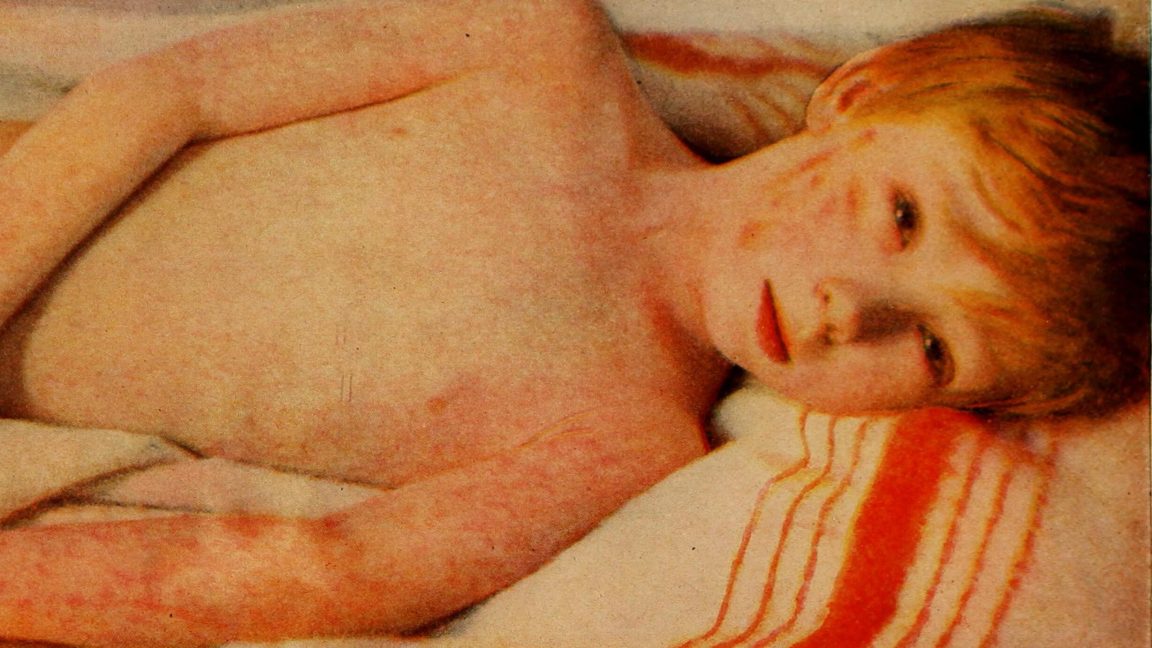
International health authorities formally announced on Tuesday that the US has lost its measles elimination status, a hard-fought public health triumph won in 2000 after decades-long vaccination efforts. The loss had been widely expected by public health experts for months, and the decision was leaked by the press last week. Still, having the designation officially stripped stings.
After the announcement Tuesday, public health experts, doctors, and political leaders decried the dramatic backslide for the US, calling it “shameful” and a “national embarrassment.” News articles point to the staggering vertical rise of measles cases this year, currently over 5,400 cases, more than any other year since 1991. An explosive measles outbreak in Pennsylvania accounts for over 1,500 of those cases. There have been 10 confirmed deaths across three states, several deaths just in the last week.
But the measles data that caused the US to lose its status—the bits of it that are public at least—paint a darker picture of where the US is in its rematch with measles, the most contagious virus known on Earth. For one thing, almost none of the data from this year—the cases, the explosive Pennsylvania outbreak, the deaths—factored in to the loss. It was lost earlier. What’s happening now is a runaway epidemic.
Lost status
The US measles elimination status is a designation granted by the Pan American Health Organization (PAHO), which is a regional division of the World Health Organization. Last week a committee of experts assembled by the PAHO, called the RVC, met to review measles data for countries across the region, including the US. (RVC is short for the Measles, Rubella and Congenital Rubella Syndrome Elimination Regional Monitoring and Re-Verification Commission.)
For their review of the US data, the RVC heard from an independent committee of experts from the US, called the NSC, which presented measles data collected from January 2025 onward. (The NSC is short for the US National Sustainability Committee for the Elimination of Measles, Rubella, and Congenital Rubella Syndrome.)
According to the PAHO, an elimination status is lost when epidemiological and laboratory data shows that a single viral lineage has spread continuously for at least 12 months within a country. At this point, the virus is considered to be reestablished or endemic. So, to withdraw the US elimination status, the RVC needed to see evidence that a single introduction of a measles virus led to a 12-month-long chain of cases, which requires a lot of data.
The full set of data the NSC presented to the RVC is private for now. The US Centers for Disease Control and Prevention needs to review and approve such data for public release, which can be a lengthy process that has not yet occurred.
The Department of Health and Human Services, which oversees the CDC, did not respond to a question from Ars Technica regarding when the data may be released.
Private data
But Ars Technica spoke with the chair of the NSC, Noel Brewer, who tried to talk through the pieces of data in the NSC report to the PAHO that he could discuss—these are pieces that have already been made public at some point by others, such as by state health officials or researchers. Brewer said the NSC presented the PAHO with genetic data spanning January 2025 to January 2026, and also epidemiological data that extended to June 2026.
In a press briefing Tuesday, officials for the PAHO made clear that only some of the data presented by NSC factored into its assessment of the US elimination status. The RVC only looked at the reporting period between January 2025 and January 2026, which doesn’t include the massive outbreak ongoing in Pennsylvania, which began in April. “The number of cases in Pennsylvania did not actually contribute to the decision that was made by the Reverification Commission,” Rhonda Sealey-Thomas, PAHO’s assistant director, explicitly told reporters Tuesday. For 2025, the US reported 2,289 cases nationally.
Still, there was no ambiguity about the US losing its status; “multiple lines of data show clearly that the US has sustained transmission of measles,” Brewer told Ars.
Brewer, who is also the Gillings Distinguished Professor in Public Health at the University of North Carolina at Chapel Hill, confirmed that the beginning of the end of US elimination was January 20, 2025, in Texas—that date was included in the letter PAHO sent to the US informing it of the loss of elimination status. That Texas outbreak was declared over on August 18, 2025, after 762 cases were confirmed in the state. But the virus carried on elsewhere and is still simmering.
“Since January 20, 2025, the US, Canada, and Mexico have been passing measles cases back and forth across borders,” Brewer said, and the national data shows multiple, “genetically distinct” measles introductions into the US. “However, there is one genomic lineage that predominates across the cases and ties many of them, the majority of them, together,” he said.
Key question
For people closely tracking the US measles status, a key question has been whether the big outbreaks that followed the initial one in Texas were clearly linked. If they were, it would be immediately obvious that the US had lost the elimination status; but if not, and the outbreaks were driven by different virus introductions, the US could have kept its measles-free status based on the technicality of how the status is defined.
Data that might hold the answer to this question has been elusive. The measles strain in Texas, D8-9171, appeared similar to the viruses seen subsequently in big outbreaks in Arizona and Utah. But, the strain was also similar to those from Mexico and Canada. Generally, there can be relatively small genetic changes among measles viruses, and genetic data alone is not used by PAHO to evaluate elimination. In June of this year, ProPublica tried to get at the answer itself, conducting its own genetic analysis of measles strains in the US. It concluded that “the measles virus still spreading in Utah as of this May is very closely related to the one that sickened Texans over a year ago.” But the outlet acknowledged this wasn’t a “smoking gun.”
To date, the question lingers. Brewer cannot yet explicitly disclose what the NSC reported to the PAHO about possible links between the Texas outbreak and any of the subsequent large outbreaks in 2025. That includes the one in nearby Utah or one in South Carolina, which began in October 2025 and ultimately tallied 997 cases by the time it was declared over in April, 2026.
For its part, the PAHO did not respond to multiple requests for comment from Ars Technica on linkages between the outbreaks.
But, in a twist, Brewer noted that the answer to the question might be moot; the lineage that started in Texas on January 20 might not be the only one that has been sustained and could have lost the country its status. There are “one or two that have gone on for more than 12 months,” he said.
Bleak outlook
With the designation now formally lost, health and medical experts are coming to grips with the reality that measles is once again endemic in the US. Details of how the US should move forward are up for debate; the US is now required to submit a “corrective action plan” to the PAHO, outlining how the country intends to regain its elimination status. But, the fundamental solution is obvious and straightforward: The US needs to increase vaccination rates.
While the virus has been raging in religious communities with low vaccination rates, the entire US has seen slipping vaccination coverage. That makes it easier for the virus to gain a foothold virtually anywhere.
A protective vaccination rate is considered to be 95 percent; according to the latest data, only 92.4 percent of kindergartners were vaccinated with the measles, mumps, and rubella (MMR) vaccine in the 2025–2026 school year. Only 10 states have MMR vaccination rates at or above the 95 percent threshold. Meanwhile, non-medical exemptions from school vaccination requirements have never been higher, at 4 percent. Currently, 24 states have exemption rates at or above 5 percent, meaning that even if they are able to vaccinate every single non-exempt child, they would still not meet the 95 percent target. And this is just the data for young children. The vaccination coverage for adults is another concern, and the data there is scarce. In Pennsylvania’s massive outbreak, 1,055 of the 1,561 cases this year have been in adults ages 18 and older (less than 1 percent of the cases were fully vaccinated).
While some health officials have noted optimistically that 92.4 percent in children is just a few percentage points from the target, the reality of bringing up vaccination rates is more onerous.
PAHO Director Jarbas Barbosa stressed the point in the press briefing Tuesday: It’s “not the national average or the average in the state or even the average in a big city, you need to guarantee that in every community, village, you have this vaccination coverage up to 95 percent. This is very important,” Barbosa said.
The point has been demonstrated in the US. In 2019, the US came very close to losing its measles elimination status. Unlike now—when the virus is on a nationwide rampage, with 47 states and jurisdictions reporting cases—in 2019, the US nearly lost its status from a single, large outbreak that spread in New York. Though it didn’t explode on a national level, it took 11 months to stamp out in those under-vaccinated communities. In that year, the US reported 1,274 measles cases total.
The situation in the US has only gotten worse, and the outlook is bleak, Brewer warns. “The measles outbreaks in Canada and Mexico are winding down,” he noted. “However, in the US, our measles problem continues to accelerate. There is no end in sight.”

Beth is Ars Technica’s Senior Health Reporter. Beth has a Ph.D. in microbiology from the University of North Carolina at Chapel Hill and attended the Science Communication program at the University of California, Santa Cruz. She specializes in covering infectious diseases, public health, and microbes.
KioskNews shows a cleaned-up reading view extracted from the publisher’s page — the original always lives on their site, not ours.