‘My car stands like a prisoner’: In Goa village, a railway line cuts off homes
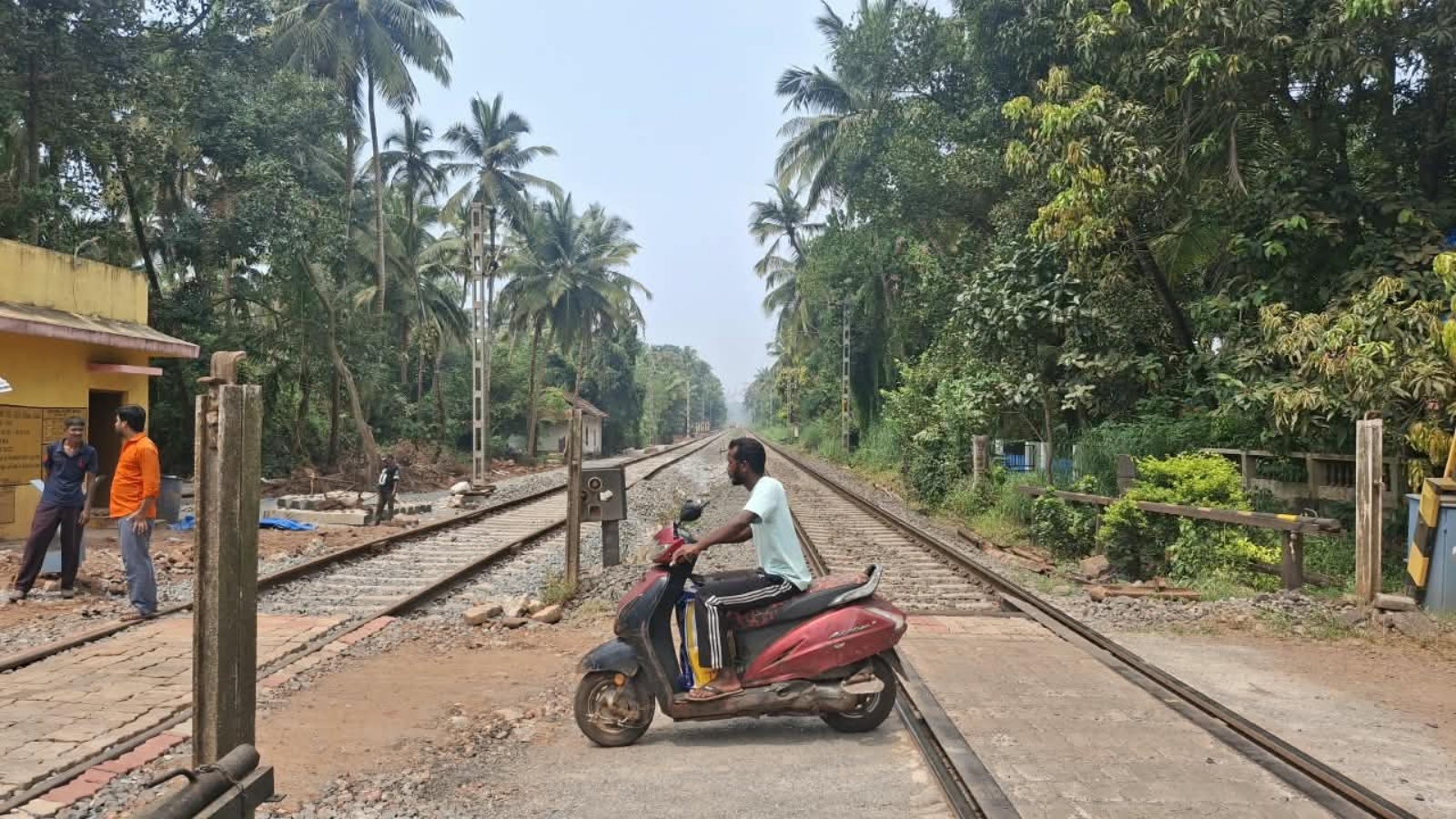
Sandra Rodrigues says her family has been left ‘land-locked’. A 51-year-old resident of Velsao in South Goa’s Mormugao taluka, Rodrigues lives in a 400-year-old heritage house facing a railway track.
Her ancestral home was built long before the railways arrived in the area in the late 19th century. But now, with the ongoing double-tracking project, mud, soil and other construction material have been dumped near her house by the South Western Railway (SWR) contractor, blocking the traditional motorable access road [Level Crossing 26] and the family’s right of way, she says. As a result, she has to “trespass” on a neighbour’s property to leave her house. The debris has also cut off vehicular access for ambulances and fire tenders in an emergency.
“My car stands in our compound, like a prisoner,” she says.
For years, residents of Velsao have been protesting against the 363-km-long Hospet-Tinaighat-Vasco da Gama double-tracking project, being executed by state-owned Rail Vikas Nigam Limited (RVNL) to increase the line’s capacity to handle passenger and freight traffic.
The proposed doubling of the 91-km Tinaighat-Vasco stretch, including the section passing through the Western Ghats between Castle Rock and Kulem, has been particularly contentious. Environmentalists and residents argue that the project will facilitate coal transportation from Mormugao Port in Goa to Karnataka and threaten the ecologically sensitive Western Ghats.
In Velsao, residents say the project is being carried out without regard for their property rights, access to their homes and health. Rodrigues’ neighbour, Oscar Goes, says cracks have developed in some walls of his house because of vibrations when trains pass. Residents say an average of seven goods trains carrying coal pass daily, covering their houses with dust.
Orville Dourado Rodrigues, founder of NGO Goencho Ekvott, which has been at the forefront of protests against the double-tracking project, says: “We are already suffering because of a single [railway] track. If and when this double-tracking project is complete, the coal dust will severely impact our health”.
Story continues below this ad
The opposition extends beyond Velsao, particularly over the project’s potential impact on the Western Ghats. The Supreme Court (SC), in 2022, set aside the clearance granted by the standing committee of the National Board for Wildlife for doubling the railway line from Castle Rock in Karnataka to Kulem in Goa. The apex court accepted the recommendations of the SC-appointed Central Empowered Committee (CEC), which said in its report that it did not find any justification for the track as it “will destroy the fragile ecosystem of the Western Ghats which is an internationally recognised biodiversity hotspot and also one of the most important wildlife corridors of the country”.
The CEC also said that it “will only be marginally enhancing the capacity of the most inefficient section of the railway network passing through ecologically sensitive and biodiversity-rich tiger reserve, two wildlife sanctuaries and a national park”.
What is the double-tracking project
Sanctioned in the 2010–11 Railway Budget, the Hospet–Tinaighat–Vasco da Gama double-tracking project has been implemented in phases. While 312 km of the 363-km route had been commissioned by September 2025, sections in Goa — including the Castle Rock–Kulem stretch — remained pending amid environmental clearance issues.
The existing single railway line between Hospet and Vasco, laid in 1900, connects iron ore mining and industrial areas in Hospet in Karnataka to Mormugao Port in Vasco. The project seeks to add a second line to increase the route’s capacity to carry freight and passenger trains.
Story continues below this ad
The 26-km stretch between Castle Rock and Kulem, which has faced strong opposition, passes through natural forests of the Western Ghats.
The Railways has argued that industrial growth and an increase in tourism have saturated the capacity of the existing single line, which needs to be doubled to meet rising demand and accommodate more goods and passenger trains. Environmentalists and residents dispute this argument.
The protests
In September 2025, the Goa government said that no expansion of coal transportation capacity would be permitted in the state, adding that reports suggesting additional land was being acquired for coal handling in connection with the Hospet-Vasco double-tracking project were “incorrect”.
In Velsao, residents allege that the “temporary” second railway track has been laid haphazardly and soil dumped despite the SWR not having title documents for the land. The issue of land ownership near the Velsao railway line is being contested in a civil suit before the District Judge, South Goa, at Margao, and the Court of the Inspector of Survey and Land Records, Salcete.
Story continues below this ad
In the suit, the SWR has denied any trespass, encroachment or illegal interference with private property, arguing that RVNL and SWR are carrying out the double-tracking work strictly on land in the Railways’ possession and occupation. The SWR has also submitted that the Government of Goa, through an official gazette notification issued in May 2023 under the Goa Land Revenue Code, 1968, recorded that certain lands in the SWR’s possession and occupation had not been assigned survey numbers and had no records of rights in Forms 1 and 14.
It has further argued that railway land along the Castle Rock-Vasco da Gama section has been in the exclusive possession of the Railways for railway purposes “from time immemorial” and that the area residents refer to as a “pathway” or access has never formed part of privately owned land.
When contacted, Sashibhusan Sahoo, general manager of the Rail Vikas Nigam Limited (RVNL), declined to comment. The Public Relations Officer of the South Western Railway could not be reached.
Max Rodrigues, whose house faces the railway tracks, worked as an architect in Mumbai for several years before returning to his ancestral home in Velsao in 2013 to pursue farming.
Story continues below this ad
“If the double tracking project goes through, we will have sleepless nights. Every hour, a goods train will pass from here. The coal transportation would exacerbate air pollution from coal dust and pose a severe risk of respiratory ailments,” he says.
KioskNews shows a cleaned-up reading view extracted from the publisher’s page — the original always lives on their site, not ours.