Shonen Jump's Last Surviving Sports Series Gets Glowing Recommendation From Racing Legend

Umair is a contributor for the ScreenRant anime section. He has always been enthusiastic about pop culture. Whether it's anime, movies, TV shows, manga, manhwa, video games, or pop music, he is always tuned in.
From the classic Dragon Ball to the underrated Dororo, he has a broad knowledge of the most.
When he's not writing, you may find him editing on his favorite anime, movie, or pop star on his Instagram.
Sign in to your ScreenRant account
Shonen Jump has never been short on sports manga. Slam Dunk changed basketball manga forever, Kuroko's Basketball turned impossible passes and Zone abilities into Jump-level hype, and Haikyu!! became one of the magazine's biggest modern success stories. But that same magic has been much harder to find in recent years. Sports series have come and gone, with Jump's current lineup looking very different from the days when a big match could dominate the magazine's entire conversation.
And now the magazine has found a new type of sports series with HAL FORMULA: Formula racing. Created by Kento Terasaka, the manga follows Miharu Suzukaze, a struggling young racer competing in WF4, the feeder series for the fictional WF1 championship. It mixes Miharu's racing career with his relationship with his younger brother Haruka, while leaning into the details of motorsport. The manga even wears its real-world racing influences proudly, making the Initial D comparison almost impossible to avoid.
Now the series has received a pretty serious co-sign. HAL FORMULA volume 1 hit Japanese shelves on October 2, and the promotional band around the book carries a recommendation from Shuichi Shigeno, the creator of Initial D and MF Ghost. Coming from a mangaka who has spent decades drawing cars, racing, and the people obsessed with both, that is about as fitting a recommendation as HAL FORMULA could have asked for.
Initial D Creator Shuichi Shigeno Gives HAL FORMULA The Ultimate Racing Co-Sign
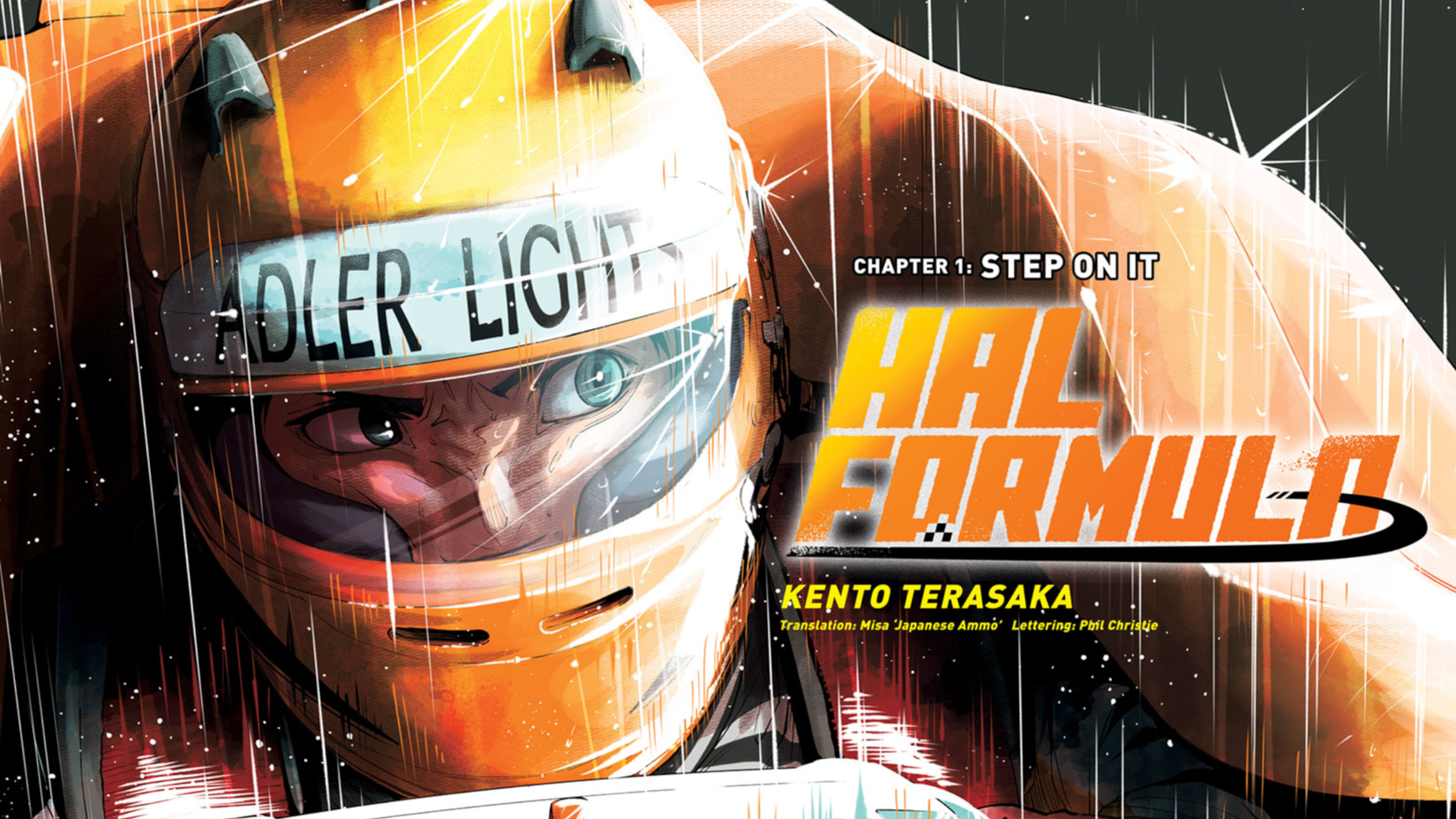
Shuichi Shigeno clearly sees something special in HAL FORMULA. The Initial D creator praised Kento Terasaka's artwork on the volume 1 obi, even saying the rookie was drawing things that he himself couldn't. That's a wild compliment coming from the man behind one of manga's most famous racing series, especially when HAL FORMULA is putting this much effort into getting its cars and racing scenes right.
Miharu Suzukaze also isn't some hotshot prodigy who jumps into a race and starts leaving everyone in the dust. He is a young orphan trying to look after his little brother while fighting his way through WF4, the entry-level series on the road toward WF1. The cars are mechanically identical, so there is no secret engine or ridiculous custom machine doing the work for him. If Miharu wants to move up, the driver has to be the difference.
And that is where the manga gets really fun. Miharu isn't just learning racing lines and chasing faster lap times. He has to get his head right before he can push the car to its limit. The fear of taking a corner too fast is very real, and the series doesn't need some glowing aura around the protagonist to make that exciting.
Terasaka also fills the story with real motorsport history, with names like Michael Schumacher and Ayrton Senna being part of the conversation. It gives HAL FORMULA the feeling of a manga made by someone who actually loves racing, rather than a Jump series that simply picked cars as its latest gimmick. With sports manga having a rough time in Weekly Shonen Jump, that authenticity could be HAL FORMULA's biggest weapon.
Despite The Massive Endorsement, HAL FORMULA Is Already Fighting For Its Life In Jump


Shigeno's recommendation gives HAL FORMULA a great story to put on the cover, but it can't decide the manga's future on its own. That part comes down to readers actually buying volume 1. The current reader response isn't exactly encouraging either. HAL FORMULA has been missing from Manga Plus' “Hottest” and “Trending” rankings, which makes the upcoming physical sales even more important for a series still trying to find its audience.
Terasaka has already been through this twice with Green Green Greens and Beast Children, both of which ended early, so there is plenty riding on how HAL FORMULA performs now that volume 1 is finally out. A strong recommendation from the creator of Initial D can bring attention, but attention has to turn into readers sticking around.
Akane-banashi has already shown that Jump's classic training, rivalry, and competition formula can still work, even without the usual basketball, soccer, or boxing setup. Rakugo somehow became a competition manga with the intensity of a battle series, and readers bought into it.
HAL FORMULA has its own version of that formula. There are cars instead of courts, corners instead of finish lines, and Miharu has a very long road before WF1 becomes reality. Shigeno has already given the series his blessing. Now the real race is whether enough readers want to see where Miharu's road leads.
- TV Show(s)
- One Piece, Naruto, Naruto: Shippuden, Dragon Ball, Dragon Ball Z, Bleach, My Hero Academia, Demon Slayer: Kimetsu no Yaiba, Jujutsu Kaisen, Hunter x Hunter, Hunter x Hunter, JoJo Bizarre Adventure, Death Note, Yu Yu Hakusho: Eizou Hakusho, Black Clover, Dr. Stone, Haikyuu!!, The Promised Neverland, Food Wars!: Shokugeki No Soma, Kuroko's Basketball, Tokyo Ghoul, Toriko
- Video Game(s)
- J-Stars Victory VS+, Jump Force
- First Film
- Dragon Ball: Curse of the Blood Rubies
- First TV Show
- Dr. Slump
- Cast
- Mayumi Tanaka, Junko Takeuchi, Masako Nozawa, Masakazu Morita, Daiki Yamashita, Natsuki Hanae, Junya Enoki, Megumi Han, Kazuyuki Okitsu, Mamoru Miyano, Nozomu Sasaki, Gakuto Kajiwara, Yûsuke Kobayashi, Ayumu Murase, Sumire Morohoshi, Yoshitsugu Matsuoka, Kensho Ono, Ryôtarô Okiayu
- Created by
- Takashi Isono, Kazuhiko Torishima
Shonen Jump is one of Japan's most successful manga anthology franchises, published by Shueisha. Launched in 1968, it is the source of some of the most beloved and popular anime and manga series, such as One Piece, Dragon Ball, and Naruto. The franchise has extended into multiple adaptations across various media, including anime, films, video games, and merchandise.
KioskNews shows a cleaned-up reading view extracted from the publisher’s page — the original always lives on their site, not ours.