‘A restless mind’: A peek into life story of sitar maestro Pt Ravi Shankar, once an ‘outsider’
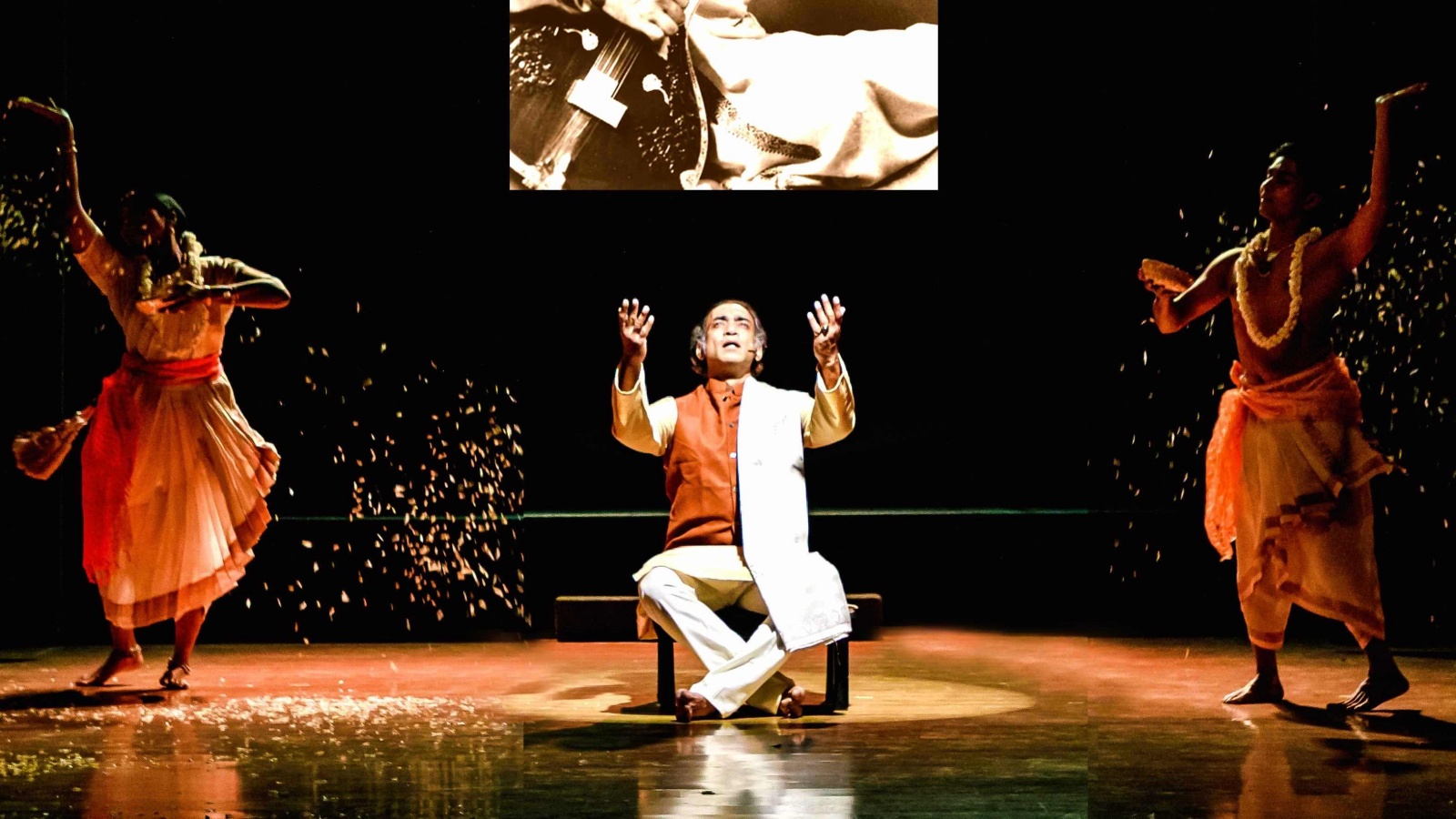
He didn’t have many friends while growing up. So, he would stand before a mirror and conjure up a world full of colourful characters – he tried to be everything at once. “Hero, heroine, god, demon, giant, villain, clown,” says the narrator of ‘Enchantment’, a play based on the life of Pt Ravi Shankar.
Gowri Ramnarayan, Chennai-based playwright, director and performer, turns the mirror on his life in ‘Enchantment’. “All my life, I have been called a globetrotter. Now here, now there, everywhere, hardly ever alone, rarely ever free. Restless lifestyle, a restless mind… Now that I find myself to be truly alone, I suppose I could look back. How did I become a musician? That is a good question,” says Pt Ravi Shankar, played by Yohan Chacko, setting out the intent of the play. The 90-minute production by JustUs Repertory will be staged at the India Habitat Centre in Delhi on November 21.
With two actors and two dancers on stage, the play launches into a story of an “outsider” to Indian classical music, an art form that is, still, rooted in the family traditions. It was not enough to be talented; one had to be “the son of a son of a son of an Ustad or a Pandit to be validated”.
Ravi tells the audience that his father had been the Diwan of the erstwhile princely Jhalawar state, now a city in Rajasthan, who had abandoned his wife and his five sons. From being elite, the family then went on to see difficult times.
Uday Shankar, a renowned dancer, introduced Ravi to Western audiences who gave him rave reviews for dancing and the solo choreography that he had created at the age of 16.
Music, dances and archival images form interludes in a play dominated by conversations. Ramnarayan’s flair for language fills dialogues with evocative emotion as the story expands to Ravi’s curious nature, his spirit of adventure, his rivalry with Ustad Vilayat Khan, his marriages and his philandering.
“I was not focussing on the music as everybody knows about Pt Ravi Shankar as a great musician. I was really looking at him as a man, who made an evolutionary change in the early part of his life, when he suddenly left dance, and began to learn music, sticking to it for years even when he was not making a success of it. The stage presents a superstar, but audiences in previous performances have seen a human being whose vulnerabilities were their own,” says Ramnarayan.
Story continues below this ad
Fame and popular history have thrown a cover over Ravi’s struggles, the neglect and the feeling that he was not being noticed. The play imagines his feeling of being bypassed as a musician even as he struggled to sustain a family.
“He had married Annapurna Devi and had a child but he was not happy in the marriage,” says Ramnarayan.
Ramnarayan has interviewed Pt Ravi Shankar and written about him. She also draws upon her wealth of information as well as conversations with him, his partner Kamala Chakravarty, and his wife Sukanya. She has heard him play to a Western audience, to an audience in India as well as at home concerts. “He was strong and powerful, where it felt as if he had realised the limitless possibilities of the sitar. It was a profound and resonant experience,” she recollects.
‘The osmosis’
Delhi has been the site of some of Ramnarayan’s strongest plays, such as ‘Sarpa Satra’, about a grand ritual on snake sacrifice from the epic Mahabharata; ‘Fire and Ash’, which looks at Shiva through a 21st century lens, and ‘Yashodhara’, about Buddha’s wife.
Story continues below this ad
Ramnarayan was born and grew up in a family of artists in Chennai. Her grandfather, Kalki Krishnamurthy, was, probably, the most famous of Tamil writers. Her grand aunt, MS Subbulakshmi, was a musician, whom Ramnarayan accompanied on vocals for 16 years. Ramnarayan’s mother was a dancer.
“You get a lot within you by osmosis,” he says, adding that it was Kalakshetra in Chennai that honed her personality.
Rukmini Devi, who founded Kalakshetra — a dance and music academy based on the Gurukul system — used to say that you don’t have to learn dance to become a dancer. You learn to dance in order to expand your mind and to understand the world.
Even though she learned dance and music, it was journalism that drew Ramnarayan. It would lead her to write Dark Horse’, her first play in 2005, which revolved around poet Arun Kolatkar and had Dhritiman Chatterjee as the lead. “That play became so successful we traveled all over India. Then, I wrote another play — ‘Waterlilies’. I didn’t even know I was a playwright. I just became one by accident,” she recalls.
KioskNews shows a cleaned-up reading view extracted from the publisher’s page — the original always lives on their site, not ours.