Domestic datacentres: how computer power can help heat your home

‘When Giles Gibson turns on the hot tap in his home, the water that comes out of it is not heated by gas but by the tiny datacentre strapped to the tank.
Attached to the hot water cylinder in his London home is a compact computer server that generates heat and then transfers it as it operates.
Gibson gets the benefit of hot water when he needs it at a reduced cost, while the heat that is generated by the server is not lost into the air, a big environmental problem with large datacentres around the world.
“As soon as I read about it, I thought: ‘This is obvious – why wouldn’t you do this?’”he says. “It just makes sense to take a computer out of a datacentre and to strap it next to your water tank and get free heat.”

Gibson estimates that the hot water bills for his four-bedroom house in south-east London have fallen by between £10 and £15 a month since he had the system installed last year.
“So over a year, it adds up, and it’s just another little extra that helps,” Gibson says. “Having one of these units is a no-brainer.”
Saving waste heat
With domestic energy bills set to rise again next month, and growing disquiet about the impact of large-scale datacentres on the environment, there are lots of projects looking at how to harness the heat being thrown out by computers.
Gibson’s system, supplied by the Surrey-based company heata, is one of a number of innovative ideas on the market that aim to tackle the problem of waste heat on a domestic scale.
Heata operates a sustainable cloud computing business that sends processing jobs from its clients to the servers in people’s homes. The devices have the combined power of about eight laptops.
“What the home gives us is effectively somewhere to put a server that has a power connection, and a fibre connection, and a place for heat to go,” says Charlie Beharrell, commercial director of heata.
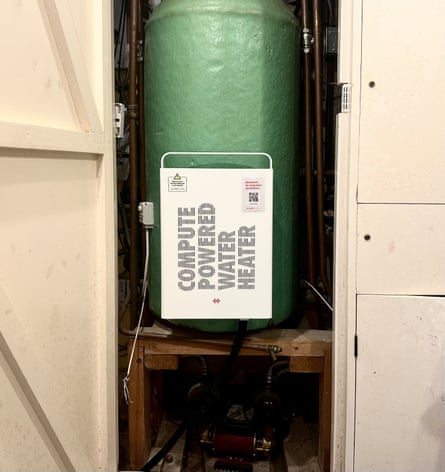
He says the company aims to provide about 80% of the heat needed for a home’s hot water. “The water in their hot water cylinder will effectively be heated by our server, and they might have to use the gas boiler for the peakier moments in the day, like when they have a bath,” Beharrell says.
“The idea is that the primary heating system is working a lot less hard to heat the water than it would normally have to do if our system wasn’t in place.”
How it works
It can only work in homes with vented, unpressurised water cylinders, typically recognisable by the blue insulation around the outside.
A container with the server in is attached to the front of the cylinder after engineers cut a hole in the insulation.
It is glued to the boiler with a thermal paste so the unit can conduct heat to the cylinder with no plumbing involved. There is no cost for the installation.
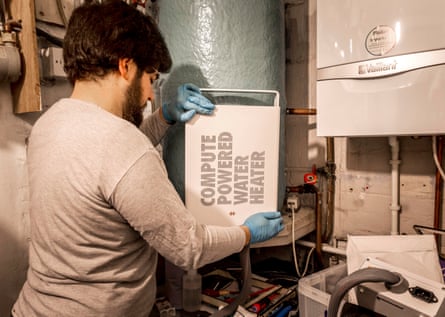
“It takes a couple of hours and we retrofit it to the domestic water system,” Beharrell says.
Heata pays for the electricity that is used to keep the server running, while the homeowner pays for the fibre broadband connection that is necessary.
Beharrell says that millions of homes are fitted with vented water cylinders, while the units can also work with heat pumps.
However, the system is not suitable for homes with combi boilers. A version for unvented cylinders is in development.
after newsletter promotion
Heata’s units are now in 100 homes and there are 3,000 people on the waiting list for installation.
Anyone interested in having one can sign up on the company’s website, heata.co.
The company says hundreds more are expected to be installed next year.
Easy as Raspberry Pi?
In a separate project in Essex, two households are testing a concept where almost 500 matchbox-sized computers are stored together to form a mini datacentre, and the heat generated from them is converted into energy.
The freezer-sized HeatHub units are made by the Wales-based company thermify and, like heata’s, also recycle the energy created when computers process tasks.
They work differently from the heata system and the makers say they could one day replace domestic boilers.
The heat created by the rows of Raspberry Pi computers warms a mineral oil that surrounds them.
“The computers get the mineral oil hot,” says thermify’s chief executive, Travis Theune. “We send that through a heat exchanger. The heat exchanger heats up the water that’s going through a radiator, and the radiator delivers heat to the room. It’s the same basic concept as an induction heater.”

The existing units have 480 computers in them, which carry out tasks for companies that buy time to process the work they want done.
Theune says that the company plans to make a range of units to cater for different-sized homes. For example, a three- to four-bedroom house will have a unit which is about the size of a washing machine, while a flat could have one the size of a microwave.
He says that the thermify systems will cost homeowners £90 a month, based on an average-sized home. A bigger house, that requires more energy, will cost more, and a flat less, he says.
The planned cost includes installation, leasing the unit, repairs, and will have a minimum 10-year contract.
The company claims that the device will lead to a 14% reduction in bill costs compared with homes with a gas boiler, and 34% for those households with a heat pump, over a 15-year period.
The savings come from not having to pay for the installation of a boiler or the heat pump.
KioskNews shows a cleaned-up reading view extracted from the publisher’s page — the original always lives on their site, not ours.