Life After... Stage 4 cancer: Producer-director wants to sleep more
SINGAPORE – Prolonged, chronic lack of sleep is what producer-director Desmond Tan believes caused him to have Stage 4 colon cancer.
When he was at the peak of his career producing commercials for many big clients, he would survive on around two hours of sleep a day, along with two cups of coffee and two cans of Red Bull caffeinated energy drink, to push through on projects.
His mind was still preoccupied with work on the day in 2019 he found out he had a Stage 4 tumour in his colon.
“When the reality was sinking in, I was in a taxi on the way to post-production, where I had to touch up burger patties to make them perfect. There was no way I could go home, because I had a job to do. I had clients to answer to,” said Tan, 51.
“It was only that night, at about 11pm, that I could be home with my wife and I broke down. Reality had hit me. My son was then barely a year old.”
Around the time he received treatment, he found out he was not the only one in his small industry to be hit by cancer.
“My ex-colleague, also a very prominent commercials director, had the exact same cancer (as I did). He had since died. Others came down with breast cancer, pancreatic cancer, lung cancer, and colon cancer. There were seven of us when I last counted. Many of us were relatively young and healthy. That really got me thinking that something is wrong with the industry somewhere,” he said.
“I actually think that sleep is very underrated and people do not talk about enough,” Tan said.
He was in his early 40s when he received the diagnosis, and “pretty much at the peak of my career as a commercials director”.
“Most often, I would have just two hours of sleep, and then the next morning, pushed myself on two coffees, two Red Bulls, and cigarettes – just to function. I suffered heart palpitations, but thought that was just me thriving,” he said.
At the top of his game, the founder of production house Atypicalfilms was responsible for creating commercials, branded entertainment and marketing campaign videos for clients such as the Republic of Singapore Navy, Republic of Singapore Air Force, the Immigration and Checkpoints Authority (ICA), tech giants, fast food restaurants, banks, and luxury homes.
“I was even flying out of the country for shoots. So I was living the so-called high life of a working director,” he told The Straits Times.
Married with two young sons, Tan said he was pulled in several directions.
“I wanted to be there for my staff and for my young family. Something had to give. On average, I slept only between two and four hours (every day). Night was the only time I had to do my own homework for work. I would sleep for a few hours, then I would wake up at around 3am. That was how I kept up with everything,” he said.
Things fall apart
It was in January 2019 when Tan felt a severe and sharp pain in his lower abdomen.
“There was also blood in my stools (for a few months before January). Yet I continued to press on at work. Like everyone else (who finds blood in his faeces), I thought it was just haemorrhoids,” he said.
However, the pain and blood persisted so Tan decided to consult a family doctor a month later. He was told there was a tumour in his colon and was referred to an oncologist. After a battery of tests and scans, the tumour was diagnosed to be at Stage 4, the most advanced phase of the disease.
In Stage 4 cancer, also known as metastatic cancer or secondary cancer, the cells break away from the primary tumour and travel through the blood or lymph system to a new location where they grow into new tumours in other parts of the body.
“Mine had spread to my liver. That was when my whole world came crashing down. Of course, there were so many questions, so many uncertainties running through my mind,” Tan said.
As if he were “the protagonist in a sad movie”, he quipped to The Straits Times, he asked the doctor how much time he had left.
“Would it matter?” the doctor replied.
“He asked if I knew, would I live my life to the fullest and maximise every single day?” Tan said.
“He did not tell me then (what the prognosis was), and until now, I don’t know.”
The doctor told Tan they were going for “as much of a cure as is possible at Stage 4”.
“I started almost immediately, going through five rounds of chemotherapy and a surgery to remove 13cm of my colon. I went from having a colon to having a semi-colon,” Tan said with a laugh.
After all of that, which lasted about six months, Tan thought he was “good to go” and went back to business.
“I started going for meetings, getting briefs from ad agencies and clients. Then I got the result of a follow-up scan and realised the cancer had come back. This time, it had spread to the peritoneum,” he said.
The peritoneum is a continuous, thin protective membrane that lines the abdominal cavity and surrounds the internal abdominal organs. Patients whose cancer has spread to the peritoneum often face a grim prognosis and rapid disease progression.
“When I got the news, my heart really sank,” Tan said.
That was when his wife, a family physician, did some research and decided he should see oncology surgeon Melissa Teo, who carries out specialised HIPEC procedure.
HIPEC, or hyperthermic intraperitoneal chemotherapy, is a specialised two-step cancer treatment that combines surgery with heated chemotherapy to target advanced abdominal cancers.
Teo, who is in private practice, told ST she had used the same treatment on another Stage 4 colorectal cancer patient, who went to live for over 10 years.
Tan described the HIPEC treatment he received with a visual imagination befitting a commercials director: “She removed the cancer, and then poured the chemo in my abdomen, shook me like bubble tea for one hour before stitching me up,” he said.
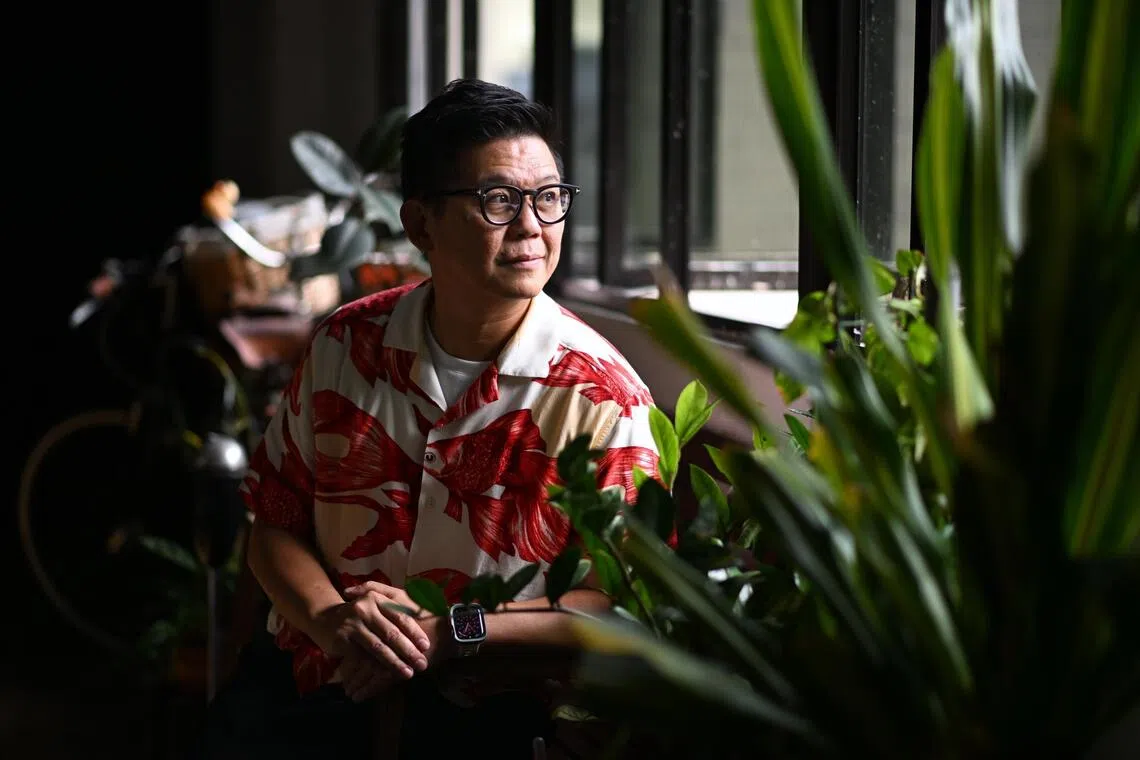
Cancer survivor and founder of Atypicalfilms Desmond Tan, 51, said he does not eat processed food but sio bak (Hokkien for roasted pork), once in a while “can lah”.
ST PHOTO: CHONG JUN LIANG
Blessing in disguise
After Tan went through two surgeries and 20 rounds of chemotherapy in 1½ years, he found himself smack in the middle of the Covid-19 pandemic.
“It was perhaps a blessing. I was remotely running my company and there was no hustle and bustle of people around me, so the risk of infection was much less,” he said.
He also changed his entire view of work and approach to it.
“Film production is quite brutal – long hours. There’s an unspoken work ethic where we glamorise long hours and hard work. I am now able to see that it was not sustainable because I became the product of that,” he said.
Work is now “something that is a bit more balanced” for his staff and production crew members.
“I try to inculcate that in the company and among the crew working with me on projects. We would cater food that’s a little bit healthier. Even when I hire, I acknowledge that people are different. Young people today want their time, their energy and their space, and I agree with that,” he said.
“In hindsight, there’s a part of me that is thankful for cancer because it allowed me to pull the brakes and slow down to realise that it’s not all about the work. I think if I had continued on my breakneck speed, I might have ended up not being here today.”
He also goes to the gym or swims every day, does not eat processed food, and prefers fish and chicken.
“But sio bak (Hokkien for roasted pork), once in a while can lah,” he mused.
KioskNews shows a cleaned-up reading view extracted from the publisher’s page — the original always lives on their site, not ours.