Many unaware of plant expansion, poll shows
By Hsu Li-chuan and Esme Yeh / Staff reporter, with staff writer


More than 80 percent of residents of Kaohsiung’s Linyuan (林園) and Daliao (大寮) districts did not know about a pending naphtha cracker expansion project in the region, a Greenpeace Taiwan poll released on Monday showed.
State-run CPC Corp, Taiwan launched the NT$106.2 billion (US$3.37 billion) project to replace the aging unit with a newly built naphtha cracker in Linyuan District.
However, environmental advocates said that describing the project as a replacement plan obscures that the new cracker would upgrade annual ethylene production capacity to 1 million tonnes from 350,000 tonnes.
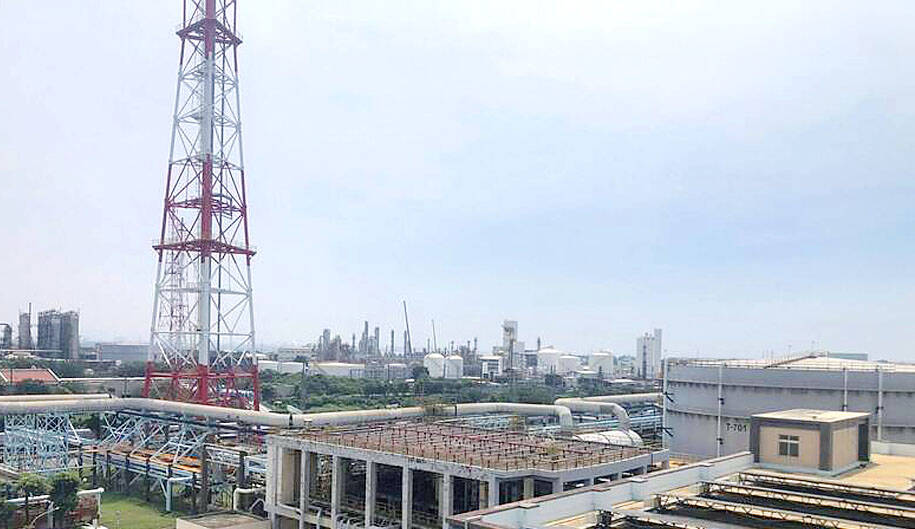
Infrastructure at a CPC Corp, Taiwan naphtha cracker is pictured in Kaohsiung an undated photograph.
Photo: Taipei Times
The poll showed that 90.3 percent of Kaohsiung residents were unaware of the project, while 82.9 percent of Linyuan residents and residents of neighboring Daliao did not know about it.
Asked whether they backed the project, 41.4 percent of respondents said yes, 25.8 percent objected and 32.7 percent had no opinion, it showed.
After respondents were given information about international plastic-reduction trends, petrochemical-industry air pollution and health risks associated with microplastics, 36.3 percent supported the plans, 47.6 percent objected and 15.9 percent had no opinion, it showed.
The poll showed 87.2 percent agreed that the project “requires a more prudent evaluation.”
Tseng Yi-ting (曾意婷), Greenpeace Taiwan’s director of public engagement and development, said that the project was approved by the Executive Yuan in May 2024 and is in the basic-design tendering stage.
However, there are shortcomings in the information-sharing of the government and CPC, as the poll results show, Tseng said.
Instead of this project, the government should invest resources in industrial transition and value-added upgrades, particularly as the domestic petrochemical industry is facing global overcapacity and shifting demand, she said.
Lee Chin-tsung (李進宗), a former Linyuan District borough warden, said that the communication of the central government to local residents might have been insufficient.
Lee said that he approves of replacing old equipment at the plant, but opposes increasing its production capacity.
CPC yesterday said that the new naphtha cracker is still being planned and undergoing environmental impact assessments.
More accessible explanations would be provided in terms of air pollution, health risks, carbon emissions, industrial necessity and the decommissioning of the more than 40-year-old naphtha cracker, it said.
The project aims to rebuild Taiwan’s essential raw material supply capacity with enhanced safety and reduced emissions, CPC said.
Production capacity is not equivalent to production amount, nor are plastics equivalent to pollution, it said.
The Kaohsiung City Government later on Monday said it has asked CPC to incorporate advanced green equipment into the project and propose a comprehensive carbon reduction plan.
Operations at the old cracker would be suspended once trial operations at the new plant begin, it said, adding that it would tighten pollution controls in line with its net zero targets.
KioskNews shows a cleaned-up reading view extracted from the publisher’s page — the original always lives on their site, not ours.